Quick Answer
Exercise plans rarely fail because people lack motivation. They fail because unrealistic expectations, poor planning, emotional decision making and behavioural patterns gradually weaken consistency. Long term fitness depends less on finding the perfect workout and more on building habits that survive everyday life.
Introduction
Every January, millions of people promise themselves that this year will be different.
They purchase gym memberships, download fitness apps, hire personal trainers and create ambitious workout schedules. For a few weeks, motivation feels unlimited. Social media is filled with transformation stories, healthy meals and optimistic progress updates.
Yet within months, many of those exercise plans disappear.
The gym visits become less frequent.
Workout clothes remain untouched.
Fitness goals are postponed until another Monday, another month or another new year.
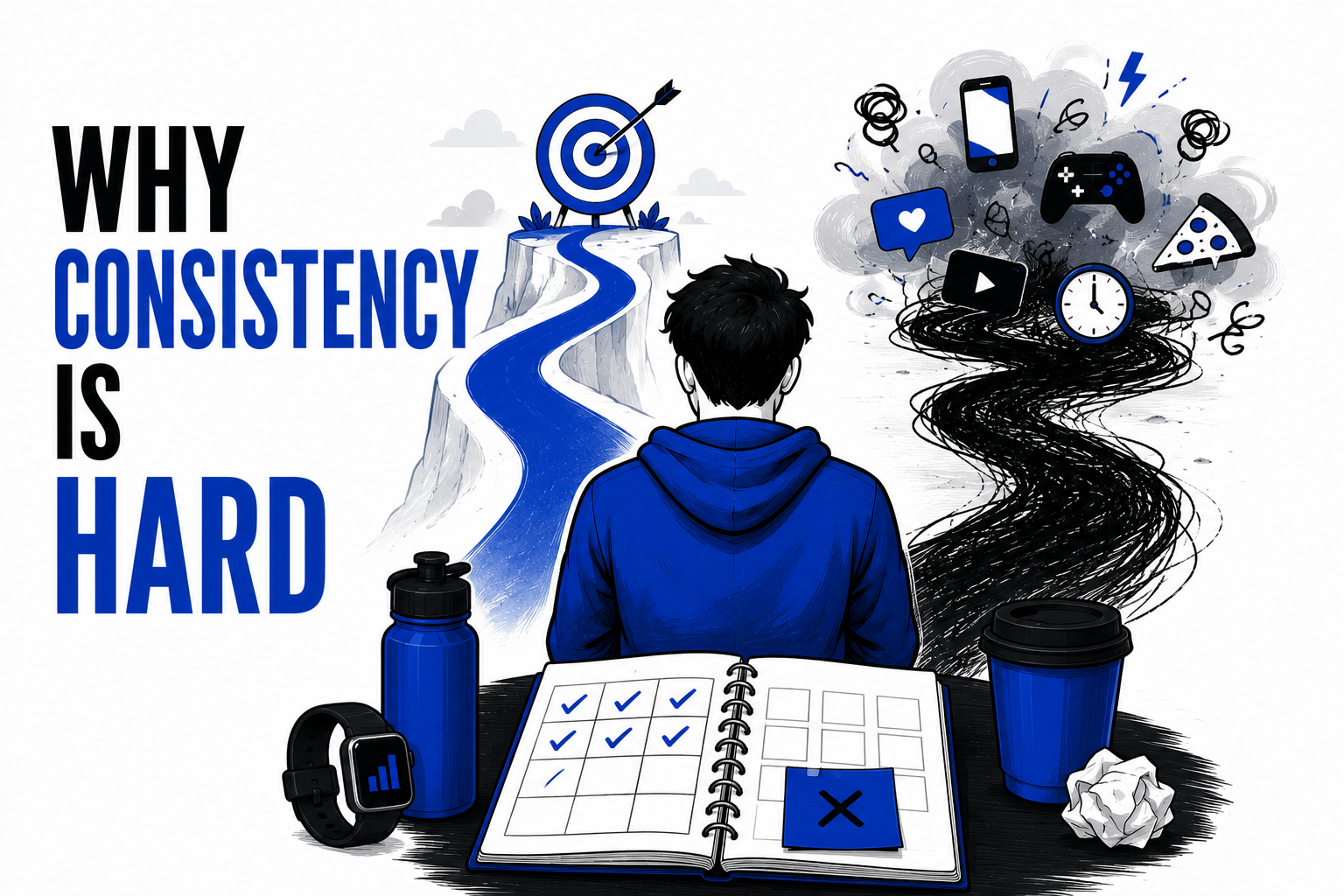
This pattern repeats across different ages, occupations and fitness levels, closely mirroring why consistency is so hard to maintain in almost every area of life. Some people stop exercising after only a few weeks, while others spend years restarting the same plan without ever making lasting progress.
This raises an important question.
Why do exercise plans fail so consistently despite the growing availability of fitness information, online coaching and health awareness?
The common explanation is a lack of willpower.
The deeper explanation is far more complex.
Exercise failure is rarely caused by laziness alone. It usually develops through predictable behavioural patterns, unrealistic expectations and decision making systems that make consistency difficult to maintain.
Understanding why exercise plans fail requires looking beyond workouts and nutrition. It requires understanding how human behaviour responds to effort, reward, uncertainty and daily life.
What Is Exercise Plan Failure?
Exercise plan failure is often misunderstood as missing a few workouts or abandoning a fitness programme.
Missing individual sessions is normal.
Life changes. Illness occurs. Work becomes demanding. Unexpected responsibilities arise.
Failure occurs when temporary interruptions become permanent habits.
It happens when a person repeatedly starts and abandons exercise without creating a sustainable routine.
The issue is not physical ability.
Most people are capable of regular movement.
The issue is behavioural consistency.
An exercise plan succeeds when healthy actions become part of everyday life rather than temporary projects driven by enthusiasm.
The Biggest Myth
The biggest myth is that successful fitness depends on motivation.
This belief dominates advertisements, social media and popular fitness culture.
People are encouraged to believe they simply need more discipline, greater determination or stronger willpower.
The evidence suggests something different.
Motivation is naturally inconsistent.
It rises after watching an inspiring video.
It falls after a stressful working day.
It increases when progress is visible.
It disappears when results arrive more slowly than expected.
If exercise depends entirely on motivation, consistency becomes impossible because motivation itself constantly changes.
Successful exercise habits rely less on feeling motivated and more on creating systems that continue working even when enthusiasm disappears.
The difference is significant.
People who depend on motivation usually stop exercising when life becomes difficult.
People who depend on routines continue because the decision has already been made.
What Usually Happens?
Most failed exercise plans follow a familiar pattern.
Someone decides to improve their health.
They create ambitious goals.
They begin exercising several days each week.
The first few sessions feel encouraging.
Progress appears quickly.
Confidence increases.
Then everyday life returns.
Work becomes busier.
Energy declines.
Minor aches appear.
Results slow down.
Missing one workout becomes missing several.
Eventually the routine disappears altogether.
The problem is rarely one missed session.
The problem is the gradual breakdown of consistency after expectations collide with reality.
Why Does It Happen?
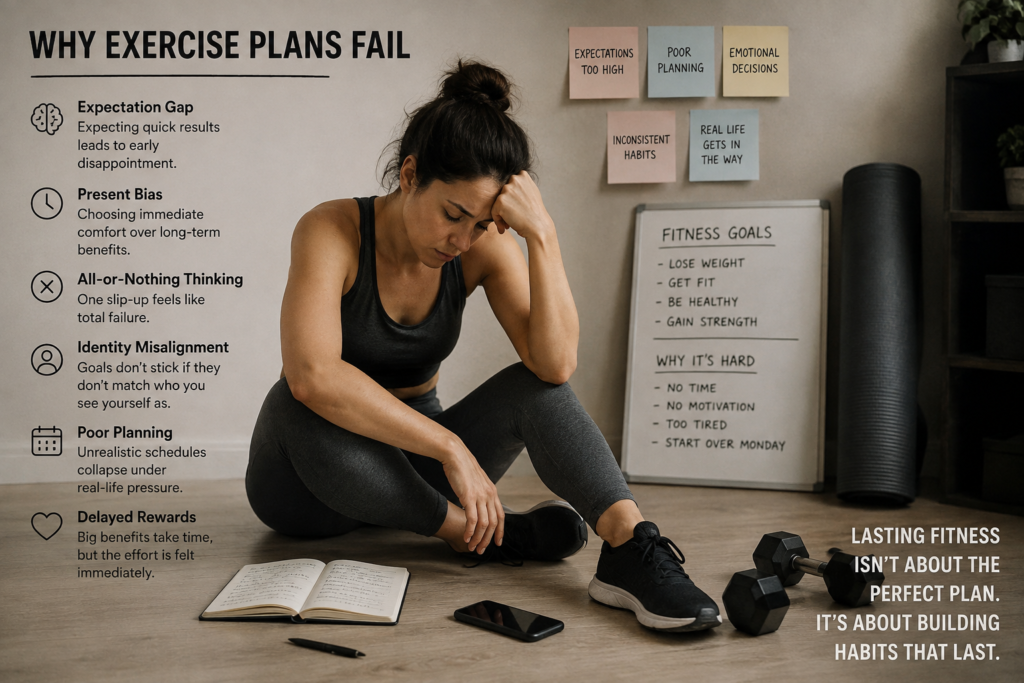
Exercise plans fail because they ask people to change behaviour without changing the systems that shape behaviour.
People often focus on choosing the perfect workout programme while overlooking the psychological and environmental factors that determine whether that programme can be maintained.
The failure begins long before someone skips the gym.
It begins with the assumptions they make about themselves.
Unrealistic Expectations Create Early Disappointment
Many people begin exercising expecting visible transformation within a few weeks.
Fitness marketing often reinforces this expectation by highlighting dramatic before and after photographs while overlooking the months or years required to achieve lasting change.
When results arrive more slowly than expected, disappointment replaces enthusiasm.
The individual concludes that the programme is ineffective.
In reality, the programme may be working exactly as expected.
The expectation was unrealistic.
Behavioural economists describe this as an expectation gap.
People judge success against imagined outcomes rather than realistic progress.
As the gap widens, commitment weakens.
Present Bias Favours Immediate Comfort
Exercise produces long term benefits but requires immediate effort.
This creates a psychological conflict known as present bias.
The human brain naturally places greater value on immediate comfort than future rewards.
Sleeping longer feels rewarding today.
Skipping a workout saves energy today.
Watching television provides immediate enjoyment.
The benefits of exercise, however, often appear gradually through improved health, increased strength and reduced disease risk.
Because the rewards are delayed, the brain frequently chooses short term comfort over long term wellbeing.
This explains why good intentions often disappear during moments of fatigue.
The decision is not based on health.
It is based on immediate emotional comfort.
All Or Nothing Thinking Destroys Consistency
Many exercise plans fail because people view success as perfection.
Missing one workout feels like failure.
Eating one unhealthy meal feels like abandoning the entire plan.
Psychologists recognise this pattern as all or nothing thinking.
Instead of accepting occasional setbacks as normal, individuals assume the entire programme has failed.
One missed day becomes one missed week.
One interruption becomes a reason to start again next month.
Ironically, the belief that exercise must be perfect often prevents it from becoming consistent.
This pattern has a clinical name. Behavioural researchers, as documented in a clinical resource from the National Center for Biotechnology Information, describe it as the abstinence violation effect: a single lapse gets reinterpreted as total failure rather than a normal, temporary setback, which increases the risk of abandoning the goal altogether. The same mechanism applies well beyond addiction recovery, including everyday habits like exercise.
Long term success depends on recovery after setbacks rather than avoiding setbacks altogether the same recovery mindset that explains why financial recovery gets ignored after a setback..
Identity Matters More Than Goals
Many people focus on achieving a specific outcome.
They want to lose weight.
Build muscle.
Run a marathon.
These goals provide direction but they do not necessarily change behaviour.
Behaviour becomes sustainable when exercise becomes part of personal identity rather than a temporary objective.
Someone who sees themselves as a healthy and active person is more likely to continue exercising because the behaviour aligns with how they view themselves.
Someone who views exercise as a short term obligation often stops once motivation declines.
This explains why lasting fitness is often driven less by goals and more by identity.
Changing behaviour without changing identity creates constant internal resistance.
Changing identity makes healthy behaviour feel increasingly natural.
Why Does It Happen?
Social Pressure Creates Unsustainable Goals
Many exercise plans begin with comparison rather than personal purpose.
People compare themselves with fitness influencers, celebrities, athletes or friends who appear to achieve remarkable results. These comparisons create unrealistic standards that ignore differences in age, genetics, health, lifestyle and available time.
Behavioural psychology shows that people often make decisions to gain social approval rather than satisfy personal needs. Exercise becomes a way to impress others instead of improving health.
When external validation disappears, commitment usually disappears with it.
Exercise driven by comparison is difficult to sustain because someone else will always appear fitter, stronger or more disciplined.
Decision Fatigue Gradually Weakens Consistency
Every day requires hundreds of decisions.
People decide what to wear, what to eat, how to work and how to manage family responsibilities.
By the evening, mental energy is often exhausted.
Exercise then becomes another difficult decision competing with easier alternatives.
Behavioural economists describe this as decision fatigue.
The issue is not laziness.
The issue is that self control becomes weaker after repeated mental effort.
People who depend on making the right decision every evening eventually experience declining consistency.
Those who establish fixed routines remove much of the decision making process.
The workout happens because it has already become part of the day rather than another choice requiring mental effort.
Poor Planning Makes Good Intentions Fragile
Many people create ambitious exercise goals without planning how those goals fit into everyday life.
The schedule looks realistic on paper but ignores commuting, family responsibilities, work deadlines and unexpected interruptions.
When reality conflicts with the plan, exercise is usually the first activity to disappear.
The problem is not commitment.
The problem is designing a system that cannot survive ordinary life.
Successful routines are flexible enough to continue during stressful periods instead of depending upon ideal circumstances.
Delayed Rewards Reduce Commitment
Exercise produces one of the greatest long term returns of any healthy habit.
Improved cardiovascular health, stronger muscles, healthier bones, better mental wellbeing and lower disease risk often develop gradually.
Unfortunately, the effort is immediate while many benefits remain invisible for weeks or months.
This creates delayed gratification.
Humans naturally respond more strongly to immediate rewards than future benefits.
As a result, missing one workout creates instant comfort while completing one workout rarely creates instant transformation a pattern also visible in why long term health plans fail more broadly.
Without recognising this psychological imbalance, many people conclude that the effort is not worthwhile.
The real challenge is not physical training.
It is remaining committed while meaningful rewards are still developing.
Warning Signs
Exercise plans rarely collapse without warning.
One of the earliest warning signs is relying entirely on motivation. When workouts happen only on days that feel inspiring, consistency quickly becomes unpredictable.
Another warning sign is creating schedules that leave no room for flexibility. Missing one session begins to feel like failure, making it easier to abandon the entire routine.
Constantly searching for new workout programmes is another indicator. Instead of improving consistency, people continue believing that success depends on finding the perfect routine rather than following a realistic one.
Negative self talk also signals growing behavioural risk. Statements such as “I always give up” or “I am not disciplined enough” gradually become self fulfilling beliefs that weaken future commitment.
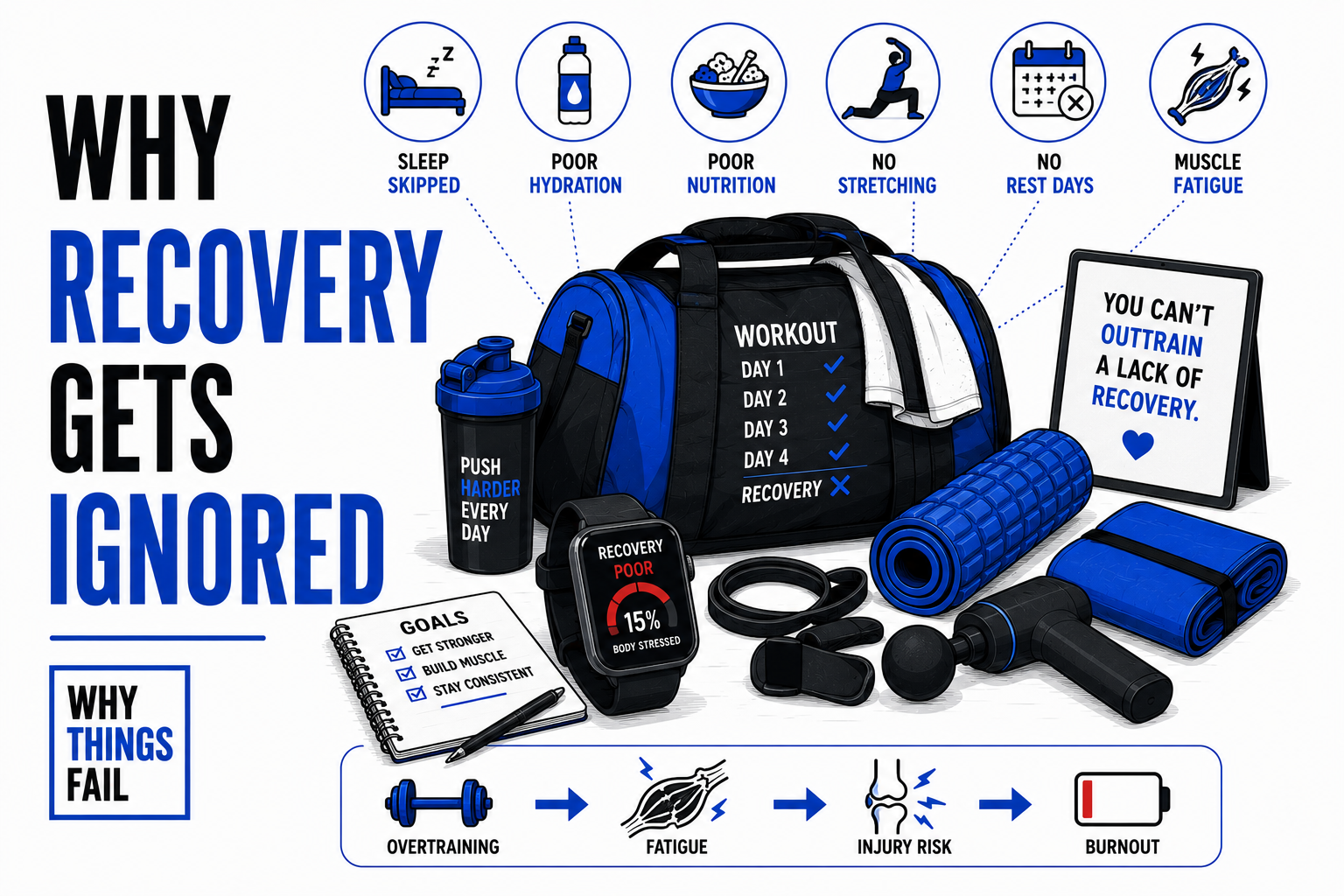
Ignoring recovery is equally damaging. Fatigue, poor sleep and unrealistic training intensity increase physical and mental exhaustion, making long term consistency increasingly difficult.
These warning signs often appear gradually, making them easy to dismiss until the routine has already begun to disappear.
What Could Have Prevented It?
Most failed exercise plans could not have been prevented through greater motivation alone.
They could have been prevented through better behavioural design.
Successful exercise routines begin with realistic expectations. Progress measured over months rather than weeks encourages patience and reduces disappointment.
Planning should also account for ordinary life. Flexible schedules are more resilient than perfect schedules because they continue working during busy periods.
Small, repeatable habits create stronger foundations than ambitious programmes that cannot be maintained.
Identity also matters.
People who begin seeing themselves as active individuals gradually make healthier choices without constant effort because those behaviours become consistent with how they view themselves.
Finally, measuring success through consistency instead of perfection changes the entire experience.
Missing one workout no longer becomes failure.
It simply becomes part of a long term process.
Lessons
Exercise plans reveal important lessons about human behaviour that extend far beyond physical fitness.
The first lesson is that systems consistently outperform motivation. Motivation creates action, but systems maintain action when enthusiasm fades.
The second lesson is that unrealistic expectations often destroy genuine progress. Sustainable improvement depends on patience rather than rapid transformation.
Another lesson is that identity shapes behaviour more powerfully than goals. Lasting habits emerge when healthy choices become part of everyday life rather than temporary challenges.
Perhaps the most important lesson is that consistency produces extraordinary results because small actions repeated over long periods create outcomes that intense short term effort rarely achieves.
Failure Pattern
The dominant pattern behind failed exercise plans is Short Term Thinking reinforced by Emotional Decision Making.
People choose immediate comfort instead of delayed health benefits.
They seek rapid transformation instead of gradual progress.
They judge success through temporary motivation instead of sustainable habits.
This same behavioural pattern appears in personal finance, investing, business and education because humans naturally prefer immediate rewards over future outcomes.
The problem is rarely the exercise programme itself.
It is the decision making process supporting it.
Hidden Lesson
Exercise plans do not usually fail because the body cannot adapt.
They fail because the mind expects progress to arrive faster than human biology allows.
The deeper lesson is that lasting health is rarely determined by extraordinary workouts.
It is determined by ordinary behaviours repeated consistently after excitement has disappeared.
Failure Scorecard
| Area | Score | Explanation |
| Discipline | 5/10 | Initial commitment is often strong but difficult to sustain. |
| Decision Making | 5/10 | Daily choices are frequently influenced by comfort rather than long term health. |
| Planning | 4/10 | Many exercise plans ignore realistic schedules and everyday responsibilities. |
| Long Term Thinking | 4/10 | Expectations focus on quick results instead of gradual improvement. |
| Health Knowledge | 7/10 | Information is widely available but behaviour often fails to reflect that knowledge. |
| Emotional Control | 5/10 | Motivation, frustration and disappointment frequently influence consistency. |
| Adaptability | 6/10 | Successful routines adjust to changing circumstances instead of depending on perfection. |
| Habit Building | 4/10 | Many people prioritise motivation over creating sustainable daily habits. |
Key Takeaways
- Exercise plans usually fail because behaviour changes more slowly than intentions.
- Motivation starts habits but systems maintain them.
- Unrealistic expectations create unnecessary disappointment.
- Small consistent actions outperform occasional intense effort.
- Present bias encourages immediate comfort over future health.
- Identity influences long term behaviour more than short term goals.
- Flexible routines survive real life more effectively than perfect schedules.
- Consistency remains the strongest predictor of lasting fitness success.
Frequently Asked Questions
Why do most exercise plans fail?
Most exercise plans fail because they rely on temporary motivation instead of sustainable habits. Unrealistic expectations, poor planning and emotional decision making gradually reduce consistency.
Is lack of motivation the main reason people stop exercising?
No. Motivation naturally changes over time. Long term success depends more on routines, environment and behavioural systems than on feeling motivated every day.
Why do people quit after making good progress?
Early progress often slows as the body adapts. Many people mistake this natural process for failure and abandon their routine before long term benefits become visible.
How important is consistency compared with intensity?
Consistency is generally more important because repeated healthy behaviours create lasting physical and psychological adaptation, while occasional intense effort is difficult to maintain.
Can a simple exercise routine be more effective than a complex one?
Yes. Simple routines are easier to follow consistently, making them more likely to produce sustainable long term results.
Conclusion
Exercise plans rarely fail because people do not understand the importance of health. They fail because human behaviour naturally favours immediate comfort, unrealistic expectations and emotional decision making over consistent long term action.
Understanding these behavioural patterns changes the conversation from blaming willpower to improving decision making. The real challenge is not creating the perfect exercise plan. It is building a system that continues working long after motivation has faded.