Introduction
Eating is one of the most basic human behaviours. It keeps us alive, supports growth and provides the energy needed for everyday life. Yet for millions of people, eating has gradually become something more complicated than simply satisfying hunger.
Many people continue eating long after they feel full. Others snack without realising it while working, watching television or scrolling through their phones. Some turn to food during periods of stress, sadness or boredom even when they have no physical need to eat.
This raises an important question.
Why do people overeat despite understanding the consequences?
The common explanation is a lack of self control. However, this view oversimplifies a much deeper issue.
Overeating is rarely caused by a single poor decision. Instead, it develops through a complex interaction between biology, psychology, habits, modern food environments and emotional decision making. The human brain evolved to survive food scarcity, yet it now operates in a world where highly rewarding food is constantly available.
Understanding why people overeat therefore requires more than discussing calories or diets. It requires examining the hidden behavioural patterns and environmental systems that quietly influence everyday decisions.
What Is Overeating?
Overeating occurs when a person regularly consumes more food than their body requires for energy and normal functioning.
This does not mean enjoying a large meal on a special occasion or celebrating with family during holidays.
The problem begins when excessive eating becomes a repeated behavioural pattern rather than an occasional event.
Some people overeat because they struggle to recognise natural feelings of fullness.
Others eat in response to emotions instead of hunger.
Many consume highly processed foods that encourage continued eating even after energy needs have been met.
Over time, these behaviours may contribute to weight gain, metabolic disorders, reduced energy levels and an unhealthy relationship with food.
More importantly, they reveal that eating decisions are influenced by far more than hunger alone.
The Biggest Myth
The most common belief is simple.
People overeat because they lack willpower.
This explanation is appealing because it places responsibility entirely on the individual.
Yet behavioural science tells a different story.
If overeating depended only on self discipline, it would occur equally across all foods and situations.
Instead, people are far more likely to overeat foods that are rich in sugar, fat and salt. They are also more likely to eat excessively when stressed, distracted, tired or surrounded by abundant food choices.
The environment shapes behaviour just as much as personal choice.
Modern food companies spend enormous resources designing products that maximise taste, convenience and repeat consumption. Restaurants often serve portions far larger than nutritional requirements, while advertising continuously encourages eating for pleasure rather than necessity.
Willpower certainly plays a role.
However, expecting willpower alone to overcome powerful biological drives, emotional triggers and carefully engineered food environments ignores how human behaviour actually works.
What Usually Happens?
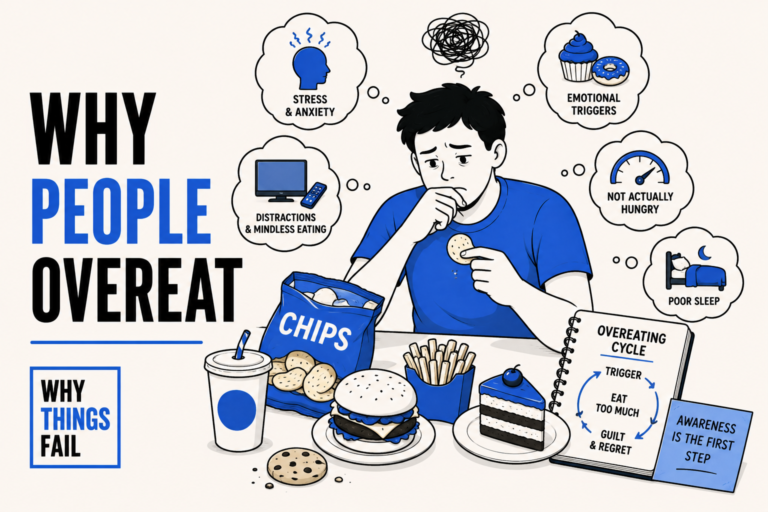
The pattern of overeating is remarkably consistent.
A person experiences stress, boredom or emotional discomfort.
Food provides immediate comfort and pleasure.
The brain associates eating with emotional relief.
The behaviour becomes a habit.
Over time, larger portions may be required to produce the same feeling of satisfaction.
Eventually, eating becomes an automatic response rather than a conscious decision.
Although the circumstances differ from person to person, the underlying behavioural process changes very little.
People rarely overeat because they are constantly hungry.
They overeat because food begins serving emotional and psychological needs beyond nutrition.
Why Does It Happen?
Understanding overeating requires looking beneath visible behaviour.
The question is not simply why people eat too much.
The more important question is why the brain repeatedly encourages behaviour that often conflicts with long term health goals.
The answer lies in the interaction between biology, psychology, environment and learned behaviour.
The Brain Rewards Food More Than We Realise
The human brain evolved during a time when food was uncertain.
Finding energy rich food increased the chances of survival.
As a result, the brain developed powerful reward systems that encourage eating whenever high calorie foods become available.
When people eat foods rich in sugar, fat or refined carbohydrates, the brain releases dopamine, a neurotransmitter associated with reward, learning and motivation.
Contrary to popular belief, dopamine does not simply create pleasure.
It teaches the brain to repeat behaviours that previously produced rewarding outcomes.
Every rewarding eating experience strengthens the connection between certain foods and future cravings.
Over time, the desire to eat becomes increasingly automatic.
The brain is not making a poor decision.
It is following survival mechanisms that evolved thousands of years ago.
Emotional Eating Replaces Physical Hunger
One of the strongest drivers of overeating is emotional eating.
Food often becomes a method of managing uncomfortable emotions rather than satisfying nutritional needs.
Stress, anxiety, loneliness, disappointment and boredom all activate emotional discomfort.
Highly palatable food offers immediate psychological relief.
For a short period, attention shifts away from emotional distress towards the pleasurable experience of eating.
The relief is temporary.
However, the brain remembers the association.
The next time similar emotions appear, food once again becomes the preferred coping mechanism.
This cycle explains why many people continue eating despite feeling physically full.
Their body no longer requires energy.
Their mind is seeking emotional comfort.
Habits Become More Powerful Than Decisions
Many people believe eating decisions are made consciously.
Behavioural research suggests otherwise.
Repeated behaviours gradually become habits that require very little conscious thought.
Someone may automatically reach for biscuits while making tea.
Others snack while watching television every evening.
Some buy sweets whenever they stop at a petrol station.
These actions often occur without deliberate planning.
The environment provides a cue.
The brain responds with an established routine.
Eventually, the behaviour feels natural even though genuine hunger may never have existed.
This explains why changing eating behaviour is often much harder than simply learning about healthy nutrition.
The challenge is not information.
It is interrupting deeply established behavioural routines.
Modern Food Environments Encourage Continuous Eating
Human biology evolved slowly.
The food environment changed rapidly.
Today, food is available almost everywhere.
Supermarkets display thousands of highly processed products.
Restaurants offer increasingly larger portions.
Food delivery services provide immediate access to meals at any hour.
Advertising constantly associates eating with happiness, celebration and relaxation.
These environmental cues influence behaviour whether people consciously notice them or not.
Behavioural economists describe this as choice architecture.
The environment shapes decisions before conscious reasoning even begins.
When highly rewarding food is inexpensive, convenient and constantly visible, resisting temptation becomes significantly more difficult.
The issue therefore extends beyond individual behaviour.
Modern environments actively encourage repeated consumption.
Stress Changes Appetite And Decision Making
Stress affects eating in different ways.
Some people lose their appetite.
Many others experience stronger cravings for foods that provide quick energy and emotional comfort.
This response is influenced by hormones such as cortisol, which can increase appetite during prolonged periods of stress.
At the same time, stress reduces cognitive capacity.
People become less patient.
Impulse control weakens.
Immediate rewards become more attractive than future benefits.
Choosing nutritious meals requires planning and attention.
Highly processed snacks require neither.
Under stress, the brain naturally favours the easier option.
This explains why busy lifestyles, demanding work schedules and emotional pressure frequently contribute to overeating even among people who understand healthy eating principles.
Warning Signs
Overeating rarely begins with dramatic changes. Instead, it develops through subtle behaviours that gradually become part of everyday life.
One of the earliest warning signs is eating without physical hunger. Meals become driven by routine, emotion or convenience rather than genuine nutritional need. Hunger and fullness signals become increasingly difficult to recognise because eating is no longer responding to the body’s requirements.
Another warning sign is relying on food to regulate emotions. After stressful meetings, difficult conversations or disappointing events, eating becomes the automatic response. The food itself is rarely solving the underlying problem, yet the temporary emotional relief reinforces the behaviour.
Frequent mindless eating is another indicator. People consume snacks while watching television, working, driving or using their phones. Because attention is divided, the brain registers less satisfaction, making it easier to continue eating beyond fullness.
Cravings for highly processed foods also deserve attention. These foods are designed to be extremely rewarding, encouraging repeated consumption even when energy needs have already been met. As cravings become more frequent, nutritious foods may feel less satisfying by comparison.
Perhaps the most overlooked warning sign is believing that overeating only occurs on special occasions. In reality, small episodes repeated every day often contribute more to long term health outcomes than occasional celebrations.
These warning signs are commonly ignored because the consequences develop slowly. Unlike an immediate injury, overeating rarely produces instant negative effects. This delay makes it difficult for people to connect everyday eating habits with future health outcomes.
What Could Have Prevented It?
Preventing overeating does not require perfect discipline or eliminating every unhealthy food. It requires creating conditions that make healthier decisions easier and automatic.
The first step is recognising the difference between physical hunger and emotional hunger. Physical hunger develops gradually and can usually be satisfied by a variety of foods. Emotional hunger often appears suddenly and demands specific comfort foods. Learning to distinguish between these experiences reduces impulsive eating.
Creating structured eating routines also improves decision making. Regular meals help stabilise appetite and reduce the likelihood of extreme hunger that encourages overeating later in the day.
The food environment matters just as much as personal intention. Keeping nutritious foods visible while reducing exposure to highly processed snacks changes behaviour without requiring constant willpower. Behavioural science consistently shows that people are more likely to eat what is convenient and immediately available.
Managing stress through healthy coping strategies also reduces emotional eating. Activities such as walking, meaningful social interaction, adequate sleep and mindfulness provide alternative ways of responding to emotional discomfort without relying on food.
Most importantly, people benefit from understanding that lasting behaviour change comes from improving systems rather than depending on motivation. Motivation changes daily. Well designed habits continue working even when motivation declines.
Lessons
Overeating teaches lessons that extend far beyond nutrition.
The first lesson is that behaviour is strongly influenced by environment. People often believe decisions are entirely personal, yet everyday surroundings quietly shape choices long before conscious thought begins.
Another lesson is that emotions frequently influence behaviour more than knowledge. Most people understand the basics of healthy eating, yet information alone rarely changes deeply established habits. Sustainable change requires addressing emotional triggers as well as nutritional understanding.
A further lesson is that immediate rewards often outweigh distant consequences. The pleasure of eating occurs within minutes, while many health consequences develop over months or years. Human psychology naturally gives greater importance to immediate experiences, making long term goals more difficult to protect.
Perhaps the most important lesson is that lasting health depends less on occasional perfection and more on consistent everyday behaviour. Small repeated choices gradually shape long term outcomes because habits become more influential than isolated decisions.
Failure Pattern
The dominant pattern behind overeating is Emotional Decision Making reinforced by Habit Formation and Immediate Reward Seeking.
This pattern appears repeatedly because the human brain naturally values immediate comfort over distant benefits. Stress encourages emotional eating. Highly rewarding foods strengthen behavioural habits. Repetition gradually transforms conscious decisions into automatic routines.
The same pattern appears in many areas of life. People overspend to reduce emotional discomfort. Investors chase short term gains despite long term risks. Businesses sacrifice sustainable growth for immediate profits. In each situation, immediate rewards quietly replace disciplined decision making.
Overeating therefore reflects a broader behavioural pattern rather than a simple nutritional problem.
Hidden Lesson
The greatest challenge is not controlling food.
It is understanding the reasons food has become more than nutrition.
Most people believe they are responding to hunger when they are actually responding to emotions, habits or environmental cues. By the time overeating becomes visible, the behavioural patterns responsible for it have often been developing for years.
The deeper truth is that overeating begins long before the first extra bite. It begins when food quietly becomes the easiest solution to problems it was never designed to solve.
Failure Scorecard
| Area | Score | Explanation |
| Self Discipline | 5/10 | Good intentions are often weakened by emotional triggers and environmental influences. |
| Decision Making | 5/10 | Food choices frequently prioritise immediate satisfaction over long term health. |
| Risk Management | 4/10 | Long term health risks are often underestimated because consequences develop gradually. |
| Long Term Thinking | 4/10 | Immediate comfort commonly outweighs future wellbeing during everyday decisions. |
| Nutritional Knowledge | 7/10 | Many people understand healthy eating principles but struggle to apply them consistently. |
| Emotional Control | 4/10 | Stress, anxiety and boredom regularly influence eating behaviour. |
| Planning | 5/10 | Lack of meal planning often increases reliance on convenient processed foods. |
| Adaptability | 6/10 | Behaviour can improve when habits and environments change, although this usually requires sustained effort. |
Key Takeaways
- Overeating is usually driven by psychology rather than physical hunger.
- Emotional eating often develops as a coping mechanism for stress and discomfort.
- Modern food environments encourage repeated consumption through convenience and constant availability.
- Habits influence eating behaviour more than daily motivation.
- Immediate rewards often outweigh distant health consequences.
- Understanding behavioural triggers is more valuable than relying on willpower alone.
- Small repeated eating habits shape long term health more than occasional indulgence.
- Sustainable change begins by improving everyday systems instead of chasing perfect discipline.
Frequently Asked Questions
Why do people overeat even when they are not hungry?
Many people overeat because emotions, habits and environmental cues activate eating behaviour even when the body does not require additional energy. The brain often seeks comfort or reward rather than nutrition.
Is overeating caused by a lack of willpower?
No. Willpower plays a role, but behavioural science shows that biology, emotions, habits and the surrounding food environment strongly influence eating decisions.
Why are processed foods easier to overeat?
Highly processed foods are designed to maximise taste and reward. Their combination of sugar, fat and salt activates the brain’s reward system, encouraging continued consumption beyond physical hunger.
How does stress contribute to overeating?
Stress increases emotional discomfort and can alter appetite regulating hormones. It also reduces self regulation, making immediate rewards such as comfort food more appealing than long term health goals.
Can overeating become a habit?
Yes. Repeated emotional eating strengthens neural pathways in the brain. Over time, eating can become an automatic response to specific emotions, places or daily routines, even when physical hunger is absent.
Conclusion
People do not overeat simply because they enjoy food too much. They overeat because human biology, emotional needs and modern environments interact in ways that make excessive eating increasingly predictable. The behaviour is rarely the result of a single poor decision. It is the outcome of repeated psychological patterns that quietly become habits.
Understanding these deeper causes changes the conversation. Overeating is no longer viewed as a failure of character but as a predictable behavioural response shaped by emotion, environment and the brain’s reward system. Recognising those patterns is the first step towards understanding why the behaviour occurs so consistently across individuals and societies.