Introduction
Home workouts have never been more popular.
Fitness apps, online coaching, wearable technology and thousands of free workout videos have made exercise accessible to almost everyone. People no longer need an expensive gym membership or specialised equipment to improve their health. A living room, a small amount of space and a mobile phone are often enough to begin.
Yet despite this accessibility, many people struggle to maintain a home workout routine for more than a few weeks. Exercise programmes begin with enthusiasm but gradually disappear from daily life. Fitness equipment gathers dust. Workout schedules become irregular. Eventually, many people conclude that home workouts simply do not work.
This conclusion is misleading.
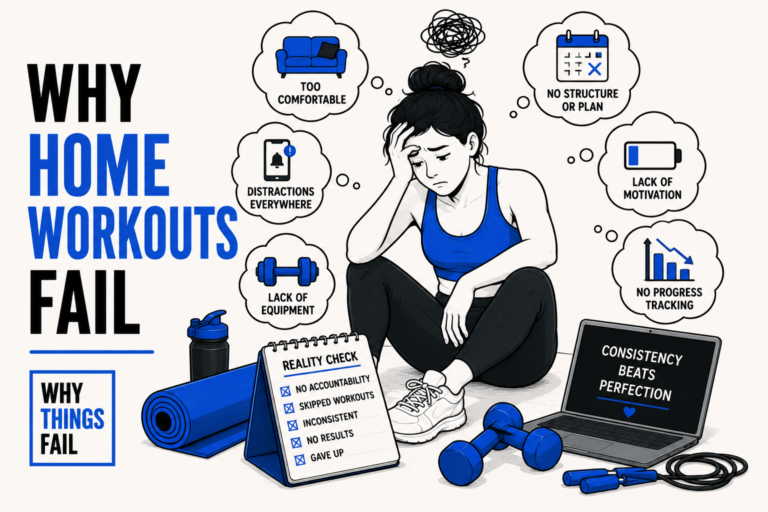
Home workouts rarely fail because the exercises are ineffective. They fail because they expose predictable patterns in human behaviour. Motivation fades, routines become inconsistent and short term emotions begin influencing long term decisions.
Understanding why home workouts fail is therefore not simply about fitness. It is about understanding how people build habits, respond to delayed rewards and make decisions when no external structure keeps them accountable.
What Is Home Workout Failure?
Home workout failure is often misunderstood as failing to lose weight or build muscle.
Those outcomes are only the visible result.
The real failure occurs when a person cannot maintain consistent exercise behaviour over time. A workout programme that is abandoned after three weeks cannot produce meaningful long term results regardless of how scientifically designed it may be.
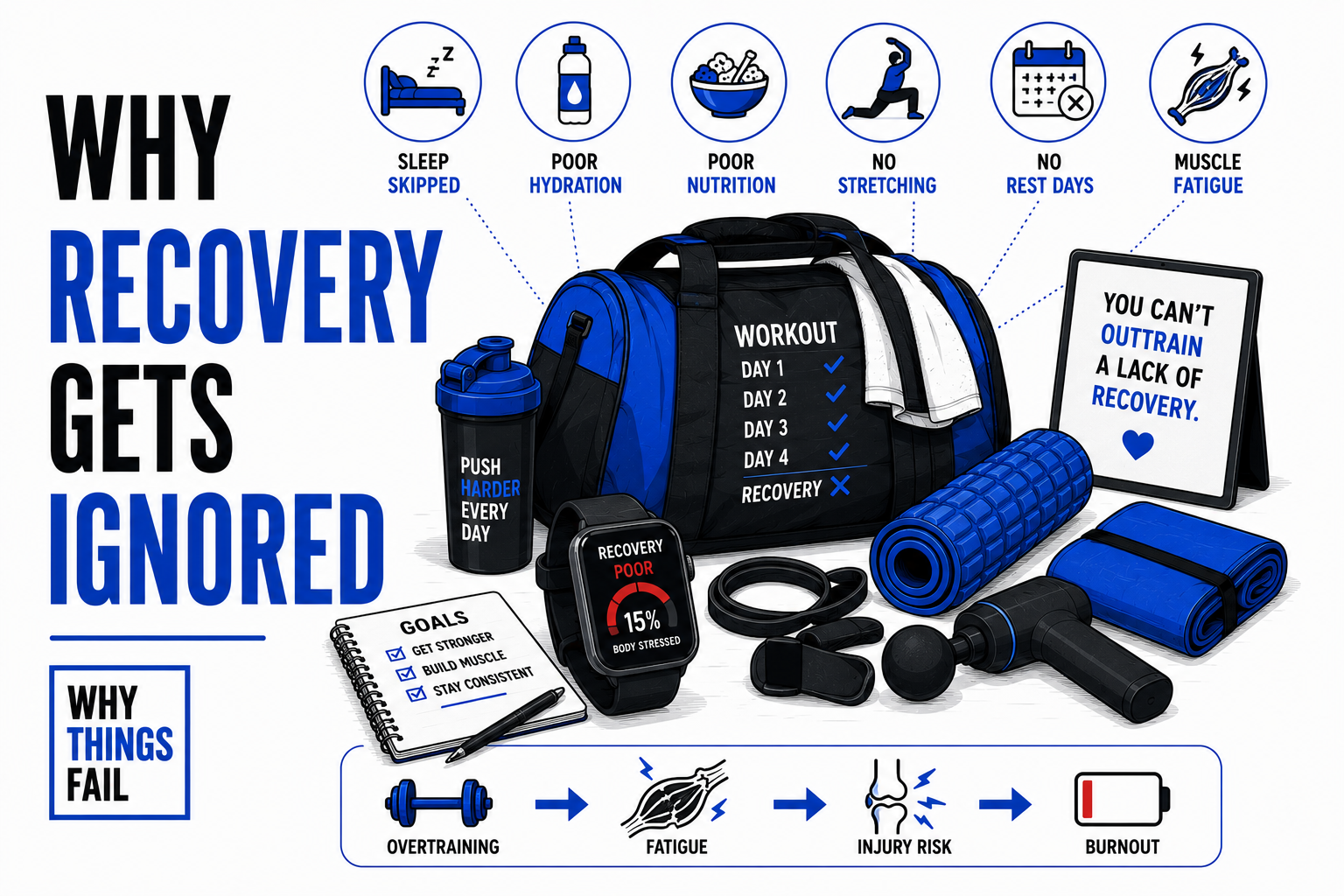
This distinction is important because successful fitness depends more on consistency than intensity.
Many people believe they need a perfect workout plan.
In reality, they need a sustainable behaviour that becomes part of everyday life.
Home workout failure is therefore less about physical ability and more about behavioural consistency.
The Biggest Myth
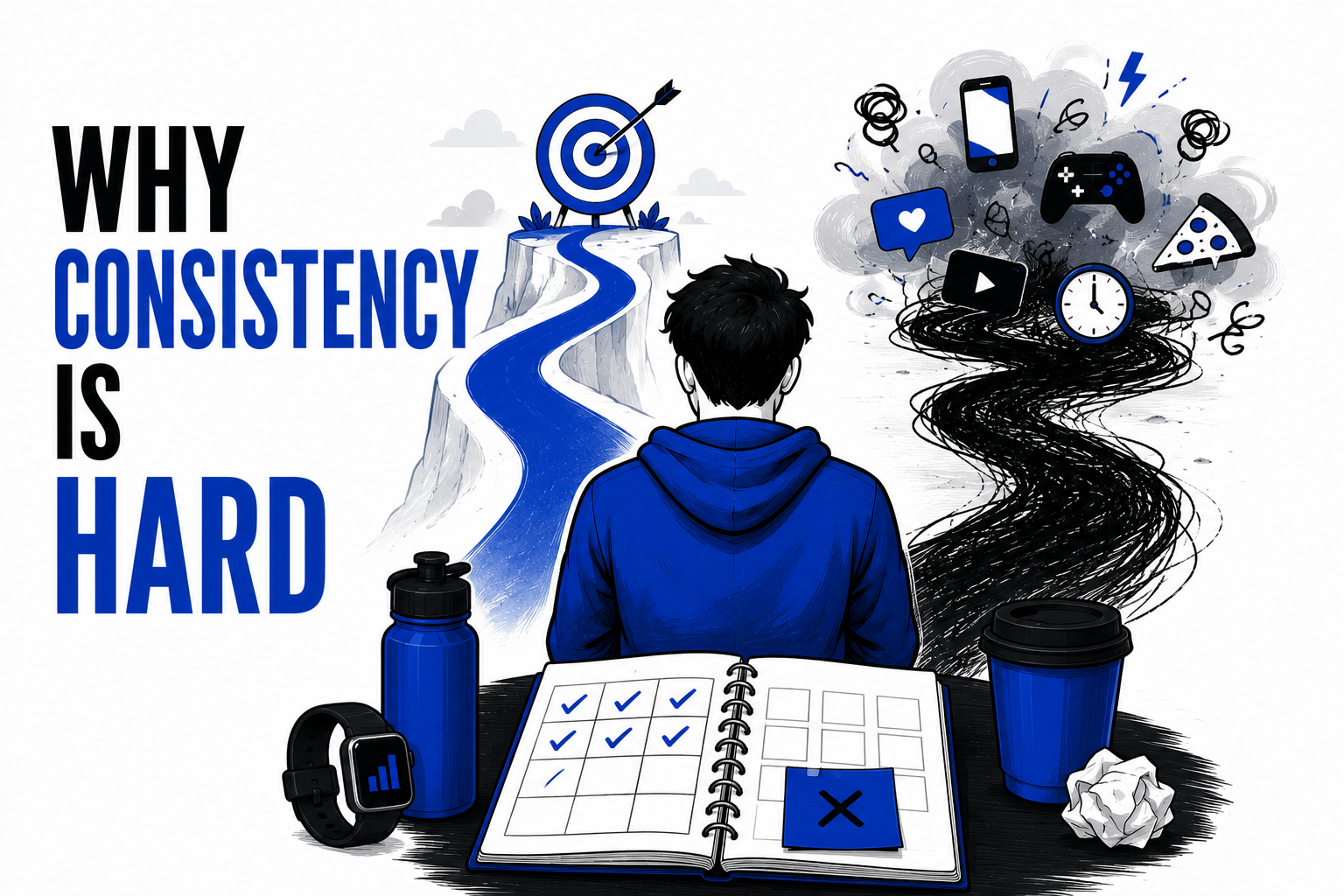
The most common belief is that people fail because they lack motivation.
This explanation sounds convincing because motivation often determines whether someone begins exercising.
However, motivation is one of the least reliable drivers of long term behaviour.
Motivation naturally rises and falls depending on mood, stress, sleep, work commitments and daily responsibilities.
If exercise depends entirely on feeling motivated, consistency becomes impossible.
People who successfully maintain home workouts rarely rely on motivation alone.
Instead, they build routines that continue even when motivation disappears.
The myth that successful fitness requires constant enthusiasm causes many people to quit too early. They mistake temporary emotional changes for personal failure when they are actually experiencing a normal part of human behaviour.
What Usually Happens?
The pattern is remarkably consistent.
Someone decides to improve their health.
They purchase workout equipment or download a fitness app.
The first few sessions feel exciting.
Visible progress creates confidence.
Then daily responsibilities increase.
Work becomes busy.
Energy levels decline.
Missing one workout feels insignificant.
One missed session becomes several.
Eventually the routine disappears completely.
Most people blame a lack of discipline.
The deeper explanation is that the system supporting the behaviour gradually collapsed.
Why Does It Happen?
Understanding why home workouts fail requires looking beyond exercise science.
Most people already understand that regular physical activity improves cardiovascular health, strengthens muscles, supports weight management and reduces the risk of chronic disease.
Knowledge is rarely the problem.
The challenge lies in consistently acting on that knowledge.
Behavioural psychology shows that people frequently choose immediate comfort over delayed rewards. Home workouts provide an excellent example of this principle.
The costs of exercise are immediate.
Physical effort.
Sweating.
Muscle soreness.
Time.
Mental energy.
The rewards are delayed.
Improved fitness develops gradually.
Weight loss takes weeks or months.
Strength increases slowly.
Better health becomes noticeable over time.
The human brain naturally gives greater importance to immediate experiences than distant rewards. This behavioural tendency makes skipping today’s workout feel easier than investing in benefits that may not appear for several weeks.
Immediate Comfort Often Wins Against Future Benefits
Behavioural economists describe this tendency as present bias.
People consistently value immediate comfort more highly than future outcomes.
After a demanding day at work, resting on the sofa provides an instant reward.
Completing a workout requires physical effort before any noticeable benefit appears.
From a purely emotional perspective, avoiding exercise often feels like the easier decision.
Repeating this decision occasionally has little impact.
Repeating it consistently gradually destroys the habit.
The problem is not laziness.
It is the way the human brain evaluates immediate and delayed rewards.
Decision Fatigue Weakens Consistency
Every day people make hundreds of decisions.
Work responsibilities.
Family commitments.
Financial concerns.
Meals.
Travel.
Communication.
By the evening, mental energy has already been consumed.
Exercise then becomes another decision requiring effort.
Decision fatigue reduces self control and encourages people to choose whichever option requires the least immediate effort.
Without a predetermined routine, home workouts become increasingly easy to postpone.
Tomorrow appears like a better opportunity.
Unfortunately, tomorrow often becomes another day with the same competing demands.
The Home Environment Encourages Distraction
Gyms are designed for one primary purpose.
Exercise.
Homes are designed for many different activities.
Relaxation.
Entertainment.
Eating.
Working.
Sleeping.
Socialising.
Every room contains competing cues that draw attention away from exercise.
Television.
Mobile phones.
Household responsibilities.
Family interruptions.
These environmental signals constantly compete with fitness goals.
Behavioural scientists have repeatedly demonstrated that human behaviour is strongly influenced by surroundings.
People often believe they control their environment.
In reality, their environment quietly shapes many of their daily decisions.
When exercise shares space with comfort and entertainment, maintaining focus becomes significantly more difficult.
The Absence Of Accountability Reduces Commitment
One advantage of gyms is external accountability.
Scheduled classes.
Personal trainers.
Workout partners.
Regular interactions with other members.
These factors create subtle social pressure that encourages consistency.
Home workouts remove many of these external influences.
Nobody notices if a workout is missed.
No trainer asks why progress has stopped.
No training partner expects attendance.
The responsibility becomes entirely internal.
Self accountability is valuable, but it also demands greater behavioural discipline.
Without external expectations, skipping one session rarely feels significant.
Over time, however, repeated exceptions become the new routine.
Unrealistic Expectations Create Early Disappointment
Many people begin exercising with ambitious expectations.
Rapid weight loss.
Visible muscle growth.
Complete body transformation within a few weeks.
Social media often reinforces these expectations by highlighting dramatic before and after photographs while rarely showing the months or years of consistent effort behind them.
When results develop more slowly than expected, disappointment begins replacing enthusiasm.
People conclude that the workout programme is ineffective.
More often, the programme simply requires more time than expected.
This misunderstanding creates a cycle of constant programme switching.
Instead of allowing one routine to produce gradual improvement, people continually search for a faster solution.
The issue is rarely the quality of the workout.
It is the expectation that meaningful physical change should occur almost immediately.
Success Creates Overconfidence
An unexpected reason many home workouts fail is early success.
After several weeks of consistent exercise, people begin feeling healthier and more energetic.
Confidence increases.
Workouts become optional rather than essential.
Missing one session appears harmless because progress has already been achieved.
This behavioural shift gradually weakens the routine that created the initial success.
The habit no longer feels necessary because the immediate problem seems solved.
Ironically, the very progress people wanted becomes one of the reasons consistency declines.
Behavioural psychology repeatedly shows that maintaining success often requires more discipline than achieving initial success because early achievements create the illusion that continued effort is no longer essential.
Warning Signs
Home workout failure rarely happens overnight. It develops through a series of small behavioural changes that gradually weaken commitment until exercise is no longer part of everyday life.
One of the earliest warning signs is relying entirely on motivation. When workouts only happen on days that feel productive, consistency becomes impossible because motivation naturally changes from day to day.
Another warning sign is frequently changing workout programmes. Many people abandon effective routines after only a few weeks because they expect dramatic results. Instead of improving execution, they continue searching for a better programme.
Skipping workouts without a clear reason is another indicator that the routine is beginning to break down. Missing one session may seem insignificant, but repeated exceptions slowly become the new habit.
Setting unrealistic goals is equally damaging. Expectations that focus on rapid weight loss or immediate physical transformation often lead to disappointment when progress follows a more realistic pace.
Perhaps the most overlooked warning sign is measuring success only through visible physical changes. Better energy levels, improved mobility, increased strength and healthier daily habits often appear long before dramatic changes in appearance. Ignoring these early improvements causes many people to believe they are making no progress at all.
These warning signs are often ignored because each one appears harmless on its own. Their cumulative effect, however, gradually undermines long term consistency.
What Could Have Prevented It?
Most home workout failures could have been prevented through better behavioural systems rather than better exercise programmes.
The first step is designing an environment that supports exercise instead of competing with it. Keeping workout equipment visible, preparing exercise clothing in advance and removing unnecessary distractions reduces the number of decisions required before each session.
Scheduling workouts at the same time each day also strengthens habit formation. Repetition allows exercise to become part of an established routine instead of a daily choice influenced by changing emotions.
Progress should be measured through behaviour before outcomes. Completing planned workouts consistently is a more reliable indicator of long term success than focusing exclusively on weight or appearance.
Realistic expectations are equally important. Sustainable fitness develops gradually. Accepting this reality reduces frustration and encourages patience during periods when visible progress appears slow.
External accountability can also improve consistency. Training with a friend, joining an online fitness community or recording completed workouts creates additional commitment that encourages long term adherence.
Ultimately, successful home workouts depend less on finding the perfect exercise routine and more on building a system that makes consistent behaviour easier than inconsistent behaviour.
Lessons
The reasons home workouts fail extend far beyond fitness.
They reveal how people approach long term goals in every area of life.
Knowledge alone rarely changes behaviour. Most people understand that regular exercise improves health, yet understanding does not automatically produce consistent action.
Another lesson is that systems outperform motivation. People who rely on temporary enthusiasm often struggle when life becomes busy. Those who build structured routines continue making progress despite changing emotions.
Home workouts also demonstrate that small decisions create significant long term outcomes. Missing one session rarely causes failure. Repeating that behaviour over several months often does.
Perhaps the most important lesson is that sustainable success depends on consistency rather than intensity. Extraordinary effort performed occasionally cannot replace ordinary effort repeated consistently.
Failure Pattern
The dominant pattern behind home workout failure is Lack of Planning combined with Short Term Thinking and Emotional Decision Making.
People begin exercising with ambitious expectations but without creating systems that support consistent behaviour. Motivation gradually declines, distractions increase and immediate comfort becomes more attractive than delayed health benefits.
This pattern appears in many other areas of life.
People abandon business plans when early success does not appear.
Investors stop investing after temporary market declines.
Students give up learning new skills because progress feels slower than expected.
In every case, short term emotions gradually replace long term thinking.
The underlying pattern remains remarkably consistent because it reflects predictable human behaviour rather than the specific activity itself.
Hidden Lesson
Home workouts do not usually fail because people are incapable of becoming healthier.
They fail because behaviour follows systems, not intentions.
Most people believe success depends on finding more motivation. The deeper truth is that motivation is temporary, while well designed habits continue functioning long after enthusiasm disappears.
The real challenge is therefore not performing a workout.
It is creating an environment, routine and decision making process that makes skipping the workout more difficult than completing it.
Failure Scorecard
| Area | Score | Explanation |
| Discipline | 5/10 | Many people begin strongly but struggle to maintain consistent exercise habits. |
| Decision Making | 5/10 | Daily choices are frequently influenced by mood, convenience and immediate comfort. |
| Planning | 4/10 | Exercise routines often lack clear schedules, measurable goals and long term structure. |
| Long Term Thinking | 4/10 | Expectations focus on rapid results instead of gradual behavioural change. |
| Health Knowledge | 7/10 | Most people understand the benefits of exercise but underestimate the importance of consistency. |
| Emotional Control | 5/10 | Temporary disappointment and declining motivation often interrupt established routines. |
| Adaptability | 6/10 | Many people struggle to adjust routines when work, family or personal responsibilities change. |
| Habit Formation | 4/10 | Sustainable systems are often replaced by irregular bursts of motivation. |
Key Takeaways
- Home workouts usually fail because behavioural systems are weak rather than because exercise programmes are ineffective.
- Motivation begins habits, but routines sustain them.
- Present bias encourages immediate comfort over future health benefits.
- Consistency creates greater long term results than occasional intense effort.
- Environmental distractions quietly influence daily exercise decisions.
- Unrealistic expectations often lead to unnecessary disappointment.
- Measuring behaviour instead of appearance encourages sustainable progress.
- Long term fitness depends on habit formation more than willpower.
Frequently Asked Questions
Why do home workouts fail for most people?
Home workouts usually fail because people rely on motivation instead of structured routines. Behavioural factors such as distractions, inconsistent habits and unrealistic expectations often reduce long term commitment.
Are home workouts as effective as gym workouts?
Yes. When performed consistently with appropriate progression, home workouts can improve strength, fitness and overall health. The greatest challenge is maintaining regular participation rather than the exercises themselves.
Why do people lose motivation to exercise at home?
Motivation naturally changes over time. Without external accountability or established habits, daily responsibilities and immediate comfort often take priority over exercise.
How can I stay consistent with home workouts?
Create a fixed schedule, prepare your workout space in advance, track completed sessions and focus on building a routine rather than waiting to feel motivated.
What is the biggest mistake people make with home workouts?
The biggest mistake is expecting rapid physical transformation while overlooking the importance of consistent behaviour. Sustainable progress is usually the result of small actions repeated over many months.
Conclusion
Home workouts are not limited by a lack of equipment or scientific effectiveness. They are limited by the same behavioural patterns that influence many long term goals. Immediate comfort competes with delayed rewards, changing emotions compete with established routines and intentions compete with everyday distractions.
Understanding these patterns changes the conversation. Home workout failure becomes less about physical ability and more about recognising that lasting fitness is built through systems that support consistent behaviour long after motivation has faded.