Introduction
Complacency rarely arrives loudly. It does not announce itself as danger, laziness or decline. More often, it feels like confidence. It feels like stability. It feels like proof that the current way of doing things is working.
That is why complacency is so dangerous.
People do not usually become complacent because they are foolish. They become complacent because the evidence around them appears to confirm that there is no urgent need to change. Success continues. Problems seem manageable. Risks feel distant. The system still works well enough.
But underneath the surface, standards begin to slip. Curiosity weakens. Assumptions harden. Warning signs are explained away. The person, team or organisation stops asking the questions that once made them strong.
Complacency is not simply a lack of effort. It is a failure of attention.
It happens when people become too comfortable with yesterday’s results, too attached to familiar routines and too slow to recognise that the environment around them has changed. By the time the failure becomes visible, the real damage has often already been done.
What Is It?
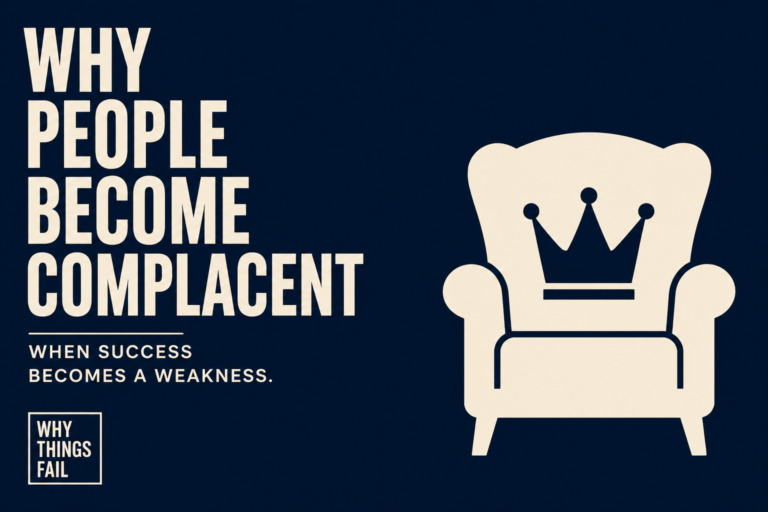
Complacency is a false sense of security created by past success, routine or comfort.
It is the belief that because things have been fine, they will continue to be fine. It makes people underestimate risk, overestimate their position and stop preparing for change.
A complacent person may still be busy. They may still be working. They may still believe they are performing well. But the quality of their attention has changed. They are no longer looking for improvement, danger or evidence that challenges their assumptions.
Complacency can appear in many forms:
A successful business stops listening to customers.
A talented employee stops learning.
A leader stops questioning their strategy.
A team stops checking the details.
A person in a comfortable life stops growing.
The problem is not comfort itself. Comfort becomes dangerous when it removes urgency, discipline and curiosity.
The Biggest Myth
The biggest myth about complacency is that it only happens to lazy people.
In reality, complacency often happens to capable people after a period of success.
Success creates evidence. Evidence creates confidence. Confidence creates routine. Routine creates blindness.
The person thinks, “This worked before, so it will work again.”
That belief may be reasonable at first. But over time, it becomes dangerous because the world does not stay still. Markets change. People change. competitors improve. Technology advances. Standards rise. Younger, hungrier people enter the field.
Complacency is not caused by stupidity. It is caused by comfort without awareness.
What Happened?
People become complacent when their environment stops giving them immediate consequences.
When a person is struggling, feedback is obvious. Bills are unpaid. Customers complain. Managers challenge them. Results expose the problem.
But when things are going well, feedback becomes softer. There is less pressure to improve. Mistakes may not hurt immediately. Weak performance may be hidden by past reputation, strong systems or favourable conditions.
This creates a dangerous delay between behaviour and consequence.
A business may lose quality long before it loses customers.
A professional may stop developing long before they lose relevance.
A leader may ignore problems long before the organisation collapses.
A relationship may weaken long before it breaks.
The failure begins quietly. Standards decline before outcomes decline. That is why complacency is hard to detect early.
Why Did It Happen?
Complacency begins with success being misunderstood.
People often treat success as proof of permanent ability. They forget that success is usually produced by a combination of effort, timing, environment, discipline, luck, relationships and market conditions.
When success arrives, people simplify the story. They believe, “We won because we are better.” That may be partly true, but it is rarely the whole truth.
This creates the first failure: overconfidence.
Overconfidence makes people stop looking for evidence that they might be wrong. They stop studying competitors. They stop listening carefully. They stop improving the product, the skill, the service or the system.
The second cause is routine.
Routine is useful because it saves mental energy. But routine becomes dangerous when it replaces thinking. People repeat actions because they are familiar, not because they are still effective.
The third cause is lack of visible threat.
Humans respond strongly to immediate danger but weakly to slow decline. A sudden crisis creates urgency. A slow erosion of standards does not. This is why complacency grows in quiet periods.
The fourth cause is comfort.
Comfort changes incentives. When people are hungry, they take action. When they are secure, they protect what they have. They become less willing to take risks, learn difficult things or challenge themselves.
The fifth cause is social reinforcement.
If everyone around a person is also comfortable, complacency becomes normal. Nobody questions the standard because the standard has become shared. Teams begin to accept average work as acceptable work.
The sixth cause is identity.
People often resist evidence that threatens how they see themselves. A successful person does not want to believe they are falling behind. A strong company does not want to believe its model is weakening. A leader does not want to admit their judgement may be outdated.
So the warning signs are reinterpreted.
Customer complaints become “isolated cases”.
Lower performance becomes “temporary”.
New competitors become “not serious”.
Personal decline becomes “just a busy period”.
This is how complacency protects itself. It does not deny reality completely. It explains reality in a way that avoids responsibility.
Warning Signs
Complacency usually shows itself before failure happens.
The most common warning sign is a decline in standards. People begin accepting work they would once have corrected.
Another warning sign is reduced curiosity. The person stops asking questions, researching, learning or seeking feedback.
A third warning sign is defensive thinking. Any criticism is treated as unfair, negative or unnecessary.
A fourth warning sign is reliance on past success. People talk more about what they used to achieve than what they are improving now.
A fifth warning sign is slow reaction. Problems are noticed, but action is delayed.
The most dangerous sign is when people still believe they are doing well while the evidence is beginning to show otherwise.
Researchers call this pattern “normalization of deviance” the gradual process by which small deviations from a standard become accepted as normal simply because they haven’t yet caused visible harm, until the accumulated deviations finally do
What Could Have Prevented It?
Complacency could have been prevented by building systems that challenge comfort before crisis arrives.
The first prevention is honest measurement. People need clear indicators that show whether performance is improving, flat or declining.
The second is regular feedback. Feedback must come from customers, colleagues, competitors, data and real outcomes, not just internal opinions.
The third is deliberate discomfort. People and organisations need controlled pressure. This can include higher standards, new goals, training, innovation or external benchmarking.
The fourth is humility. Humility does not mean low confidence. It means understanding that success must be re-earned.
The fifth is leadership. Leaders must create a culture where people can challenge assumptions before problems become emergencies.
The sixth is learning. The best protection against complacency is continuous improvement. A person who keeps learning remains harder to surprise.
Lessons
The first lesson is that success can become a trap.
The second lesson is that comfort reduces urgency.
The third lesson is that decline often starts before results show it.
The fourth lesson is that routines must be reviewed, not worshipped.
The fifth lesson is that people ignore warnings when those warnings threaten their identity.
The sixth lesson is that complacency is easier to prevent than reverse.
Once complacency becomes culture, it is difficult to remove because it feels normal.
Failure Pattern
The pattern is clear:
Success creates confidence.
Confidence creates routine.
Routine reduces questioning.
Reduced questioning hides change.
Hidden change weakens performance.
Weak performance is explained away.
By the time reality becomes undeniable, the person or organisation is already behind.
This is why complacency repeats across businesses, careers, relationships and personal lives. The surface details change, but the pattern remains the same.
People fail not because they never knew what to do, but because they stopped believing they needed to keep doing it.
Hidden Lesson
The hidden lesson is that complacency is not the opposite of ambition.
It is often what happens after ambition succeeds.
A person works hard, achieves something, becomes comfortable and slowly disconnects from the habits that created the success in the first place.
The reward becomes the risk.
The achievement becomes the excuse.
The comfort becomes the trap.
The real danger is not rest. Rest is necessary. The danger is believing that past effort permanently protects future results.
It does not.
Failure Scorecard
Overconfidence: 9/10
Complacency is strongly driven by overconfidence. People trust past success more than current evidence.
Warning Signs Ignored: 8/10
The signs usually exist early, but they are softened, delayed or explained away.
Preventability: 8/10
Complacency is highly preventable if honest feedback, measurement and challenge are built into the system.
Speed of Decline: 5/10
Complacency usually causes slow decline rather than sudden collapse, which makes it harder to notice.
Repeat Risk: 10/10
This pattern repeats constantly because human beings naturally adapt to comfort and normalise their environment.
Cultural Damage: 9/10
Once complacency becomes shared behaviour, it spreads through teams, families, businesses and institutions.
Key Takeaways
Complacency is a false sense of security.
It often follows success, not failure.
It grows when people stop questioning familiar routines.
It becomes dangerous because early decline is easy to ignore.
The main causes are overconfidence, comfort, weak feedback and fear of admitting change is needed.
The solution is not constant panic. The solution is disciplined awareness.
People avoid complacency by measuring honestly, listening carefully, learning continuously and remembering that success must be maintained.
Frequently Asked Questions
Why does success sometimes lead to failure?
Success creates confidence, and confidence reduces the urgency to keep questioning, learning and adapting the same habits that created the success in the first place.
What is normalization of deviance?
It’s when small drops in standards get quietly accepted as normal because nothing bad happens right away, until the accumulated small failures cause a larger one.
How do you prevent complacency in a team or business?
Build in honest, regular feedback from outside sources (customers, data, competitors), not just internal opinion, and treat comfort as a signal to look closer, not relax.
Conclusion
People become complacent because comfort changes how they see risk.
When life, business or work feels stable, the mind starts to relax its standards. It assumes the future will resemble the past. It treats warning signs as interruptions rather than information.
That is the beginning of failure.
Complacency does not destroy people immediately. It weakens them slowly. It removes the habits, curiosity and discipline that created success in the first place.
The tragedy is that complacency often feels reasonable while it is happening. There is no obvious disaster at the start. There is only a slight lowering of standards, a little less urgency, a little more confidence, a little more delay.
Then the world changes.
And the person who once felt secure realises they were not standing still.
They were falling behind.
That is why complacency fails.
Not because comfort is wrong.
But because comfort without awareness becomes blindness.