Introduction
Motivation often fails quietly before people notice it has gone.
At first, someone is excited. They start a business, join a gym, launch a project, begin a course, apply for jobs, or commit to changing their life. The beginning feels powerful because the future is still imaginary. Results appear possible. Identity feels flexible. The mind is full of energy because nothing has yet tested the promise.
Then reality begins.
Progress is slower than expected. The work becomes repetitive. Early praise disappears. Results do not arrive quickly enough. Doubt replaces excitement. The person who once felt driven now feels tired, distracted or emotionally flat. Eventually, they tell themselves they have “lost motivation”.
But motivation rarely disappears for no reason. It usually collapses because the system around it was weak.
People do not lose motivation simply because they are lazy. They lose motivation when expectations, emotions, habits, incentives and identity stop supporting the work. The failure is not usually a sudden lack of willpower. It is a predictable breakdown between desire and reality.
What Is It?
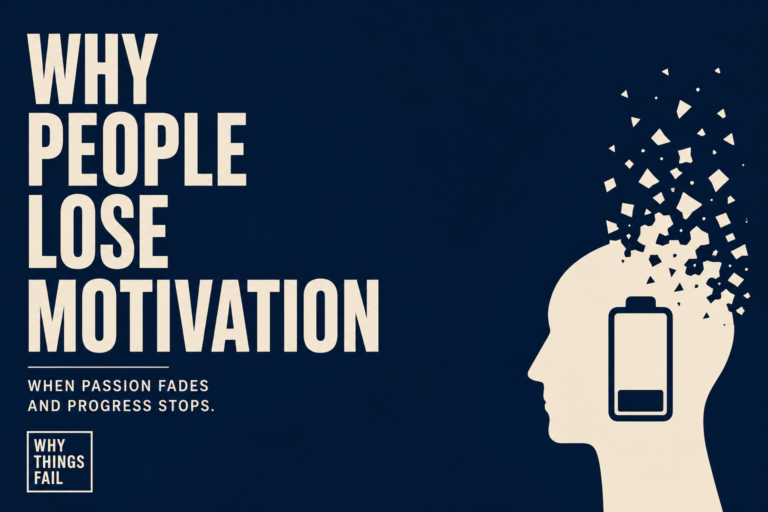
Losing motivation means losing the emotional energy to continue pursuing a goal.
It is not the same as changing priorities. Sometimes people stop because a goal is no longer right for them. That is not failure. The more common problem is different: the goal still matters, but the person no longer feels able, willing or emotionally connected enough to continue.
Motivation is the bridge between intention and action. It helps people begin, continue and recover after setbacks. But it is unstable when it depends only on excitement, pressure or hope.
Strong motivation is not just a feeling. It is supported by clear goals, visible progress, meaningful rewards, identity, environment, routine and belief. When those supports disappear, motivation starts to weaken.
The Biggest Myth
The biggest myth is that motivated people simply “want it more”.
This is comforting because it makes success look like a personality trait. Winners are disciplined. Quitters are weak. Successful people have drive. Unsuccessful people lack ambition.
Reality is more complicated.
Many people begin with strong desire. They genuinely want to lose weight, build a company, improve their career, save money, study, create content or change their life. The problem is not always desire. The problem is that desire alone cannot survive friction forever.
Motivation is expensive. It requires mental energy. Every delay, disappointment, unclear next step, lack of support, poor environment or repeated failure increases the cost of continuing.
People do not only quit because they stop caring. Often, they quit because caring becomes painful.
What Happened?
At the beginning, the goal felt exciting because the person was focused on possibility.
They imagined the result, not the process. They pictured the finished business, the fitter body, the new income, the qualification, the confidence, the recognition or the freedom. This future image created emotional fuel.
But the process looked different.
The gym required boring repetition. The business required rejection. The course required long evenings. The job search required silence from employers. The content project required months of work before attention arrived. The new habit required discipline after the initial excitement faded.
The gap between expectation and reality became uncomfortable.
When progress was not obvious, the brain started questioning the value of the effort. When results took longer than expected, doubt increased. When the person compared themselves to others, their own progress looked small. When there was no immediate reward, the work began to feel pointless.
Eventually, motivation declined. Not because the goal was meaningless, but because the emotional reward system stopped receiving enough evidence that the effort was worth it.
Why Did It Happen?
The first cause is unrealistic expectation.
Many people start with an emotional fantasy rather than a practical plan. They underestimate how long success takes, how boring consistency feels, and how many setbacks happen before visible progress appears. When reality arrives, it feels like failure even when it is normal.
The second cause is poor feedback.
People stay motivated when they can see progress. The problem is that many worthwhile goals have delayed rewards. A business may take months before it produces money. Fitness may take weeks before visible change appears. SEO may take months before rankings improve. Skills may improve long before results appear externally.
When progress is invisible, people assume nothing is working.
The third cause is dependence on emotion.
Early motivation is usually emotional. It comes from inspiration, frustration, hope or urgency. But emotions change. A person cannot rely on feeling excited every day. If the system only works when the person feels motivated, the system is fragile.
The fourth cause is identity conflict.
People struggle to continue goals that do not yet match how they see themselves. Someone may want to become disciplined, but still think of themselves as inconsistent. They may want to build a business, but still think like an employee. They may want to become healthy, but still identify as someone who always fails at fitness.
When behaviour and identity conflict, motivation becomes harder to sustain.
The fifth cause is friction.
Small obstacles destroy motivation over time. A complicated workspace, unclear task list, poor sleep, distracting phone, unsupportive people, lack of money, long commute or messy routine may seem minor individually. Together, they make action harder.
People often blame themselves for lacking motivation when the real issue is that their environment makes the right behaviour unnecessarily difficult.
The sixth cause is lack of immediate reward.
The human brain responds strongly to quick feedback. Social media, food, entertainment and comfort provide instant reward. Long-term goals often provide delayed reward. This creates an unfair competition.
The easy thing feels rewarding now. The important thing may only pay off later.
The seventh cause is repeated disappointment.
Motivation weakens when effort does not seem to change outcomes. If someone works hard but sees no result, they begin to develop learned helplessness. The mind starts protecting itself by caring less. This is not laziness. It is emotional self-defence.
The eighth cause is comparison.
People compare their private struggle with other people’s public success. This damages motivation because it creates a false sense of being behind. Instead of focusing on the next step, the person feels overwhelmed by the distance between where they are and where others appear to be.
The ninth cause is unclear purpose.
A goal without a deep reason is easy to abandon. Wanting money, status, praise or quick results may create a start, but it may not sustain the journey. Strong motivation needs meaning. People continue longer when the goal connects to identity, family, freedom, security, service or self-respect.
The tenth cause is burnout disguised as laziness.
Sometimes people do not lose motivation because they are weak. They lose it because they are exhausted. Poor sleep, stress, pressure, financial worry and constant decision-making reduce mental capacity. A tired brain does not dream boldly. It looks for relief.
Warning Signs
The first warning sign is constant restarting.
The person keeps beginning again but never builds momentum. This suggests they are addicted to the emotional high of starting but have not built a system for continuing.
The second warning sign is needing perfect conditions.
They only work when they feel inspired, confident or free from stress. This makes consistency impossible because real life rarely provides perfect conditions.
The third warning sign is avoiding measurement.
If someone stops tracking progress, they lose evidence. Without evidence, emotions take over. A bad day can feel like total failure.
The fourth warning sign is frequent comparison.
When someone spends more time watching others succeed than doing their own work, motivation becomes fragile.
The fifth warning sign is confusing boredom with failure.
Most meaningful progress becomes boring at some point. Repetition is not proof that the goal is wrong. It is often proof that the real work has started.
What Could Have Prevented It?
The first prevention is realistic expectation.
People need to understand the true cost of their goal before they begin. Motivation survives better when people expect difficulty. If struggle is expected, it feels like part of the process. If struggle is unexpected, it feels like a sign to quit.
The second prevention is building systems instead of relying on feelings.
A system turns action into routine. It reduces the need for daily motivation. For example, writing every morning, walking after dinner, making sales calls at a fixed time, or reviewing progress every Friday creates structure.
The third prevention is visible progress.
People need scoreboards. They need to track effort, not just outcomes. Calls made, pages written, workouts completed, lessons studied, videos posted, leads contacted and days completed are all forms of progress.
The fourth prevention is smaller goals.
Large goals can inspire, but they can also overwhelm. Breaking goals into small, repeatable actions keeps the brain engaged. Motivation grows when the next step feels possible.
The fifth prevention is identity reinforcement.
Instead of saying, “I am trying to get fit,” a stronger identity is, “I am becoming someone who trains even when it is not perfect.” Identity makes behaviour feel personal rather than optional.
The sixth prevention is reducing friction.
Make the right action easier. Prepare the workspace. Remove distractions. Set reminders. Keep tools ready. Plan tomorrow today. Motivation increases when the first step is simple.
The seventh prevention is recovery.
Rest is not the enemy of motivation. Exhaustion is. People who never recover eventually lose emotional energy. Sustainable motivation requires sleep, breaks, health, support and realistic workload.
Lessons
The first lesson is that motivation is not enough.
Motivation can start the journey, but systems carry it forward.
The second lesson is that boredom is normal.
Many people quit because the work stops feeling exciting. But serious progress often looks repetitive before it looks impressive.
The third lesson is that progress must be visible.
If people cannot see improvement, they will start believing nothing is happening.
The fourth lesson is that environment matters.
A person with a poor system must use more willpower than a person with a supportive system.
The fifth lesson is that motivation follows action.
People often wait to feel motivated before acting. In reality, action often creates motivation. Starting small can rebuild energy.
Failure Pattern
The pattern is simple:
A person starts with excitement.
They expect fast results.
Reality becomes slower and harder than expected.
Progress is unclear.
The work becomes repetitive.
Comparison increases doubt.
The brain stops receiving emotional reward.
The person feels demotivated.
They quit or restart with a new goal.
This is why motivation failure repeats. People keep changing the goal instead of fixing the system.
Hidden Lesson
The hidden lesson is that motivation is not lost in one dramatic moment.
It is drained by hundreds of small leaks.
Unclear goals. Unrealistic timelines. No feedback. Poor sleep. Weak routines. Constant comparison. Lack of support. Too much friction. No visible progress. Emotional dependence. Each one reduces the ability to continue.
By the time someone says, “I have lost motivation,” the failure has usually been developing for weeks or months.
Failure Scorecard
Expectation Management: 8/10
Poor expectations are one of the biggest reasons motivation fails. People expect the emotional reward of success without fully understanding the dull, slow and repetitive nature of the process.
System Strength: 9/10
Weak systems make motivation carry too much weight. Without routines, tracking and structure, even strong ambition becomes fragile.
Emotional Dependence: 8/10
People who rely on inspiration struggle when inspiration fades. Feelings are useful, but they are not reliable enough to be the foundation.
Progress Visibility: 9/10
Invisible progress destroys belief. When people cannot see evidence, they assume their effort is wasted.
Environmental Friction: 7/10
Small obstacles compound. A difficult environment makes consistency feel harder than it needs to be.
Identity Alignment: 8/10
Long-term change becomes difficult when the person’s self-image does not match the behaviour they are trying to build.
Preventability: 8/10
Motivation loss is highly preventable when people design better systems, track effort, manage expectations and reduce friction.
Key Takeaways
People lose motivation when the emotional reward of a goal no longer feels stronger than the cost of continuing.
The problem is rarely laziness alone. More often, it is a failure of expectation, structure, feedback, identity and environment.
Motivation is strongest when supported by systems.
Progress must be measured before it becomes visible.
The beginning is usually exciting because it is imaginary. The middle is difficult because it is real.
People do not need to feel motivated every day. They need a structure that keeps them moving when motivation is low.
Conclusion
People lose motivation because they misunderstand what motivation is.
They treat it like a permanent fuel source, when it is closer to a spark. It can begin action, but it cannot carry the full weight of long-term change. When people rely only on excitement, hope or pressure, motivation eventually fails.
The real failure is not that people stop caring. It is that they build goals on emotional energy instead of durable systems.
Motivation survives when expectations are realistic, progress is visible, routines are simple, identity supports the behaviour and the environment reduces friction.
People lose motivation when the gap between the dream and the daily work becomes too painful to face.
That is why the solution is not simply to “try harder”.
The solution is to design a life where the right action is easier to repeat, even on the days when motivation disappears.