Introduction
Few industries are built on repeated failure as successfully as the diet industry.
Every year, millions of people begin a new diet with optimism, determination and a belief that this attempt will finally produce lasting results. Many lose weight initially. Some lose a great deal of weight. Yet a significant number eventually regain much or all of it.
This pattern has persisted for decades despite an explosion of nutrition research, fitness apps, calorie trackers and weight loss programmes.
Why?
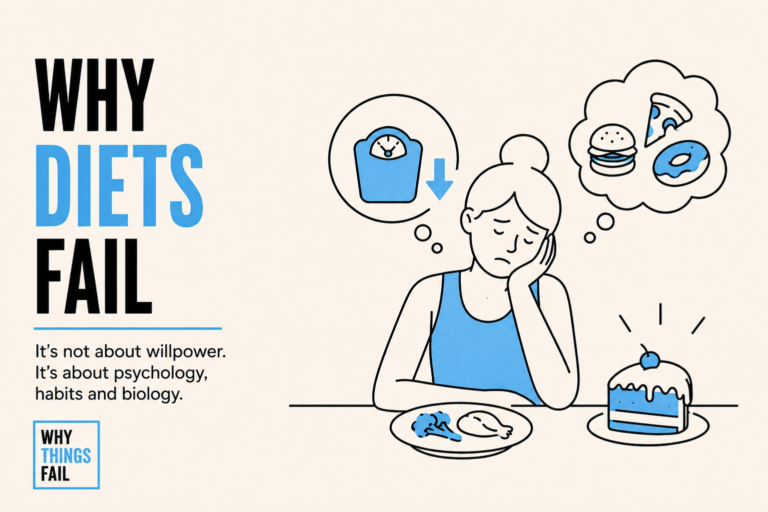
The common explanation is that people simply lack willpower. It is a convenient answer because it places responsibility entirely on the individual.
The deeper reality is far more complex.
Diet failure is rarely caused by a single moment of weakness. It is usually the result of a system that conflicts with human psychology, biology, social incentives and long term behaviour.
Understanding why diets fail therefore requires looking beyond calories and meal plans. It requires examining how people make decisions, how habits are formed, how environments shape behaviour and why short term success often creates the conditions for long term failure.
This matters because the lessons extend far beyond weight loss. The same patterns appear in investing, business, personal finance and many other areas where people struggle to sustain difficult changes over time.
What Is Diet Failure?
Diet failure does not simply mean losing weight and then regaining it.
More broadly, it refers to the inability to maintain a healthier pattern of eating and living over the long term.
A person may successfully follow a strict diet for several weeks or months. The failure occurs when the behaviour proves unsustainable and previous habits gradually return.
This distinction is important.
Many diets are effective at producing short term weight loss. The real challenge is maintaining those results for years rather than weeks.
The question is therefore not:
“Can people lose weight?”
Millions clearly can.
The more important question is:
“Why do so many people struggle to maintain the changes required to keep it off?”
The Biggest Myth
The most common belief is simple.
“Diets fail because people lack discipline.”
This explanation sounds plausible, but it ignores a crucial fact.
Many people who regain weight were disciplined enough to lose it in the first place.
They counted calories, resisted cravings, exercised regularly and followed detailed plans.
If discipline were the entire explanation, the same individuals would maintain their results indefinitely.
Research in behavioural psychology suggests a different conclusion.
Willpower is not an unlimited resource. It is heavily influenced by stress, environment, sleep, emotions, habits and social context.
A diet that requires constant self control often becomes progressively harder to maintain.
The problem is therefore not simply a lack of effort.
It is the difficulty of sustaining a behaviour that continuously fights against existing habits, biological drives and everyday environments.
What Usually Happens?
Most diet failures follow a recognisable pattern.
- Motivation is high at the beginning.
- Rules are followed strictly.
- Weight decreases.
- Progress slows.
- Restrictions become mentally exhausting.
- Small deviations appear.
- Old habits gradually return.
- Weight stabilises or increases.
- The diet is abandoned.
- A new diet is eventually started.
What makes this pattern remarkable is how consistently it appears across different diet methods.
Low carbohydrate diets, low fat diets, intermittent fasting, meal replacement programmes and many other approaches often produce similar long term challenges.
The common factor is not necessarily the diet itself.
It is human behaviour.
Why Does It Happen?
This is where the real investigation begins.
Diet failure is often presented as a nutrition problem.
In reality, it is frequently a behavioural problem.
Food choices are influenced by emotions, habits, social pressure, stress, convenience, identity and reward seeking behaviour.
Understanding these forces reveals why lasting change is so difficult.
The Brain Prefers Immediate Rewards
One of the most powerful concepts in behavioural economics is present bias.
Humans naturally value immediate rewards more highly than future benefits.
The pleasure of eating a favourite food is immediate.
The health benefits of avoiding it are delayed.
This creates a constant conflict between short term satisfaction and long term goals.
Diet plans often assume people will consistently choose the delayed benefit.
Human psychology frequently prefers the immediate reward.
Restriction Can Increase Desire
Many diets rely heavily on restriction.
Foods are labelled “good” or “bad.” Entire categories are eliminated.
Paradoxically, forbidden foods often become more psychologically attractive.
This is related to reactance theory, the tendency to desire something more when access to it is restricted.
The stricter the rules become, the more mental energy may be spent thinking about the foods being avoided.
For some people, this eventually leads to overeating episodes that feel like a loss of control.
Emotional Eating Solves A Different Problem
Many eating behaviours are not primarily about hunger.
They are responses to:
- Stress
- Loneliness
- Boredom
- Anxiety
- Fatigue
- Celebration
- Comfort seeking
A diet may reduce calories without addressing the emotional role that food plays in a person’s life.
When stress returns, the old coping mechanism often returns with it.
This is why some people can follow a diet successfully during stable periods but struggle during emotionally difficult periods.
Habit Systems Are Stronger Than Motivation
Motivation is often temporary.
Habits are often automatic.
Someone who has spent years snacking while watching television, eating under stress or buying convenience foods has built powerful behavioural routines.
A new diet asks the brain to replace these routines immediately.
That is possible for short periods.
Maintaining the change for years is much harder because the old habit pathways remain available.
The Environment Often Works Against The Diet
Many discussions about weight loss focus entirely on personal responsibility.
They ignore the environment.
Modern environments are designed to make calorie consumption easy.
- Food is available everywhere.
- Portions are large.
- Highly palatable foods are heavily marketed.
- Social events frequently revolve around eating.
- Convenience foods require little effort.
In behavioural terms, the environment constantly provides cues that encourage eating.
A successful diet often requires resisting these cues repeatedly, which can become mentally exhausting over time.
Weight Loss Changes The Body
Another factor that is frequently overlooked is biology.
When people lose weight, the body often responds by:
- Increasing hunger signals
- Reducing feelings of fullness
- Lowering energy expenditure
- Making weight regain easier
In other words, maintaining a lower weight may require ongoing effort even after the initial weight loss has been achieved.
This does not make weight loss impossible.
It helps explain why maintaining it can feel harder than expected.
Social Pressure Shapes Eating Behaviour
Humans are social creatures.
Food is deeply connected to culture, family and relationships.
People may face pressure to:
- Eat during celebrations
- Join social meals
- Avoid appearing “difficult”
- Match the eating habits of friends and family
A diet that isolates someone socially often becomes difficult to sustain.
The challenge is therefore not only nutritional.
It is also social and psychological.
The Real Root Cause
After examining the evidence, a deeper pattern emerges.
Many diets fail because they are designed as temporary interventions for a problem created by long term behaviours and environments.
People try to solve a permanent challenge with a temporary burst of motivation.
When motivation fades, the underlying habits, emotions, social pressures and environmental cues remain.
The weight often returns because the system that produced it was never fully changed.
The failure is therefore rarely a single bad decision.
It is the gradual reappearance of old patterns once the temporary structure of the diet disappears.
Warning Signs
Diet failure rarely begins with visible weight gain. It begins with subtle behavioural changes that gradually weaken commitment until old habits become stronger than new intentions.
One of the earliest warning signs is viewing the diet as a temporary challenge rather than a permanent lifestyle change. When people constantly count the days until they can return to their previous eating habits, the outcome is already becoming predictable.
Another warning sign is relying entirely on motivation. Motivation naturally rises and falls, yet many diet plans assume it will remain high indefinitely. Once enthusiasm fades, there is no behavioural system to replace it.
Food gradually becomes an emotional reward rather than nourishment. Stressful days justify treats. Successful days deserve celebrations. Difficult emotions become reasons to abandon the plan for “just one day.” These decisions seem harmless individually, but together they recreate the same behavioural patterns that existed before the diet began.
An increasing obsession with the weighing scale is another indicator. Daily fluctuations begin controlling emotions. A small increase creates frustration. A small decrease creates overconfidence. Decisions become reactive rather than consistent.
Ignoring sleep, stress management and mental wellbeing also signals future difficulty. Poor sleep increases hunger hormones, stress encourages emotional eating and fatigue reduces self control. The problem appears nutritional, but the underlying causes are behavioural and physiological.
These warning signs are often ignored because they do not immediately produce weight gain. By the time physical changes become obvious, the behavioural changes responsible have usually been developing for weeks or months.
What Could Have Prevented It?
Preventing diet failure is less about discovering the perfect eating plan and more about building a system that remains sustainable after motivation declines.
The first step is replacing temporary restrictions with realistic habits. Eating patterns should fit everyday life rather than require constant sacrifice. Behaviour that cannot be maintained for years is unlikely to produce lasting results.
Goals should also focus on behaviours instead of outcomes. Weight naturally fluctuates, but behaviours such as preparing balanced meals, eating mindfully and maintaining regular physical activity remain within personal control. This shift reduces frustration and encourages consistency.
Another important change involves designing the environment to support healthier choices. Keeping nutritious foods easily available, reducing exposure to highly processed snacks and planning meals in advance decreases the number of difficult decisions required each day.
Emotional awareness is equally important. If food has become a coping mechanism for stress, boredom or anxiety, addressing those emotional needs is often more valuable than changing the menu itself. Without alternative coping strategies, old eating habits frequently return.
Finally, expectations must reflect reality. Long term weight management is rarely a straight line. Plateaus, setbacks and occasional indulgences are normal. People who accept temporary setbacks as part of the process are more likely to continue than those who interpret every mistake as complete failure.
Lessons
The investigation into why diets fail reveals lessons that extend well beyond nutrition.
The first lesson is that lasting change depends more on systems than motivation. Motivation inspires action, but systems sustain it.
The second lesson is that human behaviour is shaped by environment as much as personal intention. Healthy choices become easier when daily surroundings support them instead of constantly creating temptation.
Another lesson is that short term success does not guarantee long term sustainability. Many diets produce rapid weight loss, but rapid results often conceal behavioural weaknesses that appear later when discipline becomes harder to maintain.
Perhaps the most important lesson is that people rarely fail because they do not know what healthy eating looks like. Most understand the basic principles of balanced nutrition. The challenge lies in applying that knowledge consistently while navigating stress, emotions, habits and social pressures.
The same principle explains failures in investing, business and personal finance. Information is valuable, but behaviour determines outcomes.
Failure Pattern
The dominant pattern behind diet failure is Short Term Thinking combined with Emotional Decision Making.
People seek rapid results because immediate progress feels rewarding. Strict diets often satisfy this desire by producing quick weight loss.
However, the behaviours required are frequently unsustainable. As restrictions increase, emotional pressure also increases. Food gradually becomes more psychologically rewarding while motivation slowly declines.
Eventually the temporary system collapses under the weight of permanent habits.
This same pattern appears in many areas of life. Businesses pursue rapid expansion without sustainable operations. Investors chase quick profits instead of long term value. Individuals seek immediate gratification while overlooking delayed consequences.
The recurring pattern is clear.
People consistently underestimate the difficulty of maintaining change over long periods.
Hidden Lesson
The greatest obstacle to lasting weight loss is not food.
It is the belief that temporary effort can permanently solve a behavioural problem.
Most diets focus on changing what people eat.
Far fewer address why people eat, when they eat and how everyday environments influence those decisions.
The deeper truth is that diets rarely fail because the nutritional advice is completely wrong.
They fail because human behaviour naturally returns to familiar patterns unless those patterns themselves are redesigned.
Weight regain is therefore not usually a sudden event.
It is the visible result of behavioural changes that quietly began long before the weighing scale reflected them.
Failure Scorecard
| Area | Score | Explanation |
| Behavioural Discipline | 5/10 | Many people begin with strong commitment but struggle to maintain consistent habits over time. |
| Decision Making | 5/10 | Food choices are often influenced by emotion rather than long term objectives. |
| Risk Management | 4/10 | Unrealistic dieting increases the likelihood of abandoning healthy routines altogether. |
| Long Term Thinking | 4/10 | Immediate weight loss is often prioritised over sustainable behavioural change. |
| Nutritional Knowledge | 7/10 | Basic nutrition information is widely available, but practical application remains inconsistent. |
| Emotional Control | 4/10 | Stress, boredom and anxiety frequently influence eating behaviour. |
| Planning | 5/10 | Many diets begin without considering how habits will be maintained after initial motivation declines. |
| Adaptability | 6/10 | Successful individuals adjust routines when circumstances change rather than abandoning them completely. |
Key Takeaways
- Diets usually fail because temporary motivation cannot sustain permanent behavioural change.
- Emotional eating often reflects unmet psychological needs rather than physical hunger.
- Present bias encourages immediate gratification over long term health benefits.
- Habits are stronger than motivation because they operate automatically.
- Restrictive dieting can increase cravings instead of reducing them.
- Healthy environments make consistent behaviour easier than relying on willpower alone.
- Long term success depends on sustainable systems rather than rapid results.
- Behaviour, not knowledge alone, determines lasting outcomes.
Frequently Asked Questions
Why do diets fail for most people?
Most diets fail because they depend on temporary motivation while ignoring long term habits, emotional eating, environmental influences and biological responses that encourage weight regain.
Is lack of willpower the main reason diets fail?
No. Research in behavioural psychology shows that stress, habits, social environments, sleep, emotions and biological changes all influence eating behaviour. Willpower alone is rarely enough to sustain lasting change.
Why do people regain weight after dieting?
Weight regain often occurs because previous habits gradually return after the structured diet ends. The behaviours responsible for gaining weight may never have been permanently changed.
Are restrictive diets effective?
Restrictive diets can produce short term weight loss, but they are often difficult to maintain. Excessive restriction may increase cravings and make long term adherence less likely.
What is the biggest mistake people make when dieting?
The biggest mistake is treating a diet as a temporary solution instead of creating sustainable habits that can continue after the initial weight loss phase.
Conclusion
Diets do not consistently fail because people lack determination or because nutrition science is fundamentally flawed. They fail because lasting health depends on changing behaviours that have often been reinforced over many years by biology, habits, emotions and environment.
Understanding this changes the conversation entirely. Weight loss is not simply a question of eating less or exercising more. It is a study of human behaviour, decision making and the systems that shape everyday choices. When those underlying systems remain unchanged, the outcome becomes surprisingly predictable, regardless of which diet is chosen.