Quick Answer
People stay sleep deprived not because they do not understand the importance of sleep, but because modern lifestyles, behavioural patterns, emotional decision making and competing priorities gradually push sleep lower on the list of daily needs. Chronic sleep deprivation is usually the result of repeated choices, social expectations and psychological habits rather than a single cause.
Introduction
Sleep is one of the most essential biological functions for human survival. It restores the brain, repairs the body, strengthens memory, regulates hormones and supports emotional wellbeing. Despite this, millions of people consistently sleep less than the recommended amount, even though they understand that poor sleep affects their health, productivity and quality of life.
This contradiction raises an important question.
Why do people willingly sacrifice something they know is essential?
The answer is more complex than simply staying up too late.
Modern society often rewards behaviours that conflict with healthy sleep. Long working hours, digital entertainment, constant connectivity and social expectations encourage people to remain awake long after their bodies need rest. At the same time, psychological factors such as stress, anxiety, fear of missing out and poor self regulation make it increasingly difficult to prioritise sleep.
Sleep deprivation is therefore not simply a medical issue.
It is a behavioural and societal issue shaped by incentives, technology, culture and human psychology.
Understanding why people remain sleep deprived requires looking beyond bedtime routines. It requires examining the decisions, habits and systems that repeatedly encourage people to ignore one of their most basic biological needs.
What Is Sleep Deprivation?
Sleep deprivation occurs when a person regularly receives less sleep than the body and brain require to function effectively.
For most adults, experts recommend around seven to nine hours of quality sleep each night. Consistently sleeping below this range reduces physical recovery, weakens cognitive performance and increases emotional instability.
Sleep deprivation may develop gradually.
Missing one or two hours each night often feels insignificant. However, when this pattern continues for weeks or months, the effects accumulate. Concentration declines, reaction times slow, decision making becomes less reliable and emotional control weakens.
The greatest danger is that people often adapt to feeling tired.
Instead of recognising declining performance, they begin accepting fatigue as normal.
This gradual adjustment hides the true cost of chronic sleep loss.
The Biggest Myth
One of the most common beliefs about sleep is that successful people simply need less of it.
Stories of entrepreneurs, executives and high performers surviving on four or five hours of sleep have created the impression that sleeping less is a sign of ambition and productivity.
Scientific evidence suggests otherwise.
While a very small number of people naturally function well with limited sleep due to rare genetic traits, the overwhelming majority require sufficient rest for optimal cognitive performance.
The appearance of productivity can also be misleading.
Someone working late every night may seem committed, but reduced sleep often decreases concentration, creativity, judgement and problem solving ability the following day.
The myth persists because the consequences of poor sleep usually develop slowly.
People notice the extra hours they remain awake.
They rarely notice the decline in the quality of the decisions made during those hours.
What Usually Happens?
Sleep deprivation rarely begins intentionally.
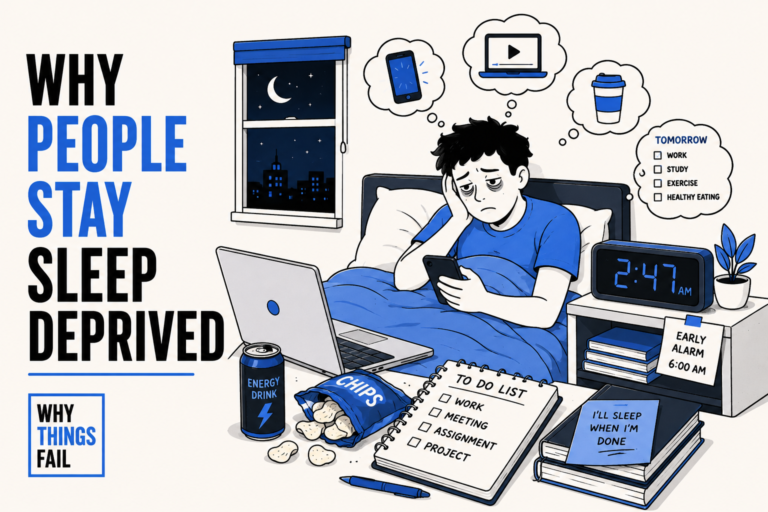
A person stays awake slightly longer to complete work, watch another episode of a television series or scroll through social media.
The following night the same decision feels harmless.
Gradually bedtime moves later while morning responsibilities remain unchanged.
Sleep debt begins to accumulate.
Fatigue reduces self control, making healthy decisions more difficult.
Caffeine becomes necessary to remain alert during the day.
Stress increases.
Sleep quality declines further.
The cycle repeats until chronic sleep deprivation becomes part of everyday life.
Many people never realise this transition has occurred because it happens gradually rather than suddenly.
Why Do People Stay Sleep Deprived?
The most common explanation is that modern life is simply too busy.
While busy schedules certainly contribute, they do not explain why people consistently sacrifice sleep instead of other activities.
The deeper explanation lies in human behaviour.
People rarely make decisions based only on what benefits them in the future.
Behavioural economists have repeatedly shown that immediate rewards often outweigh future consequences.
Sleep represents one of the clearest examples of this tendency.
Present Bias Prioritises Immediate Rewards
One of the strongest behavioural forces behind chronic sleep deprivation is present bias.
People naturally value rewards available today more than benefits they will experience tomorrow.
Watching another episode provides immediate enjoyment.
Checking messages offers instant social connection.
Finishing another hour of work creates immediate satisfaction.
The benefits of sleeping earlier are delayed.
Improved memory, stronger concentration and better emotional wellbeing become noticeable only over time.
The human brain therefore gives greater importance to activities that produce immediate emotional rewards.
This explains why people repeatedly postpone bedtime even when they know the long term consequences.
Technology Competes Directly With Sleep
Modern technology has transformed evenings into periods of continuous stimulation.
Streaming platforms provide unlimited entertainment.
Social media offers endless novelty.
Online gaming creates excitement and competition.
Smartphones ensure work, conversations and notifications continue long after traditional working hours.
Every notification represents a small psychological reward.
Every new video promises entertainment.
Every message encourages another response.
Behavioural psychologists describe this as a variable reward system.
Because people never know what the next notification might contain, they continue checking their devices.
This makes stopping far more difficult than many realise.
Technology therefore competes directly with sleep by continuously rewarding wakefulness.
Stress Prevents The Brain From Switching Off
Not everyone remains awake because of entertainment.
Many people struggle because their minds remain active long after the day has ended.
Work responsibilities.
Financial concerns.
Relationship problems.
Health worries.
Future uncertainty.
Stress activates the body’s alert systems even when physical activity has ended.
The brain continues analysing problems instead of preparing for rest.
Ironically, the more exhausted people become, the more difficult it often becomes to achieve restorative sleep.
Poor sleep increases stress hormones.
Higher stress further disrupts sleep.
This creates a self reinforcing cycle that becomes increasingly difficult to break.
Social Expectations Reward Being Busy
Modern culture often associates busyness with importance.
Working late is frequently interpreted as dedication.
Sleeping less is sometimes viewed as evidence of ambition.
People proudly describe surviving on minimal sleep as though exhaustion reflects commitment.
These social expectations quietly influence behaviour.
Individuals begin sacrificing sleep not because they enjoy being tired but because they believe productivity requires constant availability.
The incentive system rewards visible effort more than invisible recovery.
Yet sleep itself is one of the foundations of sustained performance.
Ignoring recovery eventually reduces the productivity people are attempting to increase.
Poor Self Regulation Gradually Becomes A Habit
Most people understand they should sleep earlier.
Knowledge is rarely the problem.
The challenge lies in consistently acting on that knowledge.
Every evening involves countless small decisions.
One more email.
One more video.
One more conversation.
One more task.
Individually these choices appear insignificant.
Collectively they reshape daily routines.
Over time, late nights become automatic habits rather than conscious decisions.
People no longer choose sleep deprivation.
They simply continue repeating behavioural patterns that make adequate sleep increasingly unlikely.
The Deeper Cause Is A Conflict Between Biology And Modern Life
At its core, chronic sleep deprivation reflects a conflict between human biology and the modern environment.
The human brain evolved to follow natural cycles of light, darkness and recovery.
Modern society encourages continuous stimulation, constant availability and uninterrupted productivity.
Technology removes natural stopping points.
Work follows people home.
Entertainment never ends.
Communication continues throughout the night.
The result is a system where staying awake is consistently rewarded while sleeping is repeatedly delayed.
For this reason, chronic sleep deprivation should not be viewed as a failure of willpower alone.
It is the predictable outcome of behavioural incentives, technological design and social expectations that continually compete against one of the body’s most fundamental biological needs.
Warning Signs
Sleep deprivation rarely begins with extreme exhaustion. It develops through subtle behavioural changes that gradually become normal.
One warning sign is relying on caffeine simply to function rather than to improve alertness. When coffee or energy drinks become essential for completing ordinary tasks, the body may already be compensating for inadequate sleep.
Another warning sign is feeling mentally tired despite spending enough hours in bed. Poor sleep quality often accompanies chronic sleep deprivation, reducing the brain’s ability to complete the restorative processes required for memory, emotional regulation and learning.
Difficulty concentrating is another early indicator. Small mistakes become more frequent. Simple decisions require greater effort. Tasks that once seemed routine begin taking longer to complete.
Mood changes are equally important. Irritability, impatience and emotional sensitivity often appear long before people recognise the connection with poor sleep. Relationships, workplace performance and overall wellbeing gradually begin to suffer.
Perhaps the most overlooked warning sign is believing that feeling constantly tired is normal. As the brain adapts to chronic sleep restriction, many people lose the ability to accurately judge their own level of impairment. They assume they are functioning well even though cognitive performance has declined significantly.
These warning signs are often ignored because the consequences develop gradually. Unlike an injury, sleep deprivation rarely produces immediate pain. Instead, it slowly reduces physical health, mental clarity and decision making until poor performance becomes accepted as everyday life.
What Could Have Prevented It?
Preventing chronic sleep deprivation requires more than simply going to bed earlier. It requires changing the systems and behaviours that repeatedly compete with sleep.
One important step is recognising sleep as a biological necessity rather than discretionary free time. Recovery should be viewed as an essential component of productivity, not as time taken away from it.
Establishing consistent routines also reduces unnecessary decision making. Regular sleep and wake times help regulate the body’s internal clock, making quality sleep more predictable.
Technology boundaries are equally important. Reducing exposure to smartphones, social media and digital entertainment before bedtime limits unnecessary mental stimulation and decreases the psychological rewards that encourage delayed sleep.
Stress management also plays a central role. Many people attempt to solve complex problems late at night when mental resources are already depleted. Creating space for relaxation, reflection or mindfulness allows the brain to transition more effectively towards rest.
Finally, organisations and society have a responsibility to reconsider the incentives they create. Workplaces that celebrate excessive working hours while ignoring recovery unintentionally encourage behaviours that reduce long term performance.
Sustainable productivity depends on balancing effort with recovery rather than treating them as opposing goals.
Lessons
Sleep deprivation demonstrates that understanding healthy behaviour is not enough to produce healthy behaviour.
The first lesson is that immediate rewards consistently compete with long term wellbeing. Human beings naturally choose activities that provide instant satisfaction even when they understand the future consequences.
The second lesson is that environments influence behaviour more than intentions. When technology, work expectations and social pressures continuously reward staying awake, maintaining healthy sleep requires deliberate effort.
Another lesson is that performance depends on recovery as much as effort. Productivity is not created solely through working longer hours. It is sustained through adequate physical and mental restoration.
Perhaps the most valuable lesson is that small daily decisions shape long term outcomes. Losing one hour of sleep occasionally appears harmless, yet repeating that decision every night gradually creates significant consequences for health, judgement and emotional wellbeing.
Failure Pattern
The dominant pattern behind chronic sleep deprivation is Short Term Thinking reinforced by Poor Self Regulation and Social Incentives.
People consistently choose immediate rewards over delayed benefits. Entertainment, work, social interaction and digital engagement provide instant psychological satisfaction, while the advantages of sleep remain largely invisible until much later.
This behavioural pattern appears in many areas of life. Individuals postpone exercise, delay saving money and neglect preventive healthcare for similar reasons. Immediate gratification repeatedly outweighs future wellbeing.
Sleep deprivation therefore reflects a broader pattern of human decision making rather than a simple failure of discipline.
Hidden Lesson
The greatest cause of chronic sleep deprivation is not a lack of time.
It is the way modern society assigns value to time.
People rarely feel guilty about sacrificing sleep to answer emails, finish work or consume digital entertainment because these activities appear productive or rewarding. Sleep produces no immediate visible result, even though it quietly improves every aspect of physical and mental performance.
The deeper truth is that people often sacrifice the very activity that enables them to think clearly enough to make better decisions.
Failure Scorecard
| Area | Score | Explanation |
| Self Discipline | 5/10 | Many people understand the importance of sleep but struggle to prioritise it consistently. |
| Decision Making | 5/10 | Immediate rewards frequently outweigh long term health considerations. |
| Risk Management | 4/10 | The cumulative health risks of chronic sleep deprivation are often underestimated. |
| Long Term Thinking | 4/10 | Daily choices focus on today’s demands rather than future wellbeing. |
| Health Knowledge | 7/10 | Public awareness of sleep benefits has improved, but behavioural change remains limited. |
| Emotional Control | 5/10 | Stress and anxiety commonly interfere with healthy sleep habits. |
| Planning | 5/10 | Inconsistent routines and poor evening habits reduce sleep quality. |
| Adaptability | 6/10 | Many people eventually adjust habits, but often only after noticeable health or performance declines. |
Key Takeaways
- Chronic sleep deprivation is primarily a behavioural problem rather than a knowledge problem.
- Immediate rewards often outweigh the delayed benefits of adequate sleep.
- Technology has become one of the strongest competitors for human attention during evening hours.
- Stress creates a cycle in which poor sleep increases anxiety and anxiety further reduces sleep quality.
- Small nightly decisions accumulate into significant long term health and cognitive consequences.
- Sustainable productivity depends on balancing effort with recovery.
- Healthy sleep supports better judgement, emotional regulation and long term performance.
- Modern environments frequently reward behaviours that conflict with basic biological needs.
Frequently Asked Questions
Why do people stay sleep deprived even when they know it is unhealthy?
People often prioritise immediate rewards such as work, entertainment or social interaction over the long term benefits of sleep. Behavioural psychology shows that present focused decisions frequently outweigh future health considerations.
What is the biggest cause of chronic sleep deprivation?
The biggest cause is the combination of modern lifestyle demands, digital technology, stress and behavioural habits that repeatedly delay bedtime while morning responsibilities remain unchanged.
Can people adapt to getting less sleep?
People may feel as though they have adapted, but research shows that cognitive performance, reaction time and decision making continue to decline even when tiredness begins to feel normal.
How does sleep deprivation affect decision making?
Lack of sleep reduces attention, weakens emotional control, increases impulsive behaviour and makes it more difficult to evaluate risk accurately. This often leads to poorer personal and professional decisions.
Why is sleep considered essential for productivity?
Sleep supports memory, learning, creativity, emotional regulation and problem solving. Without adequate recovery, the quality of work declines even if the number of hours worked increases.
Conclusion
People remain sleep deprived not because they underestimate the value of sleep but because modern life continually rewards the behaviours that undermine it. Immediate gratification, constant connectivity and social expectations quietly encourage choices that conflict with the body’s biological need for recovery.
Understanding chronic sleep deprivation through the lens of psychology, behavioural economics and systems thinking reveals that the issue extends far beyond bedtime. It reflects how modern environments shape human decisions, often leading people to sacrifice the very foundation of their health, judgement and long term performance.