Introduction
Commitment is one of the most desired aspects of human relationships, yet it is also one of the most misunderstood.
Many people dream of finding a stable relationship, building a family or creating a future with someone they trust. Despite these aspirations, countless relationships end because one person hesitates to commit. Others remain trapped in situationships, avoid serious conversations or repeatedly leave relationships just as they begin to deepen.
At first glance, commitment issues appear to be simple choices. One partner seems unwilling to settle down while the other appears ready for a long term future.
The reality is far more complex.
Fear of commitment is rarely about disliking relationships. More often, it reflects deeper psychological patterns shaped by childhood experiences, emotional learning, previous relationships and perceptions of risk.
Understanding why people fear commitment matters because the consequences extend beyond romantic relationships. Commitment influences friendships, careers, business partnerships and personal growth. The inability to commit often creates repeated cycles of uncertainty, emotional distress and missed opportunities.
The question is not simply why someone avoids commitment.
The more important question is why commitment feels threatening to some people even when they genuinely desire love and stability.
What Is Fear Of Commitment?
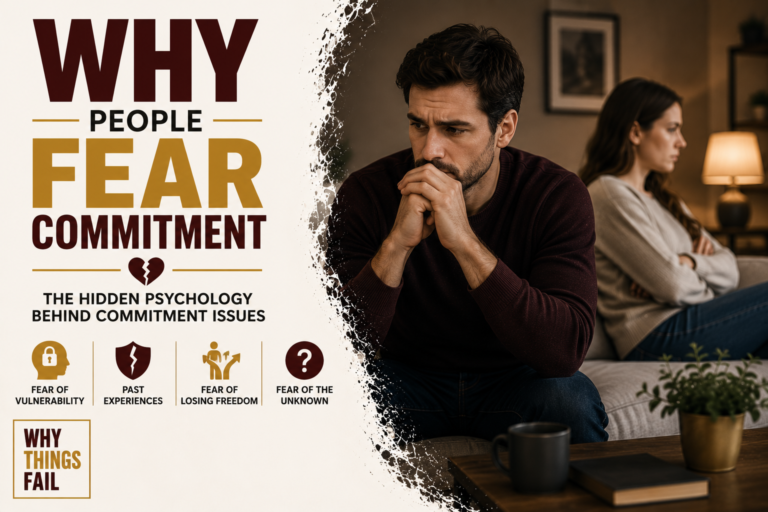
Fear of commitment is the persistent difficulty in making or maintaining long term emotional, personal or relational commitments despite wanting meaningful connection.
It does not necessarily mean someone avoids relationships altogether.
Many people with commitment concerns enjoy dating, companionship and emotional intimacy during the early stages of a relationship. The difficulty often appears when the relationship begins requiring permanence, vulnerability or shared responsibility.
Commitment therefore represents more than agreeing to stay together.
It symbolises trust, emotional dependence, uncertainty about the future and the possibility of disappointment.
For some individuals, these emotional risks feel greater than the potential rewards.
The Biggest Myth
The most common belief is that people fear commitment because they have not found the right partner.
While relationship compatibility certainly matters, this explanation rarely tells the full story.
Many individuals who struggle with commitment have experienced healthy relationships with caring partners. Others repeatedly leave relationships despite expressing genuine love and affection.
The underlying issue is often internal rather than external.
Commitment does not simply require choosing another person.
It requires accepting uncertainty, emotional vulnerability and the possibility of future pain.
Behavioural psychology suggests that people naturally avoid situations they associate with emotional loss. If previous experiences taught someone that closeness leads to rejection, conflict or disappointment, commitment may feel psychologically dangerous even when the relationship itself is healthy.
The problem is therefore not always the partner.
It is often the meaning the individual attaches to commitment itself.
What Usually Happens?
Fear of commitment rarely appears at the beginning of a relationship.
The early stages often feel exciting because expectations remain flexible and emotional obligations are relatively low.
As emotional intimacy grows, conversations begin changing.
Partners discuss exclusivity.
Future plans become more serious.
Families become involved.
Long term expectations emerge.
For someone who fears commitment, these developments increase emotional pressure.
Communication may become inconsistent.
Small disagreements become reasons to question the relationship.
Attention shifts towards perceived imperfections.
Some people withdraw emotionally.
Others end the relationship unexpectedly despite previously expressing strong feelings.
Although these behaviours appear irrational to the other partner, they often reflect an attempt to reduce emotional discomfort rather than a lack of affection.
The relationship becomes a source of anxiety instead of security.
Why Does It Happen?
Understanding commitment issues requires looking beneath visible behaviour.
Ending relationships, avoiding labels or hesitating about the future are not root causes.
They are symptoms.
The deeper causes usually involve psychological learning, emotional experiences and behavioural patterns that developed long before the current relationship began.
Fear Of Emotional Vulnerability
Commitment requires emotional openness.
It asks people to trust another person with their thoughts, insecurities and future expectations.
For individuals who have experienced betrayal, abandonment or emotional neglect, vulnerability feels risky rather than comforting.
Psychologists describe vulnerability as a willingness to accept emotional uncertainty.
This uncertainty creates discomfort because no relationship can guarantee permanent security.
Rather than risking future emotional pain, some individuals choose emotional distance.
Avoiding commitment becomes a protective strategy rather than a rejection of love.
Ironically, the behaviour designed to prevent emotional pain often creates the loneliness it was trying to avoid.
Attachment Styles Shape Adult Relationships
Research in attachment theory suggests that early childhood relationships strongly influence adult emotional behaviour.
Children who experience consistent emotional support often develop secure attachment.
They generally view relationships as safe and dependable.
Others grow up in environments where affection is inconsistent, unpredictable or emotionally unavailable.
These experiences may contribute to avoidant or anxious attachment patterns.
Adults with avoidant attachment frequently value independence above emotional closeness.
Commitment may feel like losing personal freedom rather than gaining emotional security.
Those with anxious attachment often desire commitment while simultaneously fearing rejection.
This creates confusing relationship dynamics where people seek closeness but struggle to believe it will last.
The attachment style itself is not destiny.
It simply provides a framework through which future relationships are interpreted.
Fear Of Losing Personal Freedom
Another common reason people avoid commitment is the belief that relationships reduce independence.
Some individuals associate commitment with sacrifice rather than partnership.
They worry that serious relationships will limit career opportunities, personal ambitions, friendships or individual identity.
Behavioural economists explain this through loss aversion.
People naturally focus more on what they believe they might lose than on what they could gain.
Commitment therefore becomes framed as giving something up instead of building something meaningful.
The perceived loss of freedom often outweighs the potential emotional benefits, even when those fears are exaggerated.
Perfectionism Creates Impossible Standards
Some people delay commitment because they continually search for certainty.
They believe the perfect relationship should exist without conflict, doubt or compromise.
Every disagreement becomes evidence that the relationship is not right.
Every flaw becomes a reason to continue searching.
This perfectionist mindset creates an endless cycle of comparison.
Modern dating applications and social media intensify this behaviour by creating the impression that better opportunities are always available.
Psychologists sometimes refer to this as the paradox of choice.
When options appear unlimited, making one meaningful commitment becomes increasingly difficult because every decision seems to involve giving up countless alternatives.
Previous Relationship Trauma Changes Future Decisions
Painful experiences often shape future expectations more strongly than positive ones.
Someone who has experienced infidelity, manipulation, emotional abuse or sudden abandonment may begin expecting similar outcomes in future relationships.
The brain attempts to protect itself by recognising perceived threats before they occur.
Unfortunately, this protective mechanism can become overactive.
Instead of evaluating each relationship independently, previous experiences influence present decisions.
Trust becomes more difficult.
Emotional investment feels dangerous.
Commitment becomes associated with repeating past pain rather than creating future stability.
Social Expectations And Modern Dating Culture
Commitment decisions do not occur in isolation.
Family expectations, cultural values, social media and changing relationship norms all influence behaviour.
Modern dating encourages constant comparison.
People are regularly exposed to carefully curated images of seemingly perfect relationships while simultaneously hearing stories of divorce, betrayal and failed marriages.
This creates conflicting incentives.
Society celebrates lasting relationships while continuously reminding people of the risks involved.
As a result, some individuals postpone commitment while waiting for absolute certainty.
The difficulty is that certainty rarely exists in human relationships.
Meaningful commitment has always required accepting a degree of uncertainty alongside trust, communication and shared growth.
Warning Signs
Fear of commitment rarely appears without warning. The signs usually emerge gradually as relationships become more serious and emotional expectations increase.
One common warning sign is repeatedly delaying important relationship decisions. Conversations about exclusivity, living together, marriage or future planning are postponed without clear reasons. The delay creates the illusion that more time will solve the uncertainty, when in reality the underlying fear remains unchanged.
Another warning sign is constantly finding faults in a partner once the relationship becomes emotionally secure. Small imperfections suddenly appear significant enough to question the entire relationship. This behaviour often reflects an unconscious attempt to create emotional distance rather than genuine incompatibility.
Some people also become emotionally inconsistent. They appear deeply affectionate one week and emotionally unavailable the next. This inconsistency confuses their partner because the relationship alternates between closeness and withdrawal.
Another indicator is keeping one foot outside the relationship. People may avoid introducing their partner to family, hesitate to make long term plans or maintain emotional distance by refusing to discuss the future.
Perhaps the strongest warning sign is believing that uncertainty will eventually disappear. Many people wait for complete confidence before committing, yet healthy relationships rarely begin with absolute certainty. They grow through trust, communication and shared experiences.
These warning signs are often ignored because they are mistaken for caution, independence or simply taking things slowly. In many cases they represent unresolved psychological fears rather than thoughtful decision making.
What Could Have Prevented It?
Fear of commitment cannot be prevented by finding the perfect partner because the deeper causes usually exist long before the relationship begins.
The first step is developing self awareness. People who understand their attachment patterns, emotional triggers and previous relationship experiences are better able to recognise how these factors influence present decisions.
Learning to separate past experiences from present relationships is equally important. Every relationship involves uncertainty, but previous disappointments should not automatically define future expectations.
Healthy communication also reduces unnecessary fear. Honest conversations about expectations, boundaries and concerns create emotional safety instead of allowing assumptions to grow unchecked.
Another important factor is accepting that commitment always involves risk. There is no relationship without uncertainty because people, circumstances and life itself continue changing over time.
Rather than seeking guarantees, emotionally healthy individuals learn to make thoughtful decisions despite uncertainty. This shift from searching for certainty to developing resilience fundamentally changes how commitment is viewed.
Supportive family environments, emotionally secure relationships and greater psychological education can also reduce commitment anxiety by helping people understand that vulnerability is not weakness but an essential part of meaningful human connection.
Lessons
Fear of commitment teaches lessons that extend beyond romantic relationships.
The first lesson is that people rarely avoid commitment because they dislike love. They avoid the emotional risks they associate with love.
Another lesson is that human behaviour is shaped more by previous experiences than by present circumstances. Emotional patterns developed years earlier often continue influencing decisions until they are consciously recognised.
The article also highlights the importance of emotional intelligence. Understanding personal fears, attachment styles and behavioural biases allows people to respond thoughtfully instead of reacting automatically.
Perhaps the most important lesson is that certainty is not the foundation of healthy relationships.
Trust is.
Waiting for perfect certainty often delays opportunities for meaningful connection because certainty is something relationships gradually build rather than something they provide at the beginning.
Failure Pattern
The dominant pattern behind fear of commitment is Emotional Decision Making driven by Fear of Vulnerability and Short Term Emotional Protection.
This pattern appears repeatedly because the human brain naturally prioritises avoiding emotional pain over pursuing long term fulfilment.
Individuals who fear commitment often experience temporary relief by avoiding serious relationships. Unfortunately this relief reinforces avoidance behaviour, making future commitment increasingly difficult.
The same behavioural pattern appears outside romantic relationships.
Entrepreneurs delay business decisions because they fear failure.
Employees avoid career opportunities because they fear greater responsibility.
Investors hesitate during uncertain markets because they fear temporary losses.
In each situation, short term emotional comfort comes at the expense of long term growth.
The behaviour changes.
The psychological mechanism remains remarkably similar.
Hidden Lesson
The deepest truth about commitment is that people rarely fear commitment itself.
They fear what commitment represents.
Commitment requires vulnerability.
Vulnerability creates uncertainty.
Uncertainty exposes the possibility of rejection, disappointment and emotional loss.
Avoiding commitment therefore becomes an attempt to control uncertainty.
The irony is that avoiding uncertainty often produces the very loneliness, instability and emotional dissatisfaction people hoped to escape.
The greatest barrier to commitment is rarely another person.
It is the story someone continues telling themselves about what commitment will cost.
Failure Scorecard
| Area | Score | Explanation |
| Emotional Awareness | 4/10 | Many people struggle to recognise how past experiences influence present relationships. |
| Decision Making | 5/10 | Important relationship decisions are often influenced by fear rather than objective judgement. |
| Risk Management | 4/10 | Emotional risks are frequently overestimated while the cost of avoiding commitment is underestimated. |
| Long Term Thinking | 5/10 | Immediate emotional comfort often takes priority over lasting relationship stability. |
| Relationship Knowledge | 6/10 | Many understand relationships intellectually but find emotional application difficult. |
| Emotional Control | 4/10 | Anxiety and vulnerability frequently influence behaviour during serious relationships. |
| Planning | 5/10 | Future conversations are often delayed because uncertainty feels uncomfortable. |
| Adaptability | 6/10 | Personal growth becomes possible once emotional patterns are recognised and challenged. |
Key Takeaways
- Fear of commitment is usually rooted in psychology rather than lack of love.
- Attachment styles strongly influence adult relationship behaviour.
- Vulnerability often feels dangerous because of previous emotional experiences.
- Perfectionism creates unrealistic expectations that no relationship can satisfy.
- Modern dating culture increases comparison and fear of making permanent decisions.
- Emotional avoidance provides temporary comfort but often creates long term dissatisfaction.
- Self awareness is essential for recognising behavioural patterns that repeat across relationships.
- Healthy commitment depends on trust, communication and emotional resilience rather than certainty.
Frequently Asked Questions
Why do people fear commitment even when they are in love?
Love and commitment are not identical. Someone may genuinely love another person while still fearing vulnerability, emotional dependence or the possibility of future loss.
Is fear of commitment a psychological condition?
Fear of commitment is not usually a mental disorder. It is more commonly linked to attachment patterns, previous experiences, personality traits and emotional learning.
Can commitment issues be overcome?
Yes. Greater self awareness, healthy communication, emotional reflection and understanding attachment patterns can help individuals develop more secure relationship behaviours over time.
Does childhood affect commitment in adulthood?
Research suggests that early relationships with parents and caregivers influence attachment styles, trust and emotional security, all of which can affect adult commitment.
Is fear of commitment the same as fear of marriage?
No. Fear of commitment is broader than marriage. It can influence emotional intimacy, exclusive relationships, career decisions, friendships and other long term responsibilities.
Conclusion
People rarely fear commitment because they reject love or meaningful relationships. More often, they fear the uncertainty, vulnerability and emotional exposure that genuine commitment requires. What appears to be hesitation is frequently a protective response shaped by past experiences rather than present reality.
Understanding these psychological patterns changes the conversation completely. Fear of commitment is not simply a relationship problem. It is a reflection of how human beings balance safety against connection, revealing that the greatest obstacle to lasting commitment often exists within the mind long before it appears within the relationship.