Quick Answer
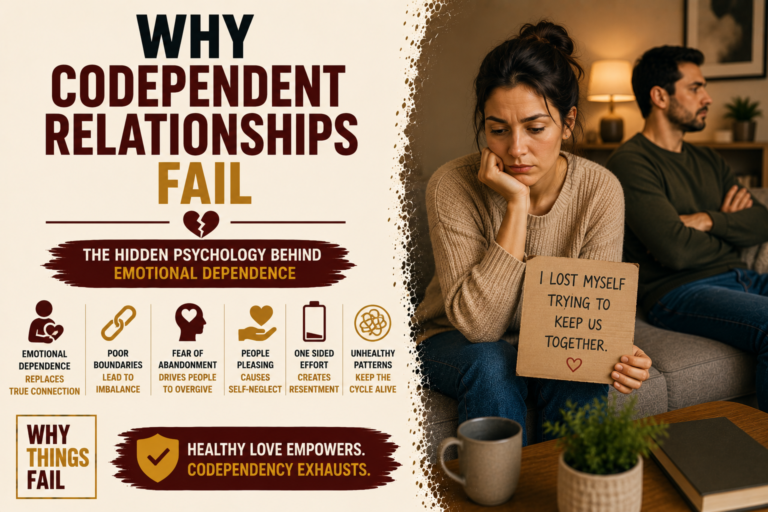
Codependent relationships fail because they rely on emotional dependence rather than mutual respect. Over time, poor boundaries, fear of abandonment, people pleasing, unhealthy attachment and emotional imbalance create a relationship where one person gives too much while the other becomes increasingly dependent. The relationship eventually collapses under emotional pressure instead of growing through trust and healthy independence.
Codependency is a relationship pattern in which one partner’s sense of identity and emotional stability becomes dependent on caring for, pleasing or rescuing the other. It is not simply “loving someone a lot” it is a learned behavioural pattern, often rooted in attachment theory, where self-worth gets tied to being needed.
Introduction
Many relationships do not end because love disappears.
They end because the relationship slowly becomes emotionally unsustainable.
At first, codependent relationships often appear deeply loving. One partner constantly supports the other. Sacrifices are made willingly. Emotional closeness feels intense. Friends and family may even describe the relationship as devoted or inseparable.
Yet beneath this appearance lies a very different reality.
One person’s identity gradually becomes dependent on meeting another person’s emotional needs. Personal boundaries weaken. Individual happiness becomes tied to another person’s approval, behaviour or wellbeing.
Over time, the relationship shifts from partnership to emotional dependency.
This transformation rarely happens overnight.
It develops gradually, through hundreds of small decisions, repeated emotional patterns and unspoken expectations that slowly replace healthy connection with unhealthy attachment.
Understanding why codependent relationships fail requires looking beyond arguments, breakups and emotional conflict.
The deeper causes are found in human psychology, attachment, childhood experiences, emotional regulation and behavioural patterns that often remain invisible until the relationship begins to collapse.
What Is A Codependent Relationship?
A codependent relationship is one in which emotional balance becomes unequal.
One partner consistently prioritises the needs, emotions and happiness of the other while neglecting their own wellbeing.
The other partner gradually becomes accustomed to receiving emotional support without developing the same level of personal responsibility or emotional independence.
This imbalance creates an unhealthy relationship dynamic.
The relationship no longer functions through mutual respect and shared responsibility.
Instead, it depends upon one person rescuing, fixing, pleasing or emotionally carrying the other.
Not every caring relationship is codependent.
Supporting a partner during difficult times is part of a healthy relationship.
Codependency begins when helping becomes an identity rather than a choice.
Instead of asking,
“What does our relationship need?”
The focus quietly becomes,
“What must I do to prevent this person from leaving, becoming upset or rejecting me?”
That shift changes the entire emotional foundation of the relationship.
The Biggest Myth
The most common misunderstanding is that codependency simply means loving someone too much.
This belief is misleading.
Healthy love encourages both people to grow.
Codependency often prevents growth.
Love creates security.
Codependency creates dependence.
Love respects individuality.
Codependency gradually removes it.
People frequently mistake constant sacrifice for commitment.
Society often praises individuals who always place others first, particularly within families and romantic relationships.
While generosity strengthens healthy relationships, sacrificing personal wellbeing to maintain another person’s emotional stability creates an unhealthy system.
The issue is not excessive love.
The issue is losing oneself in the process of loving someone else.
What Usually Happens?
Most codependent relationships follow a recognisable pattern.
One partner naturally takes on the role of caregiver, rescuer or problem solver.
The other becomes increasingly dependent upon that support.
As the relationship continues, responsibilities become emotionally unequal.
One person constantly gives reassurance, solves problems and manages conflict.
The other gradually relies upon that emotional labour.
At first, both partners may feel satisfied.
One feels needed.
The other feels protected.
Over time, however, the imbalance becomes exhausting.
Resentment quietly replaces appreciation.
Dependence replaces intimacy.
Emotional pressure increases until one or both partners begin withdrawing from the relationship.
The breakup often appears sudden.
The underlying causes have usually been developing for years.
Why Do Codependent Relationships Fail?
This is where the investigation begins.
Most people believe relationships fail because couples stop communicating or fall out of love.
These factors may contribute, but they rarely explain why emotionally dependent relationships repeatedly follow similar patterns.
The deeper explanation lies within human behaviour.
Relationships are emotional systems.
When one part of the system becomes unbalanced, the entire relationship gradually loses stability.
Codependency develops because certain psychological needs are temporarily satisfied.
Eventually those same patterns begin creating emotional harm.
H3 Fear Of Abandonment Creates Emotional Dependence
One of the strongest drivers of codependency is the fear of abandonment.
Many individuals develop a deep fear of rejection long before entering adult relationships.
Childhood experiences such as inconsistent parenting, emotional neglect, unpredictable affection or family conflict may teach someone that love feels uncertain.
As adults, they begin seeking constant reassurance.
Keeping the relationship becomes more important than maintaining healthy boundaries.
They avoid disagreement.
They suppress their own needs.
They apologise even when they have done nothing wrong.
Their behaviour is not driven by weakness.
It is driven by anxiety.
The relationship becomes a source of emotional security rather than emotional connection.
Ironically, this constant fear of losing the relationship often creates the emotional pressure that eventually damages it.
This pattern aligns with attachment research popularised by relationship experts such as the Gottman Institute, which links early emotional inconsistency to adult reassurance-seeking behaviour.
H3 People Pleasing Replaces Authentic Communication
People pleasing is frequently misunderstood as kindness.
Behavioural psychology suggests something more complex.
Many people pleasers are not simply trying to make others happy.
They are attempting to avoid conflict, rejection or emotional discomfort.
This creates a relationship where honesty slowly disappears.
Needs remain unspoken.
Disappointment remains hidden.
Personal boundaries become increasingly flexible.
From the outside, the relationship appears peaceful.
Internally, emotional frustration continues growing.
Healthy relationships require honest communication.
Codependent relationships often replace honesty with emotional accommodation.
Eventually one partner feels emotionally invisible because their own identity has been sacrificed in order to maintain harmony.
H3 Identity Becomes Attached To Being Needed
Perhaps the most overlooked reason codependent relationships fail is identity.
Some individuals develop their self worth through helping others.
Being needed provides purpose.
Solving problems creates emotional validation.
Supporting another person becomes the primary source of self esteem.
Initially this appears generous.
Over time it becomes psychologically fragile.
When the other partner becomes more independent, the caregiver may experience confusion, insecurity or emotional loss.
Their identity depended upon being essential.
Without someone to rescue, they struggle to understand their own value.
The relationship therefore becomes less about mutual connection and more about preserving personal identity.
H3 Emotional Responsibility Becomes Unequal
Healthy relationships encourage shared emotional responsibility.
Each partner manages their own emotions while supporting one another.
Codependency quietly changes this balance.
One partner begins feeling responsible for the other’s happiness, confidence, stress and emotional wellbeing.
Every disagreement feels like a personal failure.
Every bad mood becomes something to fix.
Every emotional setback becomes their responsibility.
This creates emotional exhaustion.
No individual can successfully regulate another person’s emotional life indefinitely.
Eventually burnout replaces compassion.
What once felt like love begins feeling like obligation.
The relationship weakens because emotional responsibility was never shared equally.
H3 Attachment Patterns Shape Adult Relationships
Attachment theory, developed from research on how early caregiving shapes emotional bonding, provides another important explanation.
Individuals with anxious attachment often seek continuous reassurance because uncertainty feels emotionally threatening.
Those with avoidant attachment may withdraw when relationships become emotionally intense.
When these attachment styles interact, a destructive cycle often develops.
The more one partner pursues reassurance, the more the other withdraws.
The more withdrawal occurs, the greater the anxiety becomes.
Neither person intentionally creates conflict.
Each responds according to deeply learned emotional patterns.
Without recognising these attachment dynamics, couples often mistake predictable psychological responses for evidence that the relationship itself is failing.
Warning Signs
Codependent relationships rarely collapse without warning. The challenge is that many warning signs are mistaken for proof of love rather than evidence of emotional imbalance.
One of the earliest signs is losing personal identity. Hobbies, friendships, career goals and individual interests gradually disappear because one partner becomes completely focused on the relationship. Life begins revolving around another person’s needs instead of maintaining a healthy balance.
Another warning sign is feeling responsible for another person’s emotions. If one partner believes they must constantly prevent disappointment, anger or sadness, emotional responsibility has become unequal. No relationship can remain healthy when one person carries the emotional weight of two people.
Difficulty setting boundaries is another clear indicator. Saying no creates guilt. Expressing personal needs feels selfish. Avoiding conflict becomes more important than honest communication. Over time, unspoken resentment quietly replaces genuine intimacy.
Constant reassurance seeking also signals deeper emotional insecurity. A relationship built upon repeated validation rather than mutual trust gradually becomes emotionally exhausting for both partners.
Perhaps the most overlooked warning sign is confusing emotional intensity with emotional health. Frequent emotional highs and lows may feel passionate, but healthy relationships are built upon stability, trust and respect rather than constant emotional crisis.
These warning signs are often ignored because they provide temporary emotional comfort. Being needed creates purpose. Being protected creates security. The long term emotional cost remains hidden until the relationship becomes increasingly difficult to sustain.
What Could Have Prevented It?
Most codependent relationships cannot be prevented by loving each other more.
They are strengthened by creating healthier emotional systems.
The first step is recognising that each individual remains responsible for managing their own emotions. Partners can provide support, encouragement and compassion, but they cannot become responsible for another person’s emotional wellbeing.
Healthy boundaries are equally important. Boundaries do not weaken relationships. They protect them by allowing both individuals to maintain their own identity while remaining emotionally connected.
Self awareness also plays a central role. Understanding personal attachment patterns, childhood experiences and emotional triggers helps individuals recognise behaviours before they become destructive. Many codependent patterns develop automatically because they were learned long before adulthood.
Open communication creates another layer of protection. Discussing expectations, responsibilities and emotional needs honestly prevents assumptions from quietly shaping the relationship. Difficult conversations often reduce future conflict because they replace emotional guessing with mutual understanding.
Finally, healthy relationships encourage interdependence rather than dependence. Both people remain emotionally connected while preserving personal responsibility, individual growth and independent decision making.
Lessons
Codependent relationships reveal lessons that extend far beyond romantic partnerships.
The first lesson is that love cannot replace emotional health. Deep affection does not compensate for poor boundaries, unresolved insecurity or unhealthy attachment patterns.
Another lesson is that helping someone should remain a choice rather than an identity. Relationships become stronger when support flows naturally between two emotionally responsible individuals instead of depending upon one permanent caregiver.
The investigation also demonstrates that emotional security comes from within rather than from another person. Individuals who depend entirely upon external reassurance often experience greater anxiety despite receiving constant support.
Perhaps the most valuable lesson is that healthy relationships balance connection with independence. Emotional closeness becomes sustainable only when both individuals retain their own identity, purpose and capacity for personal growth.
Failure Pattern
The dominant pattern behind codependent relationship failure is Poor Emotional Boundaries combined with Fear of Abandonment.
This pattern appears repeatedly because emotional insecurity encourages behaviours that temporarily reduce anxiety while gradually weakening the relationship.
Fear encourages people pleasing.
People pleasing weakens boundaries.
Weak boundaries create emotional dependence.
Emotional dependence increases pressure on both partners.
Eventually the relationship becomes emotionally exhausting rather than emotionally supportive.
The same behavioural pattern appears in friendships, family relationships, workplaces and even business partnerships. Whenever one person’s identity becomes dependent upon meeting another person’s emotional needs, long term balance becomes increasingly difficult to maintain.
Hidden Lesson
The greatest threat to a relationship is not conflict.
It is losing the ability to exist as two emotionally healthy individuals.
Codependent relationships often fail because partners become so focused on preserving the relationship that they neglect the personal growth required to sustain it.
The deeper truth is that relationships are strongest when neither person needs the other to complete their identity. Love becomes healthier when it is built upon choice instead of emotional dependence.
Failure Scorecard
| Area | Score | Explanation |
| Emotional Boundaries | 3/10 | Personal needs are frequently sacrificed to maintain emotional harmony. |
| Decision Making | 5/10 | Decisions often prioritise avoiding conflict rather than addressing underlying problems. |
| Emotional Regulation | 4/10 | One partner frequently becomes responsible for managing both people’s emotions. |
| Long Term Thinking | 5/10 | Immediate emotional comfort often outweighs long term relationship health. |
| Self Awareness | 6/10 | Many individuals recognise problems only after unhealthy patterns become deeply established. |
| Emotional Independence | 3/10 | Personal identity becomes increasingly dependent upon the relationship. |
| Communication | 5/10 | Honest conversations are often replaced by people pleasing and emotional avoidance. |
| Adaptability | 6/10 | Relationships improve when unhealthy patterns are recognised and intentionally changed. |
Key Takeaways
- Codependency is rooted in emotional dependence rather than genuine intimacy.
- Fear of abandonment often drives unhealthy relationship behaviours.
- People pleasing can damage relationships by replacing honest communication.
- Healthy boundaries strengthen relationships rather than weaken them.
- Emotional responsibility should be shared instead of carried by one partner.
- Attachment patterns strongly influence adult relationship dynamics.
- Sustainable love requires both connection and personal independence.
- Long term relationship health depends upon emotional maturity rather than emotional intensity.
Frequently Asked Questions
Why do codependent relationships usually fail?
They usually fail because emotional dependence gradually replaces mutual respect. One partner becomes emotionally responsible for the other, creating exhaustion, resentment and an unhealthy imbalance.
Can a codependent relationship become healthy?
Yes. Change is possible when both partners recognise unhealthy patterns, establish clear boundaries, improve communication and take responsibility for managing their own emotions.
What causes someone to become codependent?
Codependency often develops through childhood experiences, anxious attachment, fear of abandonment, low self esteem or environments where love was linked to caregiving or self sacrifice.
Is codependency the same as love?
No. Love encourages trust, respect and personal growth. Codependency is based on emotional reliance, fear of losing the relationship and difficulty maintaining healthy boundaries.
What is the biggest warning sign of codependency?
One of the strongest warning signs is believing that another person’s happiness, emotions or life choices are entirely your responsibility.
Conclusion
Codependent relationships rarely fail because two people stop caring for one another. They fail because emotional dependence quietly replaces emotional partnership until the relationship can no longer support the weight of unequal responsibility.
Understanding these patterns reveals that lasting relationships are not sustained by sacrifice alone. They endure when two emotionally healthy individuals choose to grow together without losing themselves in the process.