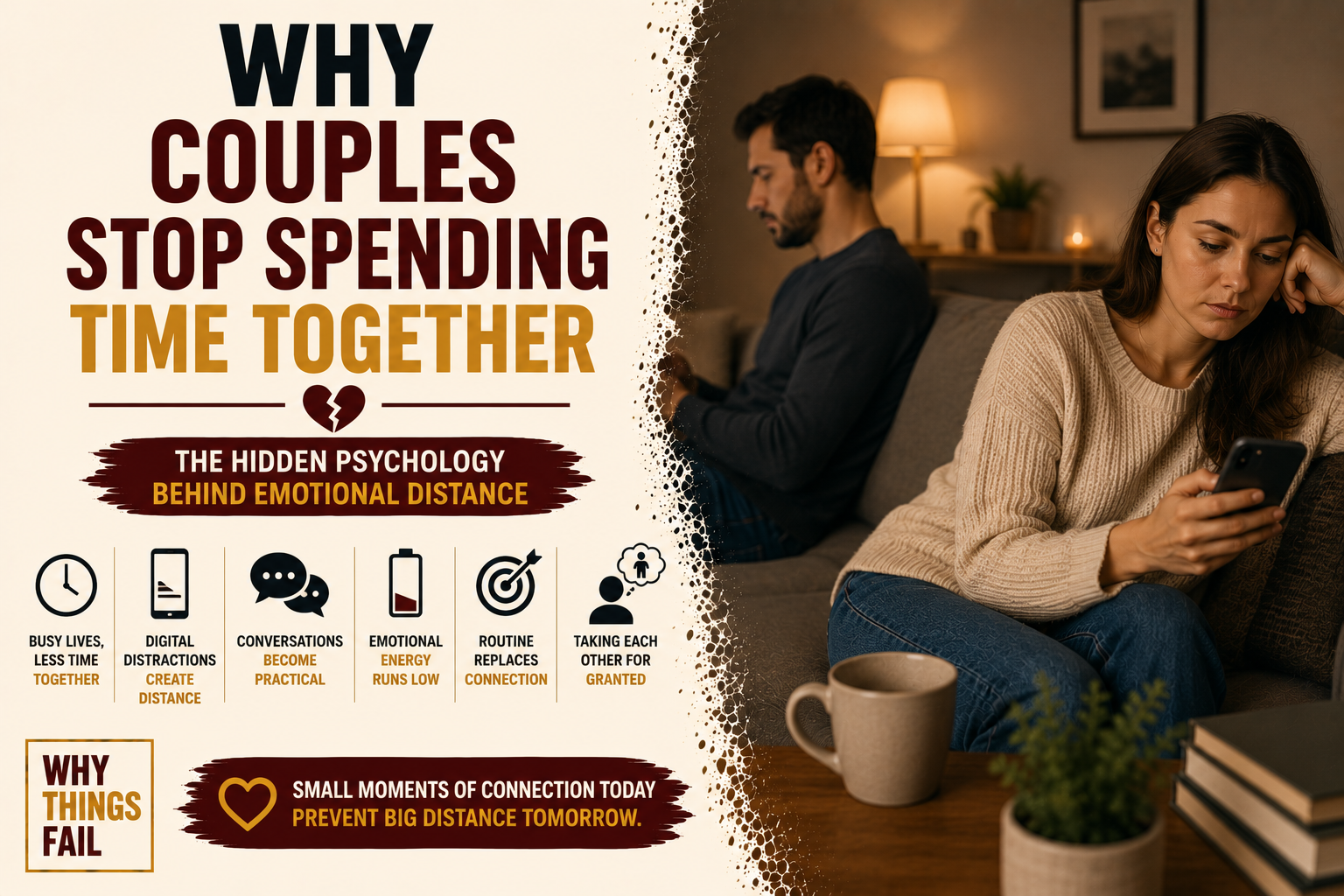

Quick Answer
Couples stop having meaningful conversations because emotional safety gradually declines, routines replace curiosity and unresolved issues remain unspoken. Over time, small communication habits become deeply rooted behavioural patterns, making silence feel easier than vulnerability.
Introduction
Every healthy relationship begins with conversation.
Two people spend hours learning about each other’s dreams, fears, values and experiences. Conversations flow naturally because curiosity is high and emotional connection feels effortless.
Yet many long term relationships experience a gradual shift.
The conversations become shorter.
Questions become practical.
Silences become more common.
Instead of discussing thoughts, ambitions and emotions, couples begin talking almost exclusively about responsibilities, children, work schedules, bills or household tasks.
From the outside, the relationship may appear stable.
Inside, something important has changed.
Meaningful conversation has slowly disappeared.
This matters because communication is not simply how couples exchange information. It is how they maintain emotional intimacy, resolve conflict and understand each other’s changing identities.
When meaningful conversations disappear, emotional distance often follows.
The important question is not why couples argue.
It is why they eventually stop talking about what truly matters.
The answer is far more complex than poor communication skills alone.
It involves psychology, emotional safety, behavioural patterns, changing priorities and the gradual decisions that reshape relationships over many years.
What Is Meaningful Conversation?
Meaningful conversation is often confused with frequent conversation.
The two are not the same.
Many couples speak every day.
They discuss shopping lists, family responsibilities, work commitments and daily routines.
Communication exists.
Connection does not.
Meaningful conversations involve emotional openness, curiosity and mutual understanding.
They allow both people to express concerns, hopes, disappointments, personal growth and changing perspectives without fear of judgement.
These conversations strengthen trust because they create emotional visibility.
Each partner feels seen rather than simply heard.
The absence of meaningful conversation therefore represents more than reduced communication.
It represents a gradual decline in emotional intimacy.
The Biggest Myth
The most common belief is that couples stop having meaningful conversations because they no longer love each other.
This explanation is appealing because it is simple.
It is also incomplete.
Many couples continue loving one another while struggling to communicate deeply.
Love and communication are related.
They are not identical.
Behavioural psychologists have found that emotional habits often become automatic over time.
Partners who once shared everything gradually become focused on solving practical problems.
They stop asking thoughtful questions because they assume they already know each other.
Curiosity quietly disappears.
When curiosity disappears, meaningful conversation often disappears with it.
The relationship becomes efficient.
It no longer feels emotionally exploratory.
This explains why some couples report feeling lonely despite spending every day together.
The issue is rarely the absence of words.
It is the absence of emotional discovery.
What Usually Happens?
The process is rarely dramatic.
It usually develops slowly.
A demanding career reduces available time.
Children require constant attention.
Stress increases.
Fatigue becomes normal.
Meaningful conversations are postponed until tomorrow.
Tomorrow becomes next week.
Next week becomes next month.
Eventually, practical discussions replace emotional ones.
Neither partner consciously decides to stop connecting.
Instead, both adapt to routines that gradually reward efficiency over intimacy.
The relationship continues functioning.
The emotional connection quietly weakens.
Why Do Couples Stop Having Meaningful Conversations?
This question reveals the deeper investigation.
Communication rarely disappears because couples forget how to speak.
It changes because human behaviour changes under pressure.
Relationships evolve within systems shaped by stress, responsibilities, expectations and emotional experiences.
The conversations people have are often a reflection of the emotional environment they live in.
When that environment changes, communication changes with it.
Emotional Safety Gradually Declines
Meaningful conversations require emotional safety.
People willingly express vulnerable thoughts only when they believe those thoughts will be respected rather than criticised.
This sense of safety is not created once.
It must be maintained repeatedly.
Small experiences gradually shape it.
A concern dismissed.
A feeling criticised.
A mistake repeatedly mentioned during arguments.
An emotional confession ignored.
None of these moments appears significant on its own.
Together, they quietly teach one partner that vulnerability carries emotional risk.
As emotional safety declines, conversations become increasingly cautious.
People begin filtering their thoughts before speaking.
Eventually, silence feels safer than honesty.
The relationship may remain peaceful on the surface while emotional intimacy slowly disappears beneath it.
Familiarity Reduces Curiosity
One of the most overlooked psychological changes in long term relationships is the decline of curiosity.
At the beginning of a relationship, partners constantly ask questions because everything feels new.
Over time, familiarity creates the illusion that there is nothing left to discover.
People assume they already know their partner’s opinions, dreams and concerns.
Human beings, however, never stop changing.
Careers evolve.
Values mature.
Life experiences reshape priorities.
Personal ambitions develop.
When curiosity disappears, partners stop noticing these changes.
Meaningful conversations become repetitive because both people continue interacting with outdated versions of each other rather than recognising who they are becoming.
Emotional Fatigue Limits Deep Conversations
Modern relationships operate within environments filled with constant mental demands.
Work pressures.
Financial responsibilities.
Parenting.
Digital distractions.
Household responsibilities.
Each consumes emotional energy.
Psychologists describe emotional energy as a limited resource.
After spending an entire day making decisions, solving problems and managing responsibilities, many people simply lack the mental capacity required for thoughtful conversations.
Practical discussions demand relatively little emotional effort.
Meaningful conversations require attention, patience, empathy and reflection.
When emotional fatigue becomes normal, practical communication naturally replaces emotional communication.
The relationship becomes operational rather than relational.
Conflict Avoidance Creates Emotional Distance
Many couples believe avoiding disagreement protects their relationship.
Initially, this approach appears successful.
Arguments become less frequent.
Daily life feels calmer.
Yet unresolved concerns rarely disappear.
They simply become unspoken.
Behavioural psychology suggests that avoiding uncomfortable conversations often increases emotional distance because important issues remain unresolved.
Each avoided discussion creates another invisible barrier.
Eventually, partners stop discussing not only conflicts but also hopes, fears and disappointments.
Silence gradually becomes the preferred method of maintaining harmony.
The relationship experiences fewer arguments.
It also experiences less emotional intimacy.
Technology Changes Attention More Than Communication
Many people blame smartphones for poor communication.
Technology is certainly influential.
Its deeper impact, however, lies in attention rather than conversation itself.
Meaningful conversations require sustained focus.
Notifications interrupt that focus.
Social media competes for attention.
Streaming platforms reduce opportunities for shared reflection.
Instead of ending the day discussing experiences, many couples end it consuming separate digital content.
Technology does not eliminate communication.
It fragments the uninterrupted attention that meaningful conversation requires.
Over months and years, these small interruptions reshape relationship habits in ways that often go unnoticed.
Assumptions Replace Questions
Perhaps the deepest behavioural pattern behind declining communication is assumption.
Partners begin believing they already understand how the other person feels.
Questions become unnecessary.
Listening becomes less intentional.
Interpretation replaces curiosity.
This behavioural shortcut saves time.
It also limits understanding.
People continue growing throughout adulthood.
When couples stop asking meaningful questions, they stop discovering those changes.
The relationship gradually becomes based on memory rather than ongoing understanding.
Meaningful conversation depends not on having all the answers but on remaining genuinely interested in discovering them.
Warning Signs
Meaningful conversations rarely disappear without warning. The signs usually emerge gradually, making them easy to dismiss as temporary changes caused by busy schedules or everyday stress.
One warning sign is when every conversation becomes transactional. Partners speak regularly, but the discussions revolve almost entirely around responsibilities, appointments, finances or children. The relationship remains organised, yet emotional connection quietly fades.
Another warning sign is the loss of curiosity. Questions such as “How are you really feeling?” or “What has been on your mind lately?” become increasingly rare. Conversations rely on assumptions rather than genuine interest.
Emotional withholding is another early indicator. One partner begins keeping disappointments, worries or achievements private because previous attempts to share them felt ignored, criticised or misunderstood. Silence gradually becomes a coping mechanism rather than a conscious choice.
Digital distraction can also become a warning sign. Shared time is replaced by individual screen time, reducing opportunities for uninterrupted conversation. Although couples remain physically together, their attention is directed elsewhere.
Perhaps the clearest warning sign is emotional loneliness despite constant proximity. Couples may spend every day together while feeling increasingly unknown by one another.
These signals are often ignored because daily life continues functioning. The relationship appears stable, making the gradual loss of emotional intimacy difficult to recognise until it becomes deeply established.
What Could Have Prevented It?
The decline of meaningful conversation is rarely prevented through better communication techniques alone. It is prevented by protecting the emotional conditions that make honest conversation possible.
Emotional safety should be treated as a shared responsibility. Partners who respond with empathy rather than judgement encourage openness. Feeling understood creates the confidence needed to discuss uncomfortable thoughts before they develop into lasting resentment.
Intentional curiosity also plays an important role. People continue changing throughout life. Asking thoughtful questions acknowledges that a partner is still growing rather than assuming everything important is already known.
Healthy relationships also require protected time without constant distractions. Meaningful conversations rarely emerge during rushed moments. They develop when attention is fully available and both people feel emotionally present.
Addressing small concerns early prevents emotional distance from becoming permanent. Difficult conversations often feel uncomfortable in the short term, but avoiding them usually creates greater problems later.
Most importantly, couples benefit from viewing communication as an ongoing process rather than something that naturally maintains itself. Emotional connection requires consistent attention, just as physical health requires consistent care.
Lessons
The decline of meaningful conversation reveals lessons that extend beyond relationships.
One lesson is that emotional intimacy depends more on daily habits than dramatic gestures. Small moments of attention, curiosity and empathy gradually strengthen relationships, while repeated emotional neglect gradually weakens them.
Another lesson is that assumptions often become the enemy of understanding. Believing we already know another person reduces the curiosity that meaningful relationships require.
The investigation also shows that silence is not always the absence of communication. Sometimes silence communicates disappointment, emotional exhaustion or fear more clearly than words ever could.
Perhaps the most important lesson is that healthy relationships are sustained by continuous discovery. Partners who remain interested in each other’s evolving thoughts and experiences create stronger emotional resilience during life’s inevitable changes.
Failure Pattern
The dominant pattern behind this relationship failure is Emotional Avoidance combined with Short Term Thinking.
Couples naturally choose conversations that feel comfortable today rather than conversations that strengthen the relationship tomorrow. Practical discussions replace emotional ones because they require less vulnerability and create fewer opportunities for disagreement.
Over time, emotional avoidance becomes habitual. Curiosity declines, assumptions increase and unresolved feelings accumulate beneath the surface. Neither partner intends to create emotional distance, yet both unknowingly contribute to it through repeated behavioural choices.
This pattern appears in friendships, families, workplaces and leadership teams because it reflects a broader characteristic of human behaviour. People often postpone emotionally difficult conversations until the relationship has already been weakened by prolonged silence.
Hidden Lesson
Meaningful conversations do not disappear because relationships suddenly become unhealthy.
They disappear because emotional connection slowly loses priority within the routines of everyday life.
The deeper truth is that most relationships are not damaged by one major conversation that never happened. They are shaped by hundreds of small conversations that were postponed, shortened or replaced with assumptions.
Silence is rarely the original problem.
It is usually the final symptom of emotional habits that have developed over many years.
Failure Scorecard
| Area | Score | Explanation |
| Emotional Openness | 4/10 | Feelings are often filtered or withheld to avoid discomfort. |
| Decision Making | 6/10 | Daily choices prioritise efficiency over emotional connection. |
| Emotional Risk Management | 5/10 | Difficult conversations are frequently delayed instead of addressed constructively. |
| Long Term Thinking | 4/10 | Immediate peace is often valued more than lasting emotional intimacy. |
| Relationship Awareness | 6/10 | Many couples notice communication problems only after emotional distance has developed. |
| Emotional Control | 5/10 | Fear of conflict and rejection influences communication patterns. |
| Planning | 4/10 | Few couples intentionally create time for meaningful conversations. |
| Adaptability | 6/10 | Healthy relationships require adapting communication as life circumstances evolve. |
Key Takeaways
- Meaningful conversations disappear gradually rather than suddenly.
- Emotional safety is the foundation of honest communication.
- Familiarity often reduces curiosity without couples recognising it.
- Avoiding uncomfortable discussions creates greater emotional distance over time.
- Digital distractions affect attention more than communication itself.
- Assumptions prevent partners from understanding each other’s personal growth.
- Emotional intimacy depends on consistent habits rather than occasional deep conversations.
- Relationships remain strong when curiosity continues long after the excitement of a new relationship has faded.
Frequently Asked Questions
Why do couples stop having meaningful conversations?
Couples often stop having meaningful conversations because routines, emotional fatigue, assumptions and declining emotional safety gradually replace curiosity and vulnerability.
Can a relationship survive without deep conversations?
A relationship may continue functioning, but the absence of meaningful conversations often weakens emotional intimacy, trust and mutual understanding over time.
Does arguing mean communication is failing?
Not necessarily. Respectful disagreement can strengthen understanding. The greater concern is when couples stop discussing important emotions altogether.
How do digital devices affect communication?
Digital devices reduce uninterrupted attention, making it more difficult for couples to engage in reflective and emotionally meaningful conversations.
What is the biggest reason emotional connection fades?
The biggest reason is not a lack of love but the gradual replacement of emotional curiosity with routine, assumptions and practical communication.
Conclusion
Couples rarely stop having meaningful conversations because they no longer care about each other. More often, they stop because everyday routines quietly replace curiosity, emotional safety and intentional attention. The decline is gradual, making it difficult to recognise until emotional distance feels normal.
Understanding this pattern changes how relationship failure is viewed. It reveals that lasting connection is not sustained by speaking more often, but by preserving the habits, behaviours and emotional conditions that make honest conversation possible throughout the changing seasons of life.