Quick Answer
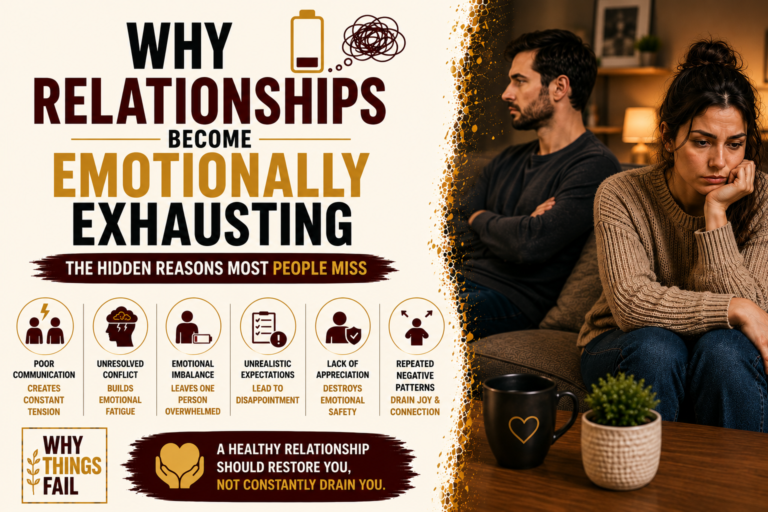
Relationships become emotionally exhausting when emotional needs consistently exceed emotional resources. Poor communication, unresolved conflict, unrealistic expectations, emotional imbalance and repeated negative interaction patterns gradually replace trust, safety and mutual support with stress, frustration and emotional fatigue.
Introduction
Every relationship begins with hope.
People enter romantic relationships believing that love will provide comfort, security and emotional connection. During the early stages, communication feels effortless, disagreements seem manageable and both partners willingly invest time and emotional energy into understanding one another.
Yet many relationships slowly transform into something very different.
Simple conversations become arguments. Small disappointments create lasting resentment. Spending time together becomes emotionally draining rather than emotionally fulfilling.
This transformation rarely happens overnight.
Instead, emotional exhaustion develops through hundreds of small interactions that gradually weaken trust, empathy and psychological safety. By the time couples recognise the problem, they often believe they have simply “grown apart.”
That explanation is rarely complete.
Relationships do not become emotionally exhausting because people suddenly stop caring. More often, they become exhausting because unhealthy behavioural patterns quietly replace healthy ones. Emotional needs remain unmet, communication deteriorates and both partners begin protecting themselves instead of supporting one another.
Understanding why relationships become emotionally exhausting therefore requires looking beyond individual arguments.
It requires understanding the psychology of emotional connection, human behaviour and the invisible systems that determine whether relationships create energy or consume it.
What Is Emotional Exhaustion In A Relationship?
Emotional exhaustion is a state in which one or both partners feel mentally and emotionally depleted by the relationship itself.
The relationship no longer feels like a source of comfort.
Instead, it becomes a source of ongoing stress.
This does not necessarily mean the relationship lacks love.
Many emotionally exhausted couples still care deeply about one another.
The problem is that emotional energy is continually being spent but rarely restored.
Every disagreement requires enormous effort.
Every conversation feels difficult.
Every misunderstanding leaves lasting emotional residue.
Over time, emotional fatigue reduces patience, empathy and resilience. Small problems begin feeling much larger because neither partner has sufficient emotional capacity to manage them calmly.
The relationship gradually shifts from connection to survival.
The Biggest Myth
One of the most common beliefs is that emotionally exhausting relationships exist because two people are simply incompatible.
Compatibility certainly matters.
However, psychological research suggests that incompatibility alone rarely explains long term emotional exhaustion.
Many couples with different personalities build deeply satisfying relationships.
Conversely, couples with remarkably similar interests often experience persistent conflict.
The difference usually lies in behavioural patterns rather than personality differences.
Relationships become exhausting when unhealthy interaction cycles repeat without resolution.
Criticism replaces curiosity.
Defensiveness replaces accountability.
Assumptions replace communication.
Emotional withdrawal replaces emotional support.
These behaviours slowly reshape the relationship regardless of how compatible two people initially appeared.
The myth of incompatibility encourages people to search for different partners instead of understanding the emotional systems that influence every relationship.
What Usually Happens?
Most emotionally exhausting relationships follow a similar progression.
Small misunderstandings are ignored because they appear insignificant.
Unspoken frustrations gradually accumulate.
Communication becomes less open.
Assumptions replace honest conversations.
Conflicts become more frequent.
Positive interactions become less frequent.
Both partners begin protecting themselves emotionally.
Instead of solving problems together, they begin defending themselves against each other.
Eventually, emotional distance becomes normal.
The relationship continues, but emotional connection steadily declines.
The exhaustion people experience is therefore not caused by one argument.
It is created by countless unresolved interactions that slowly weaken trust and emotional safety.
Why Do Relationships Become Emotionally Exhausting?
This question requires looking beneath visible conflicts.
Arguments about money, household responsibilities, family, intimacy or communication are often symptoms rather than root causes.
The deeper causes are usually psychological.
Human relationships are built upon emotional exchange.
Every interaction either strengthens emotional security or weakens it.
When negative interactions consistently outweigh positive ones, emotional reserves begin to decline.
Eventually, even ordinary conversations become emotionally demanding.
Emotional Needs Become Uneven
Healthy relationships depend upon emotional reciprocity.
Both partners contribute emotional support, understanding and empathy.
Problems arise when one person consistently becomes the emotional caregiver while the other primarily receives emotional support.
This imbalance creates emotional labour.
One partner becomes responsible for remembering important dates, resolving disagreements, maintaining communication and regulating the emotional atmosphere of the relationship.
Over time this responsibility becomes exhausting because emotional effort is not being shared equally.
The issue is rarely selfishness alone.
Often both partners fail to recognise the imbalance until emotional fatigue becomes overwhelming.
Poor Communication Creates Invisible Distance
Many couples believe communication problems involve saying the wrong thing.
More often the problem involves avoiding important conversations altogether.
Fear of conflict encourages silence.
Silence encourages assumptions.
Assumptions create misunderstanding.
Misunderstanding creates resentment.
This sequence quietly damages emotional intimacy.
People cannot solve problems they never openly discuss.
As emotional distance grows, conversations become increasingly transactional.
Partners discuss responsibilities instead of feelings.
Daily routines replace emotional connection.
Eventually both people begin feeling lonely despite remaining in the same relationship.
Emotional Decision Making Replaces Rational Discussion
Strong emotions narrow attention.
When people feel criticised, rejected or misunderstood, the brain naturally shifts towards self protection.
Listening becomes less important than defending.
Understanding becomes less important than winning.
Behavioural psychologists describe this as emotional reasoning.
People begin treating temporary emotions as objective reality.
A partner who forgets an important occasion is no longer viewed as distracted.
They are viewed as uncaring.
One disappointing conversation becomes evidence that the relationship is fundamentally broken.
Emotional reasoning magnifies ordinary disagreements into threats against the relationship itself.
Unspoken Expectations Create Constant Disappointment
Every relationship contains expectations.
Some are openly discussed.
Many remain completely invisible.
People expect appreciation without asking for it.
They expect affection to be expressed in familiar ways.
They expect partners to recognise emotional needs without explanation.
These expectations are often shaped by childhood experiences, family relationships, cultural influences and previous romantic relationships.
The difficulty is obvious.
Partners cannot consistently meet expectations they do not know exist.
Repeated disappointment gradually develops not because expectations are unreasonable but because they remain unspoken.
The Negativity Bias Changes How Relationships Are Experienced
Human psychology gives greater attention to negative experiences than positive ones.
This tendency, known as negativity bias, once helped human survival by increasing awareness of danger.
Within relationships it often creates the opposite effect.
One painful argument can outweigh several enjoyable conversations.
A single critical comment remains memorable long after expressions of affection are forgotten.
As negative memories accumulate, partners begin expecting disappointment before conversations even begin.
This expectation changes behaviour.
Neutral interactions become interpreted negatively.
Small misunderstandings become confirmation of existing frustrations.
Over time, emotional exhaustion becomes self reinforcing because perception itself has changed.
Emotional Safety Gradually Disappears
The healthiest relationships create psychological safety.
People feel comfortable expressing vulnerability without fear of ridicule, rejection or criticism.
When psychological safety declines, emotional honesty also declines.
Partners begin filtering their thoughts.
Important conversations are postponed.
Concerns remain hidden.
Outwardly the relationship may appear calm.
Internally emotional distance continues growing.
The absence of conflict is therefore not always evidence of relationship health.
Sometimes it reflects emotional withdrawal.
Relationships become exhausting not because people argue too much but because genuine emotional connection slowly disappears beneath avoidance, fear and unresolved tension.
Warning Signs
Emotionally exhausting relationships rarely deteriorate without warning. The earliest indicators are usually subtle and easy to dismiss because they develop gradually rather than suddenly.
One warning sign is feeling mentally drained after ordinary conversations. Discussions that once felt comforting begin leaving one or both partners feeling anxious, frustrated or emotionally depleted.
Another warning sign is avoiding meaningful conversations. Difficult topics are postponed because both partners expect conflict instead of understanding. Temporary peace begins replacing honest communication.
Constant defensiveness is another indicator. Every disagreement becomes a debate about who is right rather than an opportunity to understand each other’s perspective. Accountability disappears because protecting one’s ego becomes more important than solving the problem.
A growing imbalance in emotional effort also signals trouble. One partner consistently initiates conversations, resolves conflicts, remembers important occasions and maintains emotional connection while the other becomes increasingly passive.
Emotional withdrawal often follows. Partners may continue living together while sharing fewer thoughts, fewer feelings and fewer moments of genuine connection. Silence gradually replaces intimacy.
Perhaps the most dangerous warning sign is accepting emotional exhaustion as normal. Many couples believe every long term relationship eventually becomes draining. This belief discourages them from addressing problems while meaningful change is still possible.
What Could Have Prevented It?
Most emotionally exhausting relationships could not have been saved by grand romantic gestures.
They could have been strengthened through consistent emotional maintenance.
The first requirement is recognising that communication is not simply exchanging information. It is the process through which emotional security is built. Honest conversations held early prevent resentment from becoming deeply rooted.
Healthy boundaries also protect emotional wellbeing. Partners should support one another without becoming solely responsible for regulating each other’s emotions. Emotional responsibility must remain shared rather than transferred entirely to one person.
Regular relationship reflection is equally important. Couples often review careers, finances and future plans but rarely examine the health of their communication, trust and emotional connection. Small behavioural adjustments made consistently prevent much larger problems later.
Emotional intelligence also plays a central role. Understanding how stress, disappointment and fear influence behaviour allows partners to respond with curiosity rather than immediate judgement.
Most importantly, both individuals must accept that healthy relationships require continuous attention. Emotional connection is not created once and preserved automatically. It is strengthened through repeated acts of understanding, respect and mutual effort.
Lessons
Emotionally exhausting relationships reveal important truths about human behaviour.
The first lesson is that love alone cannot sustain a relationship. Emotional connection depends upon consistent behaviours rather than powerful feelings.
The second lesson is that unresolved problems become larger over time. Ignoring emotional discomfort may reduce conflict temporarily, but it often increases emotional distance in the future.
Another lesson is that communication determines the quality of every relationship. People rarely separate because they experience problems. They separate because they stop solving problems together.
Perhaps the most valuable lesson is that emotional safety creates resilience. Relationships remain strong not because conflict never occurs, but because both partners feel safe discussing difficult emotions without fear of rejection or criticism.
These lessons extend beyond romantic relationships. Families, friendships, workplaces and business partnerships all depend upon trust, communication and shared responsibility.
Failure Pattern
The dominant pattern behind emotionally exhausting relationships is Emotional Decision Making combined with Poor Communication and Avoidance.
This pattern repeats because people naturally protect themselves when they feel emotionally threatened. Fear encourages silence. Silence encourages misunderstanding. Misunderstanding creates resentment. Resentment gradually weakens trust until emotional distance becomes the normal pattern of interaction.
The same behavioural cycle appears in friendships, families, organisations and leadership teams. Problems become damaging not because they exist but because they remain unresolved.
Emotional exhaustion is therefore rarely caused by one significant event.
It develops through repeated behavioural choices that slowly replace openness with emotional self protection.
Hidden Lesson
The greatest threat to a relationship is rarely conflict.
It is emotional disconnection that develops quietly while both people believe the relationship is simply becoming more difficult.
Most relationships do not collapse because love disappears.
They weaken because emotional energy is repeatedly withdrawn without being restored.
The deeper truth is that emotional exhaustion reflects the condition of the relationship’s emotional system rather than the intentions of either partner. When communication, trust and empathy gradually decline, even ordinary interactions begin feeling emotionally expensive.
Failure Scorecard
| Area | Score | Explanation |
| Emotional Discipline | 4/10 | Emotional reactions frequently replace thoughtful responses during conflict. |
| Decision Making | 5/10 | Decisions are often influenced by assumptions rather than honest communication. |
| Conflict Management | 4/10 | Problems remain unresolved because difficult conversations are delayed or avoided. |
| Long Term Thinking | 5/10 | Many couples focus on immediate relief instead of strengthening the relationship over time. |
| Relationship Knowledge | 6/10 | Most people understand love but underestimate the importance of emotional systems. |
| Emotional Control | 4/10 | Fear, frustration and resentment often influence behaviour more than empathy. |
| Planning | 5/10 | Relationships rarely include intentional discussions about communication and emotional needs. |
| Adaptability | 6/10 | Healthy relationships improve when both partners remain willing to learn and adjust together. |
Key Takeaways
- Emotional exhaustion develops gradually rather than suddenly.
- Love cannot replace consistent communication and emotional responsibility.
- Unspoken expectations often create avoidable disappointment.
- Emotional safety allows difficult conversations to strengthen relationships instead of damaging them.
- Avoiding conflict usually increases emotional distance over time.
- Healthy relationships depend on balanced emotional effort from both partners.
- Small behavioural changes repeated consistently have a greater impact than occasional grand gestures.
- Emotional connection is maintained through trust, empathy and shared responsibility.
Frequently Asked Questions
Why do relationships become emotionally exhausting?
Relationships become emotionally exhausting when unresolved conflict, poor communication, emotional imbalance and unmet expectations gradually reduce trust and emotional safety.
Can a relationship recover from emotional exhaustion?
Yes. Recovery is possible when both partners acknowledge the underlying behavioural patterns, communicate honestly and consistently rebuild trust through shared effort.
What is emotional labour in a relationship?
Emotional labour refers to the invisible work involved in maintaining emotional connection, resolving conflict, remembering important details and supporting the emotional wellbeing of the relationship.
Why do people ignore the warning signs?
Many people believe emotional exhaustion is a normal stage of long term relationships. Others avoid difficult conversations because they fear conflict or rejection, allowing problems to grow over time.
What is the biggest cause of emotional exhaustion?
The biggest cause is the gradual loss of emotional safety. When people no longer feel understood, respected or comfortable expressing vulnerability, every interaction requires greater emotional effort.
Conclusion
Emotionally exhausting relationships are rarely created by one defining moment. They emerge through countless small behavioural choices that slowly weaken trust, communication and emotional safety until the relationship consumes more emotional energy than it restores.
Understanding this changes the way relationship failure is viewed. Emotional exhaustion is not simply the absence of love. It is evidence that the systems supporting connection have gradually broken down, revealing that lasting relationships depend less on powerful emotions and more on the everyday decisions that protect them.