Introduction
Few life events transform a relationship as profoundly as becoming parents.
For many couples, having a child represents love, hope and a shared future. Yet it also introduces new responsibilities, emotional demands and constant decision making. Sleep becomes limited. Personal time disappears. Financial pressures increase. Daily routines revolve around the needs of another person.
Despite entering parenthood with the best intentions, many couples find themselves arguing more frequently, feeling emotionally distant or struggling to communicate.
This creates an important question.
Why does an experience built on love sometimes create conflict between the very people raising the family together?
The common explanation is that parenting is simply stressful.
Stress certainly plays a role, but it does not explain why some relationships become stronger while others slowly deteriorate.
The deeper explanation lies in psychology, expectations, communication, identity and the invisible behavioural changes that occur after becoming parents.
Relationship conflict rarely begins with one major disagreement.
It usually develops through hundreds of small moments where emotional needs remain unspoken, responsibilities become unbalanced and understanding gradually gives way to frustration.
Understanding these deeper patterns allows us to see that parenting does not create conflict on its own.
Instead, it exposes weaknesses that already existed while introducing new pressures that many couples never expected.
What Is Parenting Related Relationship Conflict?
Parenting related relationship conflict is not simply arguing about children.
It describes the gradual tension that develops when raising children changes the emotional, practical and psychological dynamics between partners.
Disagreements may involve discipline, finances, household responsibilities, education or family priorities.
However, these visible disagreements are often symptoms rather than the true problem.
Beneath the surface are unmet expectations, emotional exhaustion, changing identities and different beliefs about what it means to be a parent.
Many couples believe they are arguing about chores or parenting styles.
In reality, they are often struggling to feel appreciated, understood and emotionally supported.
The conflict is rarely about one conversation.
It is the result of many unresolved experiences accumulating over time.
The Biggest Myth
One of the most common beliefs is that children create relationship problems.
This misunderstanding oversimplifies a far more complex reality.
Children do not damage relationships.
They increase the demands placed upon them.
Parenthood reduces time, energy, privacy and emotional capacity while increasing responsibility, uncertainty and decision making.
If communication is already weak, these pressures make the weakness more visible.
If trust is fragile, additional responsibilities expose that fragility.
If expectations have never been discussed openly, parenthood magnifies those differences.
The child is not the source of the conflict.
The child becomes the environment in which existing patterns become impossible to ignore.
Understanding this distinction changes how relationship conflict is viewed.
Instead of asking why children caused problems, it becomes more useful to ask why the relationship struggled to adapt to an entirely new stage of life.
What Usually Happens?
Most parenting related conflicts follow a predictable progression.
A couple welcomes a child with excitement and shared optimism.
Daily routines quickly change.
Sleep becomes inconsistent.
Work and family responsibilities increase.
Time together becomes limited.
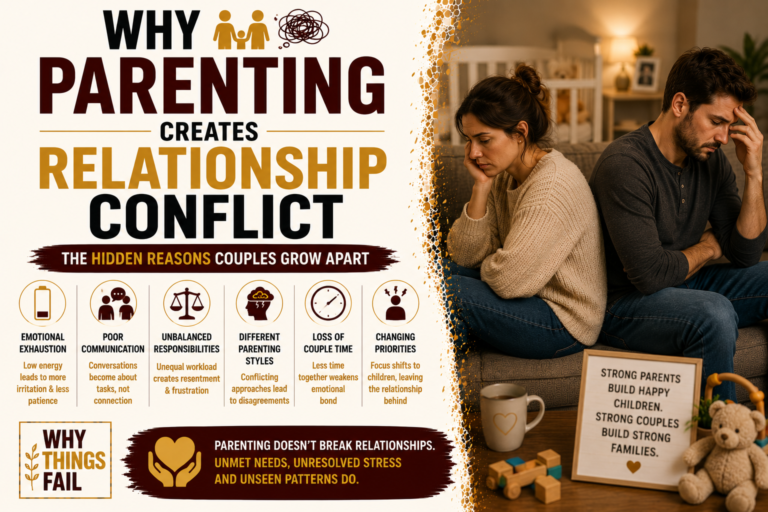
Communication becomes focused on practical tasks instead of emotional connection.
Small disappointments begin accumulating.
One partner may feel unsupported.
The other may feel unappreciated.
Neither intends to hurt the relationship, yet both become increasingly occupied with meeting immediate demands.
Over time, misunderstandings become arguments.
Arguments become emotional distance.
Without recognising the underlying causes, couples often believe the relationship has changed when, in reality, the pressures surrounding the relationship have changed.
Why Does It Happen?
This is where the investigation begins.
Parenting does not simply change schedules.
It changes identities, expectations, priorities and emotional resources.
The greatest conflicts often emerge from psychological changes that couples neither anticipate nor fully understand.
Parenting Changes Identity
Before becoming parents, many people define themselves through careers, hobbies, friendships and their relationship.
Parenthood introduces a powerful new identity.
Mother.
Father.
Caregiver.
Protector.
These identities bring meaning, but they also create pressure.
Many parents begin measuring their worth through their ability to meet every need of their child.
As attention shifts almost entirely towards parenting, the relationship itself may receive far less emotional investment.
Partners who once prioritised each other gradually become colleagues managing a household.
This identity shift rarely happens deliberately.
It develops naturally as immediate responsibilities replace intentional connection.
Emotional Exhaustion Changes Behaviour
Sleep deprivation affects far more than physical energy.
Psychological research consistently shows that fatigue reduces patience, emotional regulation and decision making.
Small frustrations begin feeling much larger.
Minor misunderstandings become emotionally charged.
Simple conversations require greater effort.
Neither partner intentionally becomes less understanding.
Their emotional capacity simply becomes depleted.
This explains why arguments often occur over seemingly insignificant issues.
The disagreement itself is rarely the true problem.
Exhaustion reduces the ability to respond with empathy, curiosity and patience.
Expectations Often Remain Unspoken
Many couples assume they share the same understanding of parenting.
In reality, expectations are often shaped by childhood experiences, cultural values and family traditions.
One partner may believe household responsibilities should remain equally shared.
Another may expect roles to change after having children.
One may value structure and routine.
The other may prefer flexibility.
Because these expectations are rarely discussed before becoming parents, differences emerge only after daily life becomes more demanding.
The resulting conflict is not created by different opinions.
It is created by assumptions that were never communicated.
Decision Fatigue Weakens Communication
Parents make hundreds of decisions every day.
Feeding schedules.
School choices.
Medical appointments.
Household responsibilities.
Financial priorities.
Discipline.
Family routines.
Behavioural psychologists describe this constant demand as decision fatigue.
As mental resources decline throughout the day, people become less patient, less flexible and more likely to react emotionally.
This helps explain why conversations late in the evening often become arguments even when neither partner intended conflict.
The issue is not simply poor communication.
It is cognitive exhaustion reducing the quality of communication.
Emotional Needs Become Less Visible
One of the most overlooked changes after becoming parents is that practical responsibilities begin replacing emotional connection.
Couples discuss shopping lists.
School schedules.
Appointments.
Household tasks.
Very little time remains for conversations about personal wellbeing, emotional needs or the relationship itself.
Over time, partners may begin feeling invisible.
Not because they are unloved.
Because survival becomes the immediate priority.
The relationship gradually shifts from emotional partnership to operational teamwork.
Although the household continues functioning, emotional intimacy slowly declines.
This pattern often develops unnoticed because both partners believe they are sacrificing for the family.
Ironically, those sacrifices can unintentionally weaken the relationship they are trying to protect.
Social Pressure Creates Unrealistic Standards
Modern parents are surrounded by constant comparisons.
Social media presents carefully curated images of perfect families.
Parenting advice appears from countless experts, influencers and online communities.
Families often feel pressure to provide the ideal childhood while simultaneously succeeding professionally, maintaining friendships and sustaining a healthy relationship.
These expectations create impossible standards.
When reality fails to match those expectations, guilt and self criticism increase.
Instead of asking for support, many parents attempt to manage everything independently.
This silent pressure often reduces communication precisely when open conversations are needed most.
Warning Signs
Relationship conflict rarely appears without warning. The challenge is that the earliest signs often seem insignificant. Couples assume they are temporary consequences of raising young children rather than indicators of a deeper shift within the relationship.
One warning sign is that conversations become entirely practical. Discussions revolve around school, meals, finances, appointments and household responsibilities while meaningful emotional conversations gradually disappear.
Another warning sign is keeping score. One partner begins believing they contribute more than the other. Appreciation is replaced by comparison. Instead of working as a team, each person quietly measures fairness through their own sacrifices.
Growing emotional withdrawal is another common indicator. Rather than discussing disappointment or frustration, partners avoid difficult conversations because they fear creating more conflict. Silence begins replacing honesty.
Resentment also develops gradually. It rarely begins with one major disagreement. It forms through repeated moments where one partner feels ignored, misunderstood or unsupported.
These warning signs are frequently ignored because both partners believe the relationship can wait until life becomes less demanding. Unfortunately, parenting responsibilities continue evolving, meaning the relationship rarely improves without deliberate attention.
What Could Have Prevented It?
No relationship can eliminate the pressures created by parenting.
What can change is how couples respond to those pressures.
The most effective protection is recognising that relationships require intentional maintenance even after children become the centre of family life. Emotional connection cannot survive on good intentions alone. It requires regular communication, shared understanding and mutual appreciation.
Open conversations about expectations before problems develop can prevent many future conflicts. Parenting roles, financial responsibilities, household tasks and personal boundaries should be discussed as circumstances change rather than assumed to remain understood.
Another important safeguard is viewing parenting as a shared system instead of separate responsibilities. When partners see themselves solving problems together rather than evaluating each other’s performance, cooperation becomes more natural.
Emotional check ins are equally valuable. Asking simple questions about stress, wellbeing and personal needs helps identify problems before resentment becomes deeply rooted.
Finally, couples benefit from accepting that perfect parenting is impossible. Trying to meet unrealistic standards often leaves little emotional energy for the relationship itself. Families usually become stronger when parents focus on consistency, communication and adaptability rather than perfection.
Lessons
Parenting reveals an important truth about relationships.
Love alone does not protect a relationship from changing circumstances.
Strong relationships are sustained through communication, flexibility and shared understanding.
Another lesson is that emotional needs do not disappear after becoming parents. They simply become less visible. Partners still require appreciation, empathy and emotional security even while caring for children.
The investigation also demonstrates that conflict is rarely created by one major event. It develops through repeated behavioural patterns that remain unaddressed.
Perhaps the most enduring lesson is that healthy families depend upon healthy relationships. Investing in the partnership is not separate from supporting children. It is one of the most important ways of supporting them.
Failure Pattern
The dominant pattern behind parenting related relationship conflict is Emotional Decision Making combined with Poor Communication and Lack of Planning.
Stress narrows emotional capacity.
Reduced emotional capacity weakens communication.
Poor communication creates incorrect assumptions.
Incorrect assumptions increase frustration.
Frustration encourages emotional reactions rather than thoughtful conversations.
This cycle repeats until conflict becomes the normal way of interacting.
The same behavioural pattern appears in businesses, friendships and organisations. Pressure does not usually create poor communication. It exposes communication systems that were never strong enough to handle increasing demands.
Hidden Lesson
The deepest lesson is that parenting rarely damages healthy relationships.
It exposes whether the relationship can continue adapting as life changes.
Children do not create emotional distance.
They reduce the time available to repair it.
The greatest risk is not disagreement.
It is allowing everyday responsibilities to quietly replace curiosity, appreciation and emotional connection until two partners become efficient parents but distant companions.
Failure Scorecard
| Area | Score | Explanation |
| Communication | 5/10 | Practical discussions often replace meaningful emotional conversations. |
| Decision Making | 6/10 | Daily stress frequently influences judgement more than thoughtful discussion. |
| Emotional Control | 5/10 | Fatigue and constant responsibility reduce patience and emotional regulation. |
| Long Term Thinking | 6/10 | Many couples become focused on immediate parenting demands instead of protecting the relationship. |
| Planning | 5/10 | Parenting expectations are often assumed rather than openly discussed. |
| Adaptability | 7/10 | Couples who adapt together generally navigate change more successfully than those who resist it. |
| Shared Responsibility | 6/10 | Imbalances often emerge when responsibilities are not reviewed regularly. |
| Relationship Maintenance | 4/10 | Emotional connection frequently receives the least attention despite being fundamental to family stability. |
Key Takeaways
- Parenting increases pressure but does not automatically create relationship conflict.
- Emotional exhaustion often explains arguments more accurately than personality differences.
- Unspoken expectations create many of the disagreements couples experience after becoming parents.
- Strong communication protects relationships during periods of significant change.
- Small moments of appreciation prevent resentment from quietly accumulating.
- Parenting works best when couples view challenges as shared responsibilities rather than individual burdens.
- Emotional connection requires ongoing attention even during the busiest stages of family life.
- Healthy relationships create healthier environments for children.
Frequently Asked Questions
Why does parenting create relationship conflict?
Parenting increases stress, responsibility and emotional demands. These pressures expose weaknesses in communication, expectations and emotional connection that may have remained unnoticed before children arrived.
Why do couples argue more after having children?
Couples often experience sleep deprivation, decision fatigue, financial pressure and reduced personal time. Together, these factors lower patience and increase the likelihood of misunderstandings.
Can parenting strengthen a relationship?
Yes. Couples who communicate openly, share responsibilities fairly and adapt together often develop stronger trust and deeper emotional resilience through parenting.
What is the biggest cause of parenting related relationship conflict?
The biggest cause is usually not parenting itself but poor communication combined with unspoken expectations and emotional exhaustion.
How can couples reduce parenting related conflict?
Regular communication, shared decision making, realistic expectations, mutual appreciation and viewing parenting as a team effort all help reduce unnecessary conflict.
Conclusion
Parenting does not fundamentally change the value of a relationship. It changes the conditions in which that relationship must survive. The pressures of raising children expose habits, expectations and patterns of communication that may have remained hidden during easier stages of life.
Understanding this transforms relationship conflict from a story of blame into one of adaptation. The strongest relationships are not those that avoid pressure, but those that continue choosing understanding, communication and partnership as life becomes increasingly demanding.