Introduction
Few human experiences are as confusing as watching someone remain in a relationship that repeatedly causes emotional pain. Friends often ask the same question.
“Why don’t they just leave?”
The question appears logical from the outside. If a relationship causes constant anxiety, manipulation, disrespect or emotional harm, leaving seems like the obvious solution.
Yet reality is rarely that simple.
Millions of people remain in toxic relationships despite recognising that something is wrong. Some stay for months. Others remain for years or even decades. Many leave several times only to return again.
This pattern appears across different cultures, ages and social backgrounds. It affects people with different levels of education, income and life experience. It is not limited to romantic relationships. Similar patterns appear within families, friendships and even workplaces.
The explanation is deeper than love.
People rarely remain in toxic relationships because they enjoy suffering. They remain because powerful psychological, emotional and social forces gradually reshape the way they think, interpret risk and make decisions.
Understanding these hidden forces matters because toxic relationships affect far more than emotional wellbeing. They influence mental health, financial stability, physical health, career decisions and long term life satisfaction.
The real question is therefore not why someone stays.
It is why leaving becomes psychologically more difficult than staying.
What Is a Toxic Relationship?
A toxic relationship is one where unhealthy patterns consistently damage one or both individuals emotionally, psychologically or sometimes physically.
Unlike ordinary disagreements, toxic relationships involve repeated behaviours that gradually reduce trust, confidence and emotional safety.
These behaviours may include manipulation, excessive control, emotional abuse, constant criticism, dishonesty, intimidation, isolation or unpredictable mood changes.
Not every difficult relationship is toxic.
Healthy relationships experience conflict because disagreement is a natural part of human interaction.
The difference lies in the pattern.
Healthy conflict usually leads to communication, understanding and growth.
Toxic conflict repeatedly produces fear, confusion, emotional exhaustion and uncertainty.
Over time, these repeated experiences influence how individuals view themselves, their partner and the possibility of leaving.
The relationship slowly becomes a psychological system that is increasingly difficult to escape.
The Biggest Myth
The most common belief is simple.
People stay because they are weak.
This assumption ignores decades of psychological research.
Remaining in a toxic relationship is rarely a sign of weakness.
It is often the result of powerful behavioural mechanisms that influence judgement over time.
Human beings make decisions based on emotion, attachment, familiarity and perceived safety as much as logic.
When relationships involve emotional dependence, shared history, financial commitments, children or repeated cycles of hope and disappointment, decision making becomes significantly more complex.
People outside the relationship evaluate the situation using objective observation.
The person inside the relationship experiences it through emotion, memory, attachment and uncertainty.
This difference explains why leaving appears easy to observers while feeling almost impossible to the individual experiencing it.
What Usually Happens?
Most toxic relationships follow a predictable pattern.
The relationship often begins with intense affection, attention and emotional closeness.
Trust develops quickly.
Emotional attachment strengthens.
Gradually, controlling or manipulative behaviour begins to appear.
Criticism becomes more frequent.
Arguments become more confusing.
Periods of emotional pain are followed by apologies, promises and temporary improvements.
Hope returns.
The cycle repeats.
Each repetition strengthens emotional attachment while weakening confidence in personal judgement.
Eventually, the relationship becomes emotionally exhausting, yet leaving feels increasingly difficult because uncertainty appears more frightening than familiarity.
Why Does It Happen?
Understanding why people remain in toxic relationships requires moving beyond surface level explanations.
Love alone does not explain the pattern.
Nor does weakness.
The deeper causes lie within human psychology, behavioural science and the way emotional experiences reshape decision making over time.
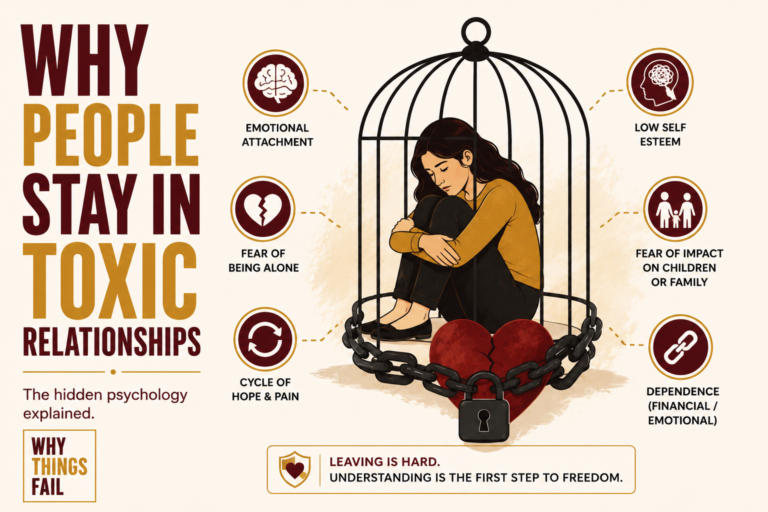
Emotional Attachment Changes Risk Perception
One of the strongest psychological forces is emotional attachment.
Human beings naturally seek security through close relationships.
Once attachment forms, the brain begins protecting that connection even when it becomes unhealthy.
Ending the relationship no longer feels like ending an unpleasant experience.
It feels like losing safety, identity and emotional stability.
Behavioural psychologists describe this as a change in risk perception.
Remaining feels painful.
Leaving feels terrifying.
The known pain becomes psychologically easier to tolerate than the uncertainty of starting again.
This explains why logical advice from friends often has little effect.
The individual is responding emotionally rather than analytically.
Trauma Bonds Create Powerful Emotional Cycles
Many toxic relationships involve what psychologists describe as a trauma bond.
This develops when periods of emotional pain alternate with moments of affection, kindness or reassurance.
The unpredictability strengthens emotional attachment.
After emotional conflict, even small acts of kindness feel intensely rewarding.
The brain begins associating temporary relief with emotional closeness.
Over time, individuals become increasingly focused on recovering positive moments rather than evaluating the relationship objectively.
The relationship becomes driven by hope instead of evidence.
Rather than asking,
“Is this relationship healthy?”
People begin asking,
“What if things improve this time?”
Hope gradually replaces realistic assessment.
Fear Often Feels Stronger Than Reality
Fear influences decision making far more than many people realise.
People fear loneliness.
They fear regret.
They fear financial uncertainty.
They fear disappointing family members.
They fear beginning again after investing years in one relationship.
Behavioural economists have shown that people naturally work harder to avoid perceived losses than to achieve equivalent gains.
This principle helps explain why leaving feels so difficult.
Ending the relationship may create the possibility of a healthier future.
Yet the immediate emotional focus remains on everything that appears to be lost.
Time invested.
Shared memories.
Future plans.
Family connections.
Emotional identity.
The possibility of gain becomes overshadowed by the certainty of immediate loss.
Low Self Esteem Gradually Changes Decision Making
Toxic relationships rarely destroy confidence overnight.
The process is gradual.
Repeated criticism.
Constant blame.
Manipulation.
Emotional invalidation.
Small incidents accumulate over months or years.
Eventually, individuals begin questioning their own judgement.
They become less confident making independent decisions.
This psychological shift increases dependence on the very relationship causing the emotional harm.
The more confidence declines, the more difficult leaving becomes.
The relationship begins influencing not only emotions but also personal identity.
The Sunk Cost Effect Keeps People Emotionally Invested
Behavioural economics offers another important explanation through the sunk cost effect.
People naturally continue investing in situations simply because they have already invested significant time, emotion or effort.
The longer the relationship lasts, the stronger this bias becomes.
Individuals think,
“I have already given this relationship five years.”
“Leaving now would mean those years were wasted.”
Unfortunately, past investment cannot improve future outcomes.
Yet emotionally, people continue investing because abandoning previous effort feels psychologically painful.
This bias explains why many toxic relationships continue long after both individuals recognise that fundamental problems remain unresolved.
Social Expectations Make Leaving More Difficult
Relationships do not exist in isolation.
Families, communities and cultural expectations often influence personal decisions.
Some people remain because they fear judgement.
Others worry about children.
Some believe ending the relationship represents personal failure.
Others fear disappointing parents, religious communities or social circles.
These external pressures create additional emotional costs.
The decision is no longer simply about the relationship.
It becomes intertwined with identity, belonging and acceptance.
As more psychological, emotional and social factors become connected to the relationship, leaving feels increasingly overwhelming even when staying continues causing harm.
Warning Signs
Toxic relationships rarely become destructive overnight. The warning signs usually appear gradually, making them easy to dismiss or rationalise.
One of the earliest signs is feeling anxious before ordinary conversations. A person begins carefully choosing words to avoid conflict rather than communicating honestly. Emotional safety slowly disappears.
Another warning sign is constant self blame. Instead of questioning unhealthy behaviour, individuals begin believing every disagreement is their own fault. Manipulation gradually changes personal perception until criticism feels deserved.
Isolation is another common indicator. Toxic partners may discourage friendships, create conflict with family members or demand increasing amounts of attention. Over time, the individual loses access to alternative perspectives, making the relationship appear more normal than it actually is.
Unpredictable behaviour also creates emotional confusion. Kindness suddenly follows emotional pain. Promises follow disappointment. Affection follows conflict. This inconsistency strengthens emotional dependence because people become focused on waiting for good moments rather than evaluating the overall relationship.
Many people also begin accepting behaviours they once considered unacceptable. Small compromises gradually become normal. Emotional boundaries weaken until disrespect, dishonesty or manipulation become expected parts of daily life.
These warning signs are often ignored because they appear one at a time rather than all at once. Each individual behaviour seems manageable. Together, they create a relationship built on uncertainty rather than trust.
What Could Have Prevented It?
Preventing toxic relationships is less about recognising obvious abuse and more about recognising unhealthy patterns before they become deeply established.
Healthy emotional boundaries provide one of the strongest forms of protection. People who clearly understand their values, personal limits and emotional needs are better equipped to recognise behaviour that repeatedly violates those boundaries.
Education also plays an important role. Many people learn about romance through films, social media or family experiences rather than evidence based relationship psychology. As a result, controlling behaviour is sometimes mistaken for love, jealousy is mistaken for commitment and emotional dependence is mistaken for intimacy.
Strong social connections can reduce vulnerability. Friends and family often recognise unhealthy dynamics long before the person experiencing them. Maintaining independent relationships provides emotional perspective that prevents isolation from shaping reality.
Another important factor is developing emotional awareness. Understanding concepts such as trauma bonding, emotional manipulation, gaslighting, attachment styles and cognitive bias enables people to identify unhealthy relationship patterns before they become deeply rooted.
Perhaps most importantly, people benefit from separating hope from evidence. Healthy relationships improve because both individuals consistently change their behaviour. Toxic relationships often survive because one person repeatedly believes future promises despite overwhelming evidence from the past.
Lessons
The reasons people stay in toxic relationships reveal broader truths about human behaviour.
The first lesson is that emotional decisions rarely follow pure logic. Human beings seek familiarity, attachment and emotional security even when those experiences become unhealthy.
The second lesson is that small behavioural patterns shape long term outcomes. Major relationship failures rarely begin with dramatic events. They develop through repeated moments of disrespect, manipulation and ignored warning signs that gradually become accepted as normal.
Another lesson is that psychological dependence often becomes stronger than practical dependence. Even when financial independence exists, emotional attachment, fear and uncertainty can continue influencing decisions.
Perhaps the most important lesson is that healthy relationships are sustained through consistency rather than intensity. Trust develops through predictable respect, honest communication and emotional safety rather than dramatic cycles of affection and conflict.
Failure Pattern
The dominant pattern behind toxic relationships is Emotional Decision Making reinforced by Fear, Attachment and Ignoring Warning Signs.
This pattern appears repeatedly because human beings naturally prioritise emotional security over objective evaluation. Familiarity often feels safer than uncertainty, even when familiarity involves emotional pain.
Hope encourages people to focus on occasional positive moments while overlooking repeated harmful behaviour. Fear discourages change by exaggerating the risks of leaving and minimising the risks of staying.
The same behavioural pattern appears beyond relationships. Employees remain in unhealthy workplaces. Entrepreneurs continue failing business models. Investors hold declining assets for too long. In each situation, emotional attachment delays rational decision making.
Hidden Lesson
The deepest reason people stay in toxic relationships is not that they fail to recognise the pain.
It is that emotional attachment gradually changes what feels possible.
As confidence declines and hope replaces evidence, the relationship becomes psychologically normal even when it remains objectively harmful.
The greatest lesson is that unhealthy relationships rarely survive because people cannot see reality. They survive because prolonged emotional conditioning changes how reality is interpreted.
Failure Scorecard
| Area | Score | Explanation |
| Decision Making | 4/10 | Emotional attachment often outweighs objective judgement. |
| Emotional Control | 3/10 | Fear, guilt and hope strongly influence relationship decisions. |
| Risk Awareness | 4/10 | Long term emotional harm is frequently underestimated. |
| Long Term Thinking | 5/10 | Immediate emotional comfort often outweighs future wellbeing. |
| Self Awareness | 5/10 | Manipulation gradually weakens confidence in personal judgement. |
| Boundary Setting | 3/10 | Personal limits are repeatedly compromised over time. |
| Planning | 4/10 | Many people remain without preparing realistic alternatives. |
| Adaptability | 5/10 | Emotional dependence makes behavioural change more difficult. |
Key Takeaways
- People rarely stay in toxic relationships because they enjoy suffering.
- Emotional attachment often changes how risk and safety are perceived.
- Trauma bonds strengthen emotional dependence through unpredictable cycles of pain and affection.
- Fear of uncertainty frequently outweighs the reality of ongoing emotional harm.
- Small warning signs gradually become accepted as normal behaviour.
- Hope should be evaluated alongside consistent evidence rather than isolated promises.
- Healthy relationships create emotional safety, not emotional confusion.
- Understanding behavioural psychology helps explain relationship decisions more accurately than judgement alone.
Frequently Asked Questions
Why do people stay in toxic relationships even when they know they are unhappy?
Emotional attachment, trauma bonding, fear of uncertainty, low self esteem and the sunk cost effect make leaving psychologically difficult even when the relationship causes ongoing emotional harm.
What is a trauma bond?
A trauma bond is a strong emotional attachment that develops through repeated cycles of emotional pain followed by affection, reassurance or temporary improvement. These unpredictable rewards strengthen dependence over time.
Can educated and successful people remain in toxic relationships?
Yes. Toxic relationships affect people across every level of education, profession and financial background because emotional decision making is influenced by psychology rather than intelligence alone.
What is the biggest warning sign of a toxic relationship?
One of the strongest warning signs is consistently feeling emotionally unsafe while believing your own thoughts, feelings or experiences are no longer trustworthy.
Why is leaving so emotionally difficult?
Leaving often involves losing emotional attachment, familiar routines, shared identity and future expectations. Behavioural psychology shows that people naturally avoid perceived losses even when change would improve their long term wellbeing.
Conclusion
People stay in toxic relationships not because they cannot recognise unhealthy behaviour, but because prolonged emotional conditioning gradually reshapes how they perceive risk, hope and attachment. The relationship becomes sustained by psychological patterns that are far stronger than simple logic.
Understanding these hidden mechanisms changes the conversation from judgement to insight. It reveals that toxic relationships are not maintained by weakness alone, but by predictable human behaviours that influence decision making long before people realise how deeply those patterns have taken hold.