Introduction
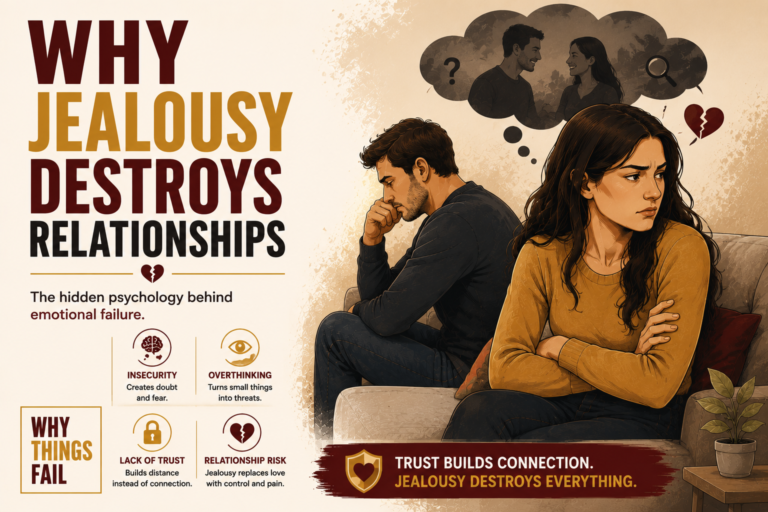
Jealousy has ended countless friendships, romantic partnerships, marriages and even successful businesses. It is one of the most powerful human emotions, yet it is also one of the least understood.
Most people assume jealousy begins because someone else behaves badly. A partner spends more time at work. A friend becomes successful. A colleague receives recognition. These events appear to explain why jealousy develops.
The reality is far more complex.
Jealousy rarely begins with another person’s actions. It usually begins with the meaning our minds attach to those actions.
This is why two people can experience exactly the same situation but react in completely different ways. One remains calm and trusting, while the other becomes suspicious, anxious or controlling.
The difference is not the event itself.
The difference is how the brain interprets uncertainty, rejection and perceived threats.
Understanding why jealousy destroys relationships requires looking beyond arguments and accusations. It requires examining human psychology, emotional security, decision making and the behavioural patterns that slowly replace trust with fear.
Only then does relationship failure become understandable rather than surprising.
What Is Jealousy In A Relationship?
Jealousy is an emotional response to the fear of losing something valuable, whether that is love, attention, trust, status or emotional connection.
In relationships, jealousy often appears as suspicion, insecurity, possessiveness or constant comparison. While occasional jealousy is a normal human emotion, persistent jealousy changes the way people think, communicate and behave.
The emotion itself is not what destroys relationships.
The problem begins when jealousy starts controlling decisions.
A partner begins checking messages instead of asking honest questions.
Simple conversations become interrogations.
Harmless situations become imagined threats.
Trust slowly gives way to doubt.
Relationship failure therefore does not begin when jealousy appears.
It begins when jealousy becomes the foundation for decision making.
The Biggest Myth
The most common belief is that jealousy proves someone truly loves their partner.
Many films, television programmes and popular culture reinforce this idea. A jealous partner is often portrayed as deeply caring or passionately committed.
This belief is misleading.
Healthy love is built on trust, respect and emotional security.
Jealousy is built on uncertainty.
While love encourages openness, jealousy encourages control.
While love creates emotional safety, jealousy creates emotional pressure.
Confusing jealousy with love prevents many people from recognising early relationship problems. Controlling behaviour becomes mistaken for commitment. Constant reassurance becomes expected rather than questioned.
As a result, unhealthy patterns continue long after warning signs become visible.
What Usually Happens?
Relationship failure caused by jealousy rarely happens overnight.
The process usually follows a predictable pattern.
Small feelings of insecurity appear.
Questions become more frequent.
Trust begins to weaken.
Monitoring behaviour increases.
Arguments become more common.
Both partners become emotionally exhausted.
Eventually, communication focuses more on defending actions than understanding emotions.
By the time the relationship ends, many people believe one final argument caused the separation.
In reality, the relationship had been gradually weakened by hundreds of small moments where fear replaced trust.
Why Does It Happen?
Understanding jealousy requires looking beneath the emotion itself.
Jealousy is rarely the real problem.
It is usually the visible symptom of deeper psychological processes.
Fear Of Loss Shapes Human Behaviour
From an evolutionary perspective, humans developed strong emotional responses to protect important relationships and social belonging.
Thousands of years ago, losing a trusted partner or social group could reduce safety, resources and survival.
Although modern relationships operate very differently, the human brain still responds to perceived emotional threats with remarkable intensity.
When someone believes a valued relationship is at risk, the brain often reacts before logical reasoning has time to evaluate the evidence.
This explains why jealousy frequently feels immediate and overwhelming.
The emotional system acts first.
Logic attempts to catch up later.
Insecurity Creates Stories That Feel Like Facts
Behavioural psychology suggests that people naturally attempt to fill gaps in missing information.
When certainty disappears, the mind creates explanations.
Unfortunately, these explanations are not always accurate.
A delayed reply becomes evidence of losing interest.
A friendly conversation becomes proof of emotional betrayal.
An innocent social media interaction becomes confirmation of hidden intentions.
The human brain dislikes uncertainty.
Creating a story feels psychologically easier than accepting that not every situation has a clear explanation.
The problem is that imagined stories often become treated as objective reality.
Once that happens, behaviour changes accordingly.
Emotional Decision Making Replaces Rational Thinking
Jealousy narrows attention.
Instead of viewing the relationship as a whole, the mind becomes focused on identifying possible threats.
Psychologists describe this as confirmation bias.
People begin noticing only information that supports their existing fears while ignoring evidence that suggests trust remains justified.
Every action becomes interpreted through suspicion.
Neutral behaviour suddenly appears meaningful.
Ordinary events become emotionally charged.
The more this pattern repeats, the more difficult it becomes to separate facts from assumptions.
Eventually, decisions are no longer based on what actually happened.
They are based on what someone fears might happen.
Low Self Worth Increases Relationship Anxiety
Many people believe jealousy develops because of their partner’s behaviour.
Research in relationship psychology suggests another important factor.
Individuals with low self esteem often experience greater relationship anxiety because they already doubt their own value.
Instead of asking,
“Can I trust my partner?”
their subconscious question becomes,
“Am I enough?”
This subtle difference changes everything.
A person who feels emotionally secure usually interprets uncertainty with patience.
Someone who doubts their own worth often interprets the same uncertainty as rejection.
The relationship therefore becomes a reflection of internal beliefs rather than external reality.
Social Comparison Intensifies Jealousy
Modern technology has transformed how jealousy develops.
Social media constantly exposes people to carefully selected moments from other people’s lives.
Partners compare themselves with former relationships, online friendships, attractive strangers and unrealistic lifestyles.
Behavioural economists describe comparison as a powerful driver of human satisfaction and dissatisfaction.
People rarely evaluate happiness in isolation.
They evaluate it relative to others.
The same principle influences relationships.
The more comparisons people make, the easier it becomes to believe someone else offers greater excitement, greater success or greater happiness.
Many of these comparisons are inaccurate.
Yet emotionally they feel convincing.
The Desire For Control Creates The Very Outcome People Fear
Perhaps the greatest paradox of jealousy is that attempts to protect relationships often weaken them.
Checking phones.
Monitoring social media.
Demanding constant reassurance.
Questioning harmless interactions.
Restricting friendships.
These behaviours are usually motivated by fear rather than malice.
The jealous partner believes greater control will create greater security.
Instead, it creates emotional distance.
Trust begins disappearing from both sides.
One partner feels constantly anxious.
The other feels constantly monitored.
The relationship slowly changes from a place of emotional safety into a place of emotional pressure.
Ironically, the behaviour intended to prevent relationship failure often becomes one of its primary causes.
The Root Cause Lies Deeper Than Jealousy
If we continue asking why, an even deeper pattern emerges.
People do not simply fear losing a relationship.
They often fear losing their identity, their sense of belonging or the emotional security that relationship provides.
Jealousy therefore becomes less about another person’s actions and more about protecting an internal sense of self.
When emotional security depends entirely upon another person’s behaviour, every uncertainty feels threatening.
That is why jealousy is so powerful.
It is not merely an emotion.
It is the mind attempting to defend itself against the possibility of emotional loss, even when that loss exists only in imagination.
Warning Signs
Jealousy rarely appears as constant anger from the beginning. It usually develops through small behavioural changes that seem reasonable in isolation but become destructive when repeated.
One of the earliest warning signs is the growing need for reassurance. A partner who once felt secure begins seeking constant confirmation of love, loyalty or commitment. While reassurance is healthy in moderation, needing it repeatedly often reflects deeper emotional insecurity rather than genuine relationship problems.
Another warning sign is excessive monitoring. Checking messages, analysing social media activity, questioning harmless conversations or becoming suspicious of ordinary behaviour signals that trust is being replaced by surveillance.
Emotional reactions also become increasingly disproportionate. Small misunderstandings trigger major arguments because every disagreement is interpreted as evidence of a larger threat.
Communication gradually changes as well. Conversations become focused on defending actions rather than understanding emotions. Instead of asking questions with curiosity, people ask questions expecting guilt.
Perhaps the clearest warning sign is the loss of emotional freedom. One partner begins changing normal behaviour simply to avoid conflict. Friendships become limited. Personal interests disappear. Honest conversations become carefully filtered.
These warning signs are often ignored because jealousy develops slowly. Both partners adapt to each new behaviour until unhealthy patterns begin feeling normal.
What Could Have Prevented It?
Most relationships damaged by jealousy do not require perfect partners.
They require healthier emotional foundations.
The first safeguard is recognising that trust is a decision supported by evidence rather than a feeling that appears automatically. Trust grows through consistent behaviour, honest communication and emotional reliability.
Emotional self awareness is equally important. Individuals who understand their own fears are less likely to project them onto their partner. Instead of assuming betrayal, they become curious about why uncertainty feels so threatening.
Healthy communication also prevents assumptions from becoming accepted as facts. Asking honest questions creates understanding. Making accusations creates defensiveness.
Another important protection is maintaining an independent sense of identity. Relationships become stronger when both people retain personal confidence, friendships, interests and emotional resilience. When self worth depends entirely on another person’s behaviour, jealousy becomes far more likely.
Finally, recognising behavioural patterns early allows small concerns to be addressed before they become destructive habits. Jealousy becomes dangerous not because it exists but because it remains unexamined.
Lessons
Jealousy teaches an important lesson about human behaviour.
People rarely respond only to reality. They respond to the meaning they assign to reality.
This explains why identical situations produce completely different emotional reactions in different people.
Another lesson is that emotional security cannot be created through control. Attempts to reduce uncertainty by controlling another person usually increase distrust rather than reducing it.
Relationships also demonstrate that communication alone is not enough. Honest conversations become effective only when both people are willing to examine their own assumptions instead of defending them.
Perhaps the most important lesson is that strong relationships depend less on eliminating conflict and more on managing insecurity before it influences behaviour.
Failure Pattern
The dominant pattern behind relationship failure caused by jealousy is Emotional Decision Making driven by Fear and Insecurity.
The cycle usually begins with uncertainty.
Uncertainty creates anxious thoughts.
Those thoughts become assumptions.
Assumptions influence behaviour.
Controlling behaviour weakens trust.
Reduced trust creates greater insecurity.
This self reinforcing cycle gradually damages communication, emotional safety and mutual respect.
The same behavioural pattern appears beyond relationships. Business leaders become controlling after periods of uncertainty. Investors panic during market declines. Entrepreneurs ignore objective evidence because fear influences judgement.
The underlying pattern remains remarkably consistent.
When emotions replace objective thinking, decisions often create the very outcome people hoped to avoid.
Hidden Lesson
Jealousy does not destroy relationships because it proves someone cares too much.
It destroys relationships because it gradually replaces trust with control.
The deeper truth is that jealousy is rarely about another person’s behaviour.
It is often about unresolved fears, emotional insecurity and the human desire for certainty in situations where complete certainty can never exist.
Relationships begin to fail long before separation occurs. They begin failing when fear becomes more influential than trust.
Failure Scorecard
| Area | Score | Explanation |
| Emotional Discipline | 4/10 | Emotional reactions often replace thoughtful communication. |
| Decision Making | 5/10 | Assumptions frequently influence behaviour more than objective evidence. |
| Risk Management | 4/10 | Emotional risks within the relationship are often ignored until trust has already weakened. |
| Long Term Thinking | 5/10 | Immediate emotional relief is prioritised over long term relationship health. |
| Self Awareness | 5/10 | Many people recognise jealousy but fail to understand its deeper psychological causes. |
| Emotional Control | 3/10 | Fear, insecurity and anxiety often dominate behaviour during conflict. |
| Communication Planning | 6/10 | Honest communication exists in many relationships but is often replaced by defensiveness under pressure. |
| Adaptability | 6/10 | Healthy relationships improve when both partners are willing to examine and change unhealthy patterns. |
Key Takeaways
- Jealousy is usually a symptom of deeper emotional insecurity rather than the true problem.
- Trust weakens gradually through repeated behavioural patterns rather than one major event.
- Fear often creates stories that feel true despite lacking evidence.
- Controlling behaviour reduces emotional safety instead of increasing it.
- Healthy communication challenges assumptions before they become beliefs.
- Emotional security begins within the individual before it strengthens the relationship.
- Strong relationships depend on trust, respect and self awareness rather than constant reassurance.
- Understanding the psychology behind jealousy makes destructive patterns easier to recognise before lasting damage occurs.
Frequently Asked Questions
Why does jealousy destroy relationships?
Jealousy destroys relationships because it gradually replaces trust with suspicion, emotional safety with control and honest communication with assumptions. Over time these behaviours weaken the foundation of the relationship.
Is jealousy a sign of love?
No. While occasional jealousy is a normal human emotion, persistent jealousy usually reflects insecurity and fear rather than healthy love. Strong relationships rely on trust more than control.
What causes jealousy in relationships?
Common causes include low self esteem, fear of abandonment, past relationship experiences, emotional insecurity, social comparison and cognitive biases such as confirmation bias.
Can a relationship survive jealousy?
Yes, provided both partners recognise the behavioural patterns early and are willing to address the underlying emotional causes through honest communication, self awareness and rebuilding trust.
Why do jealous people become controlling?
Control creates the illusion of certainty. When people fear losing an important relationship, controlling behaviour often feels like protection even though it usually increases emotional distance and weakens trust.
Conclusion
Jealousy rarely destroys relationships through one dramatic moment. It weakens them through countless small decisions where fear quietly replaces trust, assumptions replace communication and control replaces emotional security.
Understanding this changes the conversation completely. Relationship failure is no longer explained simply by arguments or misunderstandings. It becomes the predictable outcome of psychological patterns that remain unnoticed until trust has already been replaced by uncertainty.