Quick Answer
Gym memberships often go unused because motivation fades while daily habits remain unchanged. Behavioural psychology shows that unrealistic expectations, poor planning, decision fatigue, present bias and environmental influences make skipping workouts easier than building consistent exercise habits.
Introduction
Every January, millions of people join gyms with genuine optimism.
They promise themselves that this year will be different. They buy new workout clothes, download fitness apps and commit to transforming their health.
For a few weeks, the gym is full.
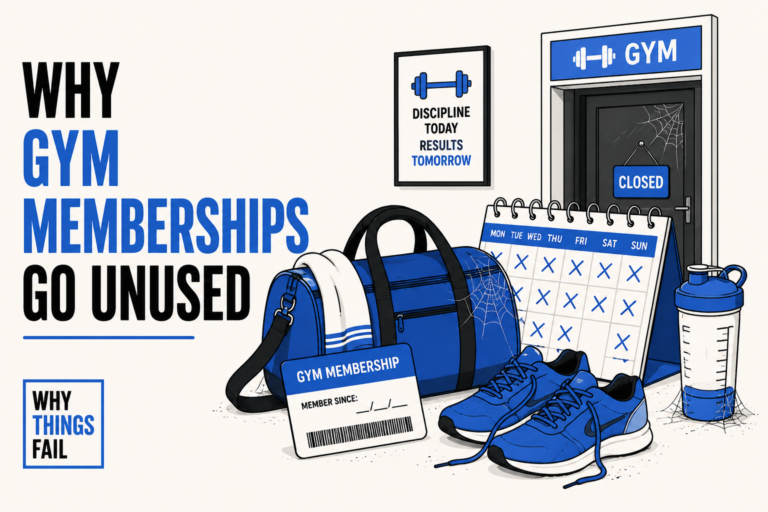
By spring, many treadmills stand empty. Membership cards remain unused while monthly payments continue leaving bank accounts.
This pattern repeats every year across countries, age groups and income levels.
The obvious explanation is that people lose motivation.
The deeper explanation is far more interesting.
Most people do not purchase a gym membership because they enjoy exercising. They purchase the idea of becoming healthier, stronger and more confident. The membership represents hope rather than habit.
Understanding why gym memberships go unused is therefore not simply about fitness.
It is about understanding how people make decisions, why intentions rarely become consistent behaviour and how predictable psychological patterns quietly undermine long term health goals.
What Is It?
An unused gym membership is more than a financial expense.
It represents a gap between intention and action.
Someone makes a rational decision to improve their health, invests money and begins with enthusiasm. Yet attendance gradually declines until the membership becomes another recurring payment that provides little value.
The failure is not purchasing the membership.
The failure is allowing short term emotions to replace long term commitment.
This makes unused gym memberships an excellent example of behavioural decision making rather than physical ability.
Most people already know exercise improves health.
The challenge is consistently acting on that knowledge.
The Biggest Myth
The most common belief is simple.
People stop going to the gym because they are lazy.
This explanation feels satisfying because it places responsibility entirely on the individual.
Behavioural science suggests something different.
Most people who stop exercising are not unwilling to improve themselves. They simply underestimate how difficult it is to change established habits while managing work, family responsibilities, stress and daily decision making.
Motivation may encourage someone to join a gym.
Habit determines whether they return next week.
The real challenge is therefore not generating excitement.
It is creating a system that continues working after excitement disappears.
What Usually Happens?
The pattern is remarkably consistent.
Someone decides to improve their health after a significant moment.
It may be New Year, a birthday, a medical appointment or seeing an unflattering photograph.
They purchase a gym membership with genuine commitment.
During the first few weeks attendance is frequent.
Visible progress feels exciting.
Then everyday life gradually returns.
Work becomes busier.
Family responsibilities increase.
Energy declines.
Missing one workout becomes missing several.
Eventually the membership remains active while attendance quietly disappears.
This progression rarely happens because of one major event.
It develops through dozens of small decisions that slowly change priorities.
Why Does It Happen?
Understanding unused gym memberships requires looking beyond exercise itself.
The real causes lie in psychology, behavioural economics and the way humans respond to delayed rewards.
People rarely avoid the gym because they dislike better health.
They avoid it because immediate costs feel greater than distant benefits.
Present Bias Prioritises Comfort Over Future Health
One of the strongest behavioural biases affecting exercise is present bias.
Humans naturally value immediate rewards more than future benefits.
Sleeping for another hour produces an instant reward.
Watching television after work feels immediately relaxing.
Skipping one workout creates immediate comfort.
The benefits of exercise are very different.
Improved cardiovascular health.
Lower disease risk.
Greater strength.
Higher energy.
Better mental wellbeing.
These rewards develop gradually over weeks or months.
The brain therefore compares immediate comfort with delayed improvement.
Without recognising this psychological tendency, choosing comfort becomes the easier decision.
This trade-off between short-term comfort and long-term benefit is well documented in behavioural research. A study on time preference and physical activity, published through the National Institutes of Health, found that people with stronger present bias were consistently less likely to sustain regular exercise and that this tendency could often be measured before attendance actually declined.
The problem is not poor intentions.
The problem is how the brain evaluates time.
Motivation Declines While Habits Remain
Many people believe motivation creates consistency.
Behavioural psychology shows the opposite.
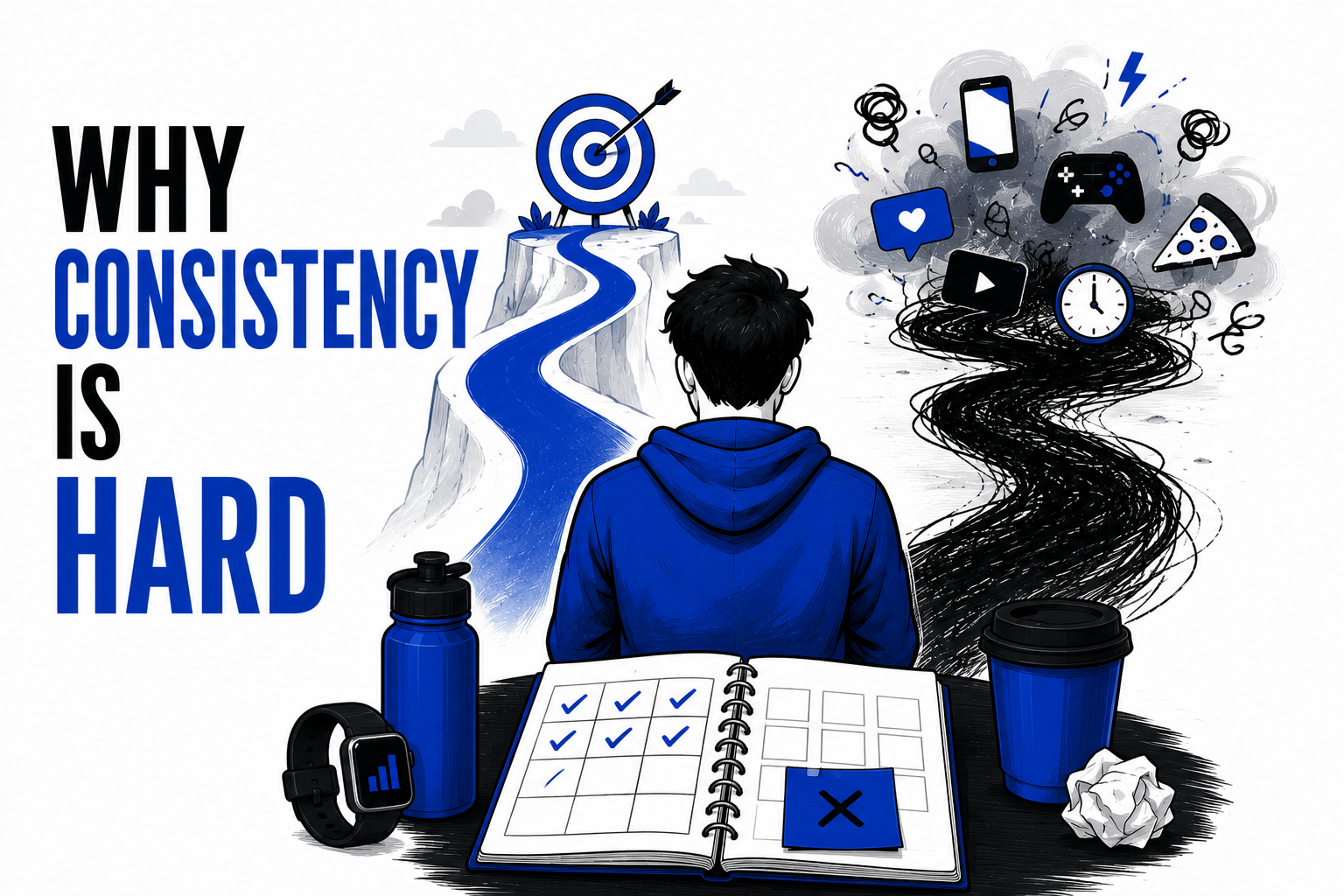
Motivation fluctuates constantly. Habits remain stable which is exactly why consistency is so hard to sustain once initial excitement fades.
Joining a gym is usually an emotional decision inspired by excitement, guilt or hope.
Returning repeatedly requires automatic routines that continue regardless of mood.
When workouts depend entirely on motivation, attendance naturally declines as emotional intensity fades.
This explains why highly motivated people often stop exercising despite genuinely wanting better health.
Their commitment depends on feelings rather than established routines.
Decision Fatigue Reduces Self Control
Every day people make hundreds of decisions.
What to wear.
What to eat.
Which tasks deserve attention.
How to respond to work demands.
By evening, mental energy is often depleted.
Psychologists describe this as decision fatigue.
After making countless choices throughout the day, deciding to exercise feels significantly more difficult.
Going home requires no additional effort.
Travelling to the gym demands planning, preparation and physical energy.
The easier option frequently wins.
This does not reflect weak character.
It reflects how cognitive resources become limited after repeated decision making.
Unrealistic Expectations Create Early Disappointment
Another common reason memberships go unused is unrealistic expectations.
Many people expect noticeable physical changes within a few weeks.
Social media often reinforces these expectations by highlighting dramatic transformation stories while ignoring the months or years of consistent effort behind them.
When rapid progress fails to appear, motivation declines.
People begin questioning whether the effort is worthwhile.
In reality, meaningful physical improvement is usually gradual.
The expectation of immediate transformation creates frustration that has little relationship with actual progress.
The problem is not the pace of improvement.
It is the expectation created before improvement even begins.
Identity Conflict Makes Consistency Difficult
Behavioural researchers argue that lasting habits develop when actions become part of personal identity.
Someone who thinks, “I am trying to exercise,” behaves differently from someone who believes, “I am a person who looks after my health.”
Many new gym members continue identifying with their previous lifestyle.
Exercise feels like an obligation rather than a natural part of who they are.
Every workout therefore becomes a negotiation.
Should I go today?
Do I really need this session?
Would one missed workout matter?
Because the behaviour has not become part of personal identity, skipping the gym feels easier than maintaining consistency.
Changing behaviour without changing identity often produces temporary results instead of lasting habits.
Social Pressure Creates Temporary Commitment
Many people join a gym after comparing themselves with others.
They see fitness influencers, friends posting transformation photos or colleagues discussing new exercise routines. This creates a powerful psychological force known as social comparison the same instinct behind why people spend to impress others.
The decision to join the gym often feels personal, but it is frequently influenced by external expectations.
The problem appears once external attention disappears.
Friends stop asking about workouts.
The excitement of sharing progress fades.
Without social reinforcement, commitment weakens because the original motivation came from comparison rather than personal purpose.
Behaviour that depends on external validation rarely survives everyday life.
The Planning Fallacy Encourages Unrealistic Schedules
Another hidden cause is the planning fallacy.
People consistently underestimate the time and effort required to achieve long term goals.
A new member may promise to visit the gym six days every week despite having no previous exercise routine.
The schedule looks realistic on paper.
Reality quickly proves otherwise.
Unexpected meetings.
Family responsibilities.
Poor sleep.
Travel.
Stress.
Each small disruption makes the ambitious schedule impossible to maintain.
Missing several planned sessions creates disappointment.
Instead of adjusting expectations, many people abandon the routine entirely.
The problem is not lack of commitment.
The problem is building a plan that leaves no room for real life.
The Cost Already Paid Creates False Satisfaction
Behavioural economists describe another important concept called the sunk cost effect.
Paying for a gym membership creates the feeling that an important step has already been completed.
The purchase itself provides psychological satisfaction.
People begin identifying themselves as someone who is improving their health before consistent behaviour actually begins.
This creates a dangerous illusion.
Buying the membership becomes confused with achieving the goal.
The financial commitment feels like progress even when behavioural commitment never develops.
Over time, the monthly payment becomes normal while attendance quietly disappears.
Modern Environments Reward Inactivity
Human biology evolved in environments where movement was unavoidable.
Modern life encourages the opposite.
People work at desks.
They travel by car.
Entertainment is available without leaving the sofa.
Food delivery removes the need to walk.
Technology continually reduces physical effort.
The gym therefore requires people to deliberately choose discomfort within an environment designed around convenience.
This is not simply a personal challenge.
It is a systems challenge.
When every surrounding incentive encourages inactivity, maintaining regular exercise demands consistent behavioural effort.
Warning Signs
Unused gym memberships rarely happen without warning.
One early sign is relying entirely on motivation instead of establishing a routine. When workouts depend on feeling inspired, attendance becomes unpredictable.
Another warning sign is creating goals that focus only on physical appearance. People motivated solely by weight loss or visible changes often become discouraged when progress is slower than expected.
Frequently skipping planned workouts while promising to compensate later is another common indicator. One missed session gradually becomes several weeks of inactivity.
Avoiding the gym because of guilt also signals a developing problem. The longer someone stays away, the more uncomfortable returning feels. Embarrassment begins replacing confidence, making the next visit even less likely.
Perhaps the clearest warning sign is paying monthly membership fees while believing attendance will improve “next week.” This delays recognising that behaviour has already changed.
These signs are usually ignored because people remain optimistic about future motivation.
What Could Have Prevented It?
Preventing unused gym memberships requires changing systems rather than relying on willpower.
Realistic planning creates sustainable habits. Beginning with two or three sessions each week is often more effective than attempting daily workouts that cannot be maintained.
Linking exercise to existing routines also improves consistency. Visiting the gym immediately after work or exercising at the same time each day reduces the number of decisions required.
Setting process goals instead of appearance goals changes expectations. Focusing on attending scheduled sessions creates a sense of progress even before visible physical changes appear.
Environmental design also matters. Preparing gym clothes in advance, choosing a gym close to home or work and reducing unnecessary obstacles makes attendance easier.
Finally, understanding that motivation naturally rises and falls encourages people to trust routines rather than emotions.
Long term consistency is usually built through systems that continue working even on days when enthusiasm disappears.
Lessons
Unused gym memberships demonstrate that good intentions rarely create lasting change.
The first lesson is that behaviour follows systems more reliably than motivation. People who depend on excitement eventually struggle when enthusiasm declines.
The second lesson is that immediate comfort often defeats long term rewards. Understanding present bias explains why intelligent people repeatedly postpone actions that benefit their future selves.
Another lesson is that identity influences behaviour more than goals. Lasting habits develop when people begin seeing healthy choices as part of who they are rather than temporary projects.
Perhaps the most important lesson is that sustainable improvement depends on consistency rather than intensity the same behavioural trap seen in why sleep plans fail, where good intentions collapse under daily decision fatigue. Small actions repeated over months create greater results than ambitious efforts maintained for only a few weeks.
Failure Pattern
The dominant pattern behind unused gym memberships is Short Term Thinking reinforced by Emotional Decision Making and Lack of Planning.
People make emotionally driven commitments during moments of inspiration. They underestimate future obstacles, overestimate motivation and fail to build routines capable of surviving ordinary life.
This pattern appears in many other areas.
Investors abandon long term strategies after short term losses.
Entrepreneurs pursue rapid growth without operational planning.
Consumers purchase products believing ownership alone will create change.
The repeated failure is not ambition.
It is confusing intention with sustainable behaviour.
Hidden Lesson
People rarely fail because they make poor decisions once.
They fail because they expect one good decision to replace hundreds of consistent actions.
Buying a gym membership feels like the beginning of transformation.
In reality, it is only permission to begin.
Health improves through repeated behaviour, not through financial commitment.
The membership never guarantees change.
Only consistent action does.
Failure Scorecard
| Area | Score | Explanation |
| Financial Discipline | 5/10 | Many people continue paying for memberships they rarely use. |
| Decision Making | 5/10 | Initial decisions are thoughtful, but daily choices become emotionally driven. |
| Risk Management | 6/10 | Health risks are recognised, but long term behavioural risks are underestimated. |
| Long Term Thinking | 4/10 | Immediate comfort frequently outweighs future health benefits. |
| Behavioural Knowledge | 4/10 | Most people understand exercise but underestimate habit formation. |
| Emotional Control | 5/10 | Motivation strongly influences attendance instead of consistent routines. |
| Planning | 4/10 | Unrealistic schedules often replace practical planning. |
| Adaptability | 6/10 | Many people abandon routines instead of adjusting them to changing circumstances. |
Key Takeaways
- Gym memberships usually go unused because habits never replace motivation.
- Present bias encourages immediate comfort over future health.
- Social comparison creates temporary commitment but rarely lasting behaviour.
- Unrealistic expectations increase disappointment and reduce consistency.
- Identity influences long term habits more than short term goals.
- Effective systems outperform willpower.
- Small consistent actions produce greater long term results than occasional intense effort.
- Sustainable behaviour is built through routine, planning and realistic expectations.
Frequently Asked Questions
Why do most gym memberships go unused?
Most gym memberships go unused because motivation fades while existing habits remain unchanged. Behavioural biases, poor planning and unrealistic expectations gradually reduce attendance.
Is laziness the main reason people stop going to the gym?
No. Research in behavioural psychology suggests that habit formation, present bias, decision fatigue and environmental factors explain the pattern more accurately than laziness alone.
How long does motivation usually last?
Motivation is naturally temporary. It often declines after the excitement of a new goal fades, making consistent routines more important than emotional enthusiasm.
Why do people keep paying for memberships they do not use?
Many continue paying because they believe they will return soon. The sunk cost effect and optimism about future behaviour make cancelling feel like admitting failure.
What is the biggest mistake new gym members make?
The most common mistake is relying on motivation instead of creating realistic routines that can continue during busy and stressful periods.
Conclusion
Unused gym memberships are not simply evidence of failed fitness goals. They reveal how easily human behaviour is shaped by present bias, unrealistic expectations and emotional decision making. The membership itself is rarely the problem. The deeper challenge lies in converting good intentions into consistent habits that survive long after motivation has disappeared.