Introduction
Every January, millions of people promise themselves that this year will be different.
Gym memberships increase dramatically. Running shoes are purchased. Fitness apps are downloaded. Social media fills with transformation stories and ambitious workout plans.
For a brief period, motivation appears limitless.
Yet within weeks, many exercise routines begin to disappear. Gym visits become less frequent. Morning runs are postponed. Home workouts become occasional rather than consistent. Eventually, exercise becomes another abandoned goal.
This pattern repeats every year across different age groups, professions and cultures.
The obvious explanation is that people lack motivation.
The deeper explanation is far more complex.
Exercise is not simply a physical activity. It is a repeated behavioural decision that competes with comfort, convenience, habits, emotions and daily responsibilities. Every missed workout reflects a choice influenced by psychology, incentives and environment rather than physical ability alone.
Understanding why people quit exercising is therefore not about discovering a better workout programme.
It is about understanding why human behaviour often conflicts with long term wellbeing despite knowing the benefits of regular physical activity.
What Is Exercise Failure?
Exercise failure is often misunderstood.
Missing one workout or taking a short break does not mean someone has failed.
Life circumstances change. Illness, family commitments and unexpected responsibilities can interrupt even the most disciplined routines.
Exercise failure occurs when a temporary interruption gradually becomes permanent because healthy habits are replaced by behaviours that are easier, more rewarding in the moment or emotionally comforting.
The failure is not the missed workout itself.
The failure is the gradual breakdown of consistency.
Most people do not consciously decide to stop exercising forever.
Instead, they slowly drift away from habits that once supported their physical and mental health.
The Biggest Myth
The most common belief is simple.
People quit exercising because they are lazy.
This explanation sounds convincing because inactivity is easy to observe.
However, behavioural science suggests something very different.
Most people who stop exercising genuinely want to become healthier.
They understand that physical activity reduces the risk of chronic disease, improves mental health, increases energy and supports long term wellbeing.
Knowledge is rarely the problem.
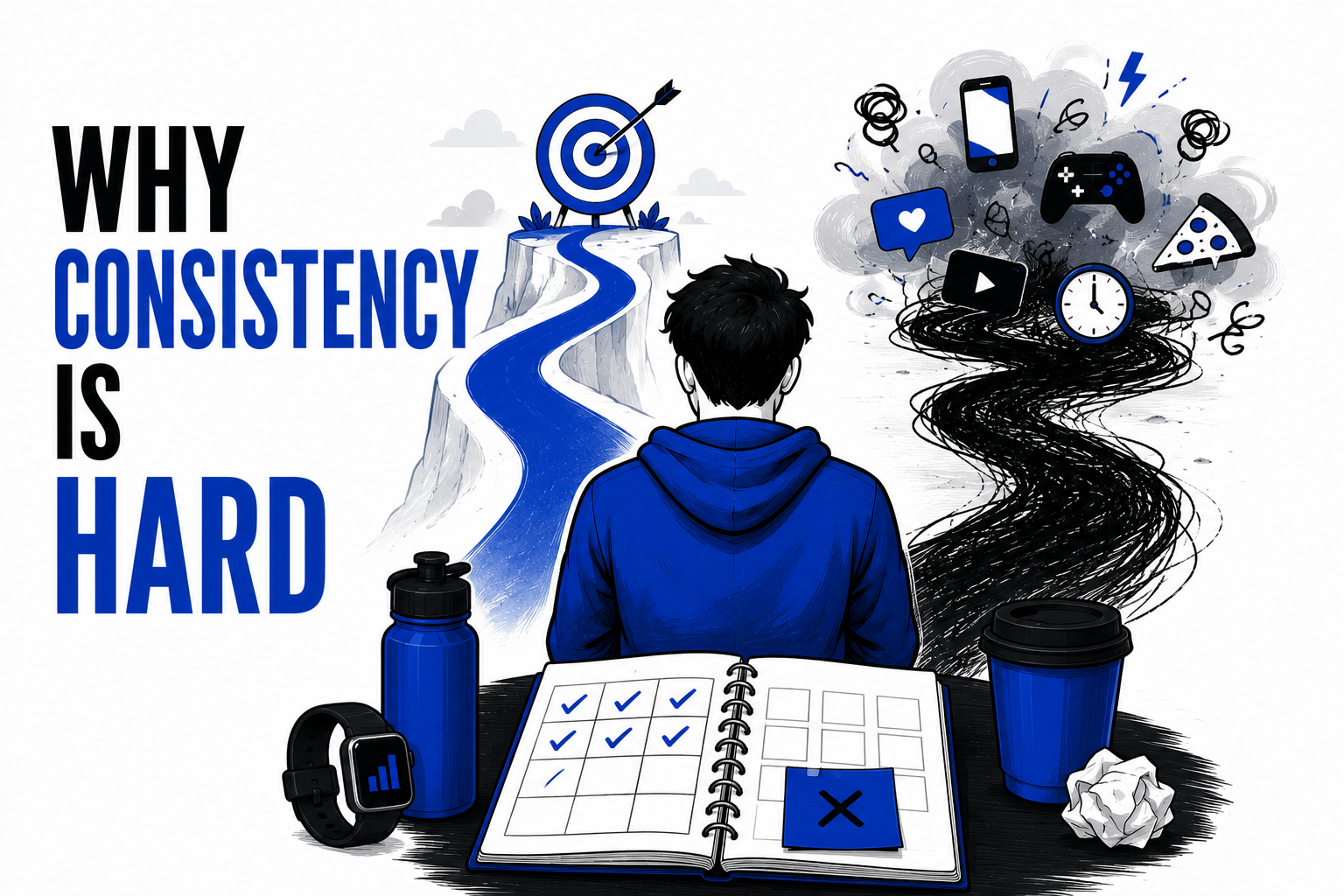
The challenge lies in turning good intentions into consistent behaviour.
Human beings naturally choose actions that provide immediate rewards over those whose benefits appear months or years later.
Exercise demands effort today while many of its greatest rewards remain delayed.
The issue is therefore not laziness.
It is the way the human brain evaluates effort, reward and time.
What Usually Happens?
The journey usually begins with enthusiasm.
Someone decides to improve their health after seeing a medical report, an inspiring success story or the beginning of a new year.
The first few workouts feel exciting.
Visible progress creates confidence.
Eventually, daily responsibilities increase.
Work becomes busier.
Energy declines.
Small interruptions become more frequent.
One missed workout becomes two.
Two become a week.
The routine slowly disappears.
Instead of restarting immediately, many people begin feeling guilty about losing consistency.
That guilt makes returning feel emotionally uncomfortable.
The longer the break continues, the more difficult restarting appears.
The routine has not failed because the body became incapable.
It failed because behaviour gradually changed.
Why Does It Happen?
Understanding why people quit exercising requires looking beyond fitness programmes and into human psychology.
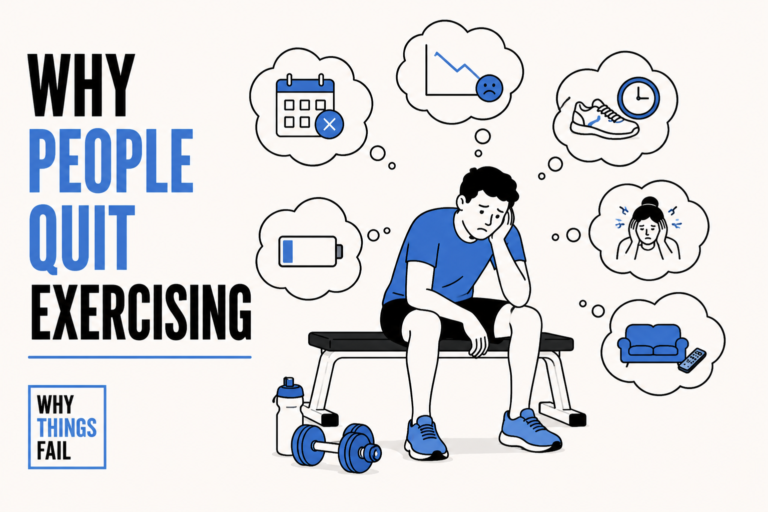
Exercise competes against some of the strongest behavioural forces that influence everyday decision making.
Comfort.
Convenience.
Immediate pleasure.
Mental fatigue.
Social expectations.
Time pressure.
These forces rarely act alone.
They interact, creating a system that slowly encourages inactivity while making exercise feel increasingly difficult.
The Brain Prioritises Immediate Rewards
Behavioural economists describe this tendency as present bias.
People naturally value rewards available today more than rewards available in the future.
Exercise requires immediate effort.
It demands physical discomfort, time and energy.
Its greatest rewards, including better cardiovascular health, lower disease risk and improved longevity, often appear months or years later.
By contrast, watching television, scrolling through social media or resting on the sofa provides instant satisfaction with almost no effort.
The brain does not automatically compare long term value.
It compares immediate experience.
As a result, short term comfort frequently defeats long term health.
Motivation Is An Unreliable System
Many people believe they need to feel motivated before exercising.
This assumption creates one of the biggest behavioural traps.
Motivation naturally rises and falls.
It changes with sleep quality, stress levels, workload, emotions and physical energy.
People who depend entirely on motivation exercise only when exercising feels easy.
The problem is that consistency requires action even when motivation disappears.
Successful habits are rarely built through constant enthusiasm.
They are built through routines that continue regardless of temporary emotional changes.
When motivation becomes the foundation, inconsistency becomes almost inevitable.
Identity Influences Behaviour More Than Goals
Many people set ambitious fitness goals.
Lose twenty kilograms.
Run a marathon.
Build muscle.
Improve appearance.
Goals create direction, but they rarely change identity.
Someone who still believes they are “not an active person” often struggles to maintain behaviours that conflict with that self image.
Psychologists have repeatedly shown that people naturally act in ways that reinforce their existing identity.
Changing behaviour therefore requires more than setting objectives.
It requires gradually seeing oneself as someone who exercises consistently rather than someone who is temporarily trying to become fit.
Without this psychological shift, old habits often return because they remain more consistent with personal identity than new behaviours.
All Or Nothing Thinking Creates Unnecessary Failure
Another common behavioural pattern is perfectionism.
People believe a workout must last an hour.
They believe missing one session means they have ruined the entire week.
This creates unnecessary pressure.
Behavioural psychology suggests that consistency matters far more than perfection.
However, perfectionists often interpret small setbacks as complete failure.
Once this mindset develops, restarting becomes psychologically difficult because people believe they must begin again from the very beginning.
Ironically, the pursuit of perfection often produces inconsistency rather than excellence.
Decision Fatigue Gradually Reduces Self Control
Every day requires hundreds of decisions.
Work responsibilities.
Family commitments.
Financial concerns.
Social obligations.
By the evening, mental energy has often been depleted.
Exercise then competes against a brain that has already spent much of its capacity making decisions.
Behavioural researchers describe this as decision fatigue.
When mental resources decline, people naturally choose behaviours requiring the least effort.
Resting becomes easier than exercising.
Ordering takeaway becomes easier than preparing nutritious meals.
These decisions appear insignificant individually.
Repeated daily, they gradually reshape long term health outcomes.
Social Environment Quietly Shapes Behaviour
Human behaviour is strongly influenced by environment.
People surrounded by active friends, supportive family members and healthy routines often find consistency easier because exercise becomes socially normal.
The opposite is equally true.
Environments that reward convenience, long working hours, excessive screen time and sedentary lifestyles quietly discourage physical activity.
Most people believe they make health decisions independently.
In reality, many choices are shaped by the expectations, routines and behaviours of the people around them.
Exercise is therefore not only an individual decision.
It is also a product of the environment in which that decision is made.
Warning Signs
People rarely stop exercising overnight. The process usually begins with subtle behavioural changes that seem harmless but gradually weaken consistency.
One warning sign is relying entirely on motivation. When exercise depends on feeling inspired, it becomes vulnerable to stress, fatigue and changing emotions. Motivation naturally fluctuates, making routines increasingly inconsistent.
Another warning sign is setting unrealistic expectations. Many people expect visible physical changes within a few weeks. When progress slows, disappointment replaces enthusiasm. The exercise routine is judged as ineffective even though meaningful health improvements often occur long before dramatic physical changes become visible.
Constantly changing workout programmes is another indicator that psychology has begun replacing consistency. Instead of improving execution, people search for the perfect routine, believing a different exercise plan will solve the problem. The issue is rarely the programme itself. It is the inability to maintain one long enough for results to appear.
Negative self talk also signals growing behavioural risk. Missing a few workouts becomes evidence of personal failure rather than a temporary interruption. This damages confidence and makes returning feel emotionally uncomfortable.
Perhaps the most overlooked warning sign is treating exercise as an isolated task instead of part of daily life. When physical activity remains separate from existing routines, it requires constant decision making. The more decisions required, the greater the likelihood of abandoning the habit.
These warning signs are often ignored because they develop gradually. Each missed workout feels insignificant, yet together they reshape behaviour until inactivity becomes the new normal.
What Could Have Prevented It?
Most people do not need greater willpower.
They need better systems.
Exercise becomes sustainable when it depends less on daily motivation and more on consistent routines. Attaching physical activity to existing habits reduces the number of decisions required each day. Behaviour becomes automatic instead of negotiable.
Setting realistic expectations also prevents unnecessary disappointment. Better sleep, improved mood, increased energy and stronger mental wellbeing often appear before dramatic physical transformation. Recognising these early benefits helps maintain commitment while larger goals develop gradually.
Planning for interruptions is equally important. Holidays, illness, busy work periods and family responsibilities are inevitable. People who expect temporary setbacks are more likely to restart quickly because interruptions are viewed as normal rather than permanent failure.
Creating supportive environments also strengthens consistency. Keeping exercise equipment accessible, reducing unnecessary barriers and surrounding oneself with people who value healthy habits makes positive behaviour easier to maintain.
Most importantly, success depends on measuring consistency rather than perfection. Missing one workout has little long term impact. Allowing one missed workout to become several weeks of inactivity has far greater consequences.
Lessons
The reasons people quit exercising reveal broader lessons about human behaviour.
People rarely fail because they lack knowledge. Most understand that regular exercise improves health, reduces disease risk and supports emotional wellbeing. The challenge lies in consistently acting upon that knowledge.
Another lesson is that habits outperform motivation. Motivation creates action, but habits sustain it. People who rely on temporary enthusiasm often struggle when life becomes demanding. Those who develop structured routines continue even when motivation declines.
The investigation also demonstrates that environment influences behaviour more than determination alone. Healthy choices become easier when surroundings support them and significantly harder when daily routines encourage inactivity.
Perhaps the most important lesson is that lasting change is created through small repeated actions rather than dramatic transformations. Long term health is rarely determined by extraordinary effort. It is determined by ordinary behaviours repeated consistently over many years.
Failure Pattern
The dominant pattern behind quitting exercise is Short Term Thinking reinforced by Emotional Decision Making.
People naturally choose immediate comfort over delayed rewards. After a demanding day, resting provides instant relief while exercise requires effort before producing meaningful benefits.
This pattern strengthens over time. Missing one workout reduces momentum. Reduced momentum makes restarting feel more difficult. Guilt replaces confidence. Eventually inactivity becomes the default behaviour because it requires less psychological effort.
The same behavioural pattern appears in personal finance, business, education and entrepreneurship. Humans consistently prioritise immediate comfort unless systems encourage long term thinking.
The issue is therefore not physical ability.
It is behavioural design.
Hidden Lesson
The greatest obstacle to regular exercise is rarely the body.
It is the way the mind responds to effort.
People often believe they quit because they became too busy, too tired or insufficiently motivated.
The deeper reality is that daily decisions gradually reshape identity. Every skipped workout reinforces the belief that exercise is optional. Every repeated habit strengthens the behaviour that follows.
The most important insight is that consistency is not created by extraordinary discipline.
It is created by ordinary decisions repeated until they become part of who a person believes they are.
Failure Scorecard
| Area | Score | Explanation |
| Discipline | 5/10 | Initial commitment is often strong but difficult to maintain when routines are disrupted. |
| Decision Making | 5/10 | Short term comfort frequently outweighs long term health benefits. |
| Risk Management | 6/10 | People often underestimate the long term consequences of prolonged inactivity. |
| Long Term Thinking | 4/10 | Immediate effort is given greater importance than future wellbeing. |
| Health Knowledge | 7/10 | Most people understand the benefits of exercise but struggle to apply that knowledge consistently. |
| Emotional Control | 5/10 | Stress, guilt and frustration often influence exercise decisions. |
| Planning | 4/10 | Many begin exercising without realistic routines that fit daily life. |
| Adaptability | 6/10 | Temporary setbacks frequently become permanent because routines are not adjusted to changing circumstances. |
Key Takeaways
- People rarely quit exercising because they are lazy.
- Behavioural psychology explains exercise failure better than motivation alone.
- Present bias encourages immediate comfort instead of delayed health benefits.
- Habits consistently outperform temporary motivation.
- Identity influences behaviour more strongly than ambitious goals.
- Perfectionism often creates inconsistency instead of progress.
- Supportive environments make healthy behaviour easier to maintain.
- Long term health depends on repeated daily decisions rather than occasional intense effort.
Frequently Asked Questions
Why do people quit exercising even when they know it is good for them?
People often prioritise immediate comfort over delayed rewards. Behavioural biases, emotional decision making and inconsistent routines usually outweigh knowledge about long term health benefits.
Is lack of motivation the main reason people stop exercising?
No. Motivation naturally changes over time. People who depend solely on motivation are more likely to quit than those who build consistent habits and structured routines.
Why is it so difficult to restart after taking a break?
Many people interpret temporary interruptions as personal failure. This creates guilt, reduces confidence and makes restarting feel emotionally difficult even though physical fitness can often be rebuilt gradually.
How does psychology influence exercise habits?
Psychological factors such as present bias, perfectionism, identity, decision fatigue and social influence all affect whether exercise becomes a lasting habit or an abandoned goal.
What is the biggest behavioural mistake people make?
The biggest mistake is expecting immediate results while ignoring the value of consistency. Small repeated actions create lasting health improvements more effectively than occasional bursts of intense effort.
Conclusion
People do not usually quit exercising because they lack knowledge or physical ability. They quit because everyday decisions are shaped by psychological patterns that consistently favour immediate comfort over delayed rewards.
Understanding these patterns changes the conversation. Exercise becomes less about finding the perfect workout and more about recognising how habits, identity, environment and decision making quietly determine whether healthy intentions become lifelong behaviour or another forgotten goal.