Quick Answer
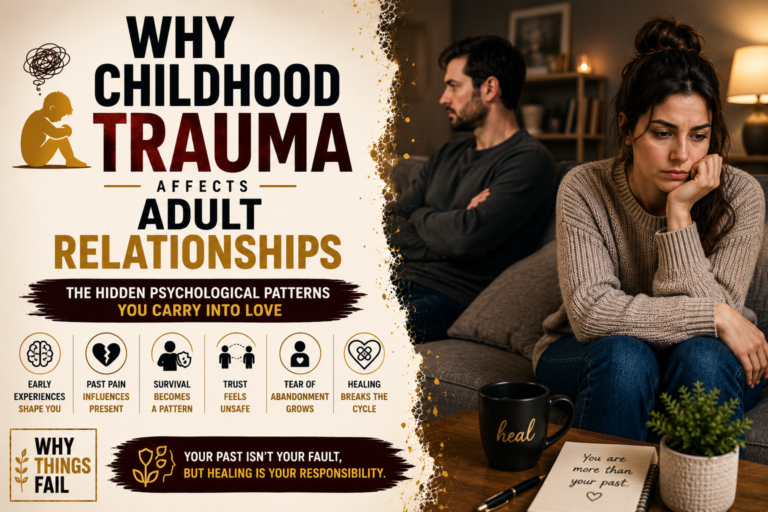
Childhood trauma affects adult relationships because early experiences shape how people develop trust, emotional security, communication and attachment. When these early experiences involve neglect, abuse, rejection or instability, the brain often learns survival behaviours that may protect a child but create difficulties in healthy adult relationships.
Introduction
Many people enter adulthood believing that childhood belongs in the past.
They assume that growing older naturally leaves painful memories behind and that adult relationships are shaped only by present choices.
Psychological research suggests something very different.
The experiences children have during their earliest years often become the foundation upon which future relationships are built. Long before someone chooses a romantic partner, forms close friendships or becomes a parent, their brain has already learned what love, safety, trust and emotional connection are supposed to look like.
This explains why two people can experience the same disagreement yet respond in completely different ways. One person may communicate calmly while another withdraws, becomes defensive or fears abandonment.
The difference often has less to do with the present situation and more to do with lessons learned decades earlier.
Childhood trauma does not simply create painful memories.
It shapes expectations, emotional responses and relationship patterns that can continue long into adulthood unless they are recognised and understood.
Understanding why childhood trauma affects adult relationships is therefore not about blaming parents or revisiting the past for its own sake.
It is about understanding how early experiences influence adult behaviour and why the same relationship struggles often repeat across different stages of life.
What Is Childhood Trauma?
Childhood trauma refers to deeply distressing experiences during early development that overwhelm a child’s ability to cope.
These experiences may include emotional neglect, physical abuse, sexual abuse, domestic violence, parental substance misuse, chronic criticism, abandonment, bullying or growing up in an unpredictable environment.
Trauma is not defined only by what happened.
It is also shaped by how a child’s developing brain interpreted those experiences.
A child who repeatedly feels unsafe, ignored or rejected may learn that relationships are unpredictable or emotionally dangerous. Because children depend on caregivers for survival, they adapt their behaviour to cope with these environments.
These adaptations often help children survive difficult circumstances.
The challenge is that the same survival strategies may later interfere with healthy adult relationships.
The Biggest Myth
One of the most common myths is that childhood trauma only affects people who experienced extreme abuse.
This misunderstanding causes many adults to dismiss their own experiences because they compare them with more severe forms of trauma.
In reality, trauma exists on a spectrum.
Repeated emotional neglect, inconsistent caregiving, constant criticism or growing up without emotional safety can shape the developing brain just as powerfully as more visible forms of adversity.
Another misconception is that people should simply move on once they become adults.
The brain does not separate childhood experiences from adult behaviour so easily.
Neural pathways formed during early development influence emotional regulation, attachment, trust and decision making throughout life.
The issue is therefore not whether someone remembers every childhood experience.
The issue is whether those experiences continue influencing present relationships without conscious awareness.
What Usually Happens?
Many adults affected by childhood trauma do not recognise its influence immediately.
Instead, they notice recurring relationship problems.
They may struggle to trust others despite wanting close connections.
Some become emotionally distant whenever intimacy increases.
Others become highly anxious whenever they fear rejection or separation.
Small disagreements may trigger intense emotional reactions that seem disproportionate to the situation.
Some people repeatedly choose emotionally unavailable partners.
Others remain in unhealthy relationships because instability feels strangely familiar.
Although these experiences appear different on the surface, they often reflect the same underlying process.
Early emotional experiences continue shaping adult expectations, reactions and relationship choices.
Why Does It Happen?
Understanding why childhood trauma affects adult relationships requires looking beyond individual behaviours.
The real question is not why someone struggles to trust.
The deeper question is why the brain learned that trust was unsafe in the first place.
Relationship patterns rarely appear without cause.
They develop through years of repeated emotional experiences that gradually shape how the brain interprets safety, connection and vulnerability.
H3: Attachment Styles Shape Future Relationships
One of the most influential psychological theories explaining adult relationships is attachment theory.
During childhood, caregivers teach children what relationships feel like.
When caregivers consistently provide safety, comfort and emotional support, children often develop secure attachment. They learn that relationships can be trusted and that emotional needs can be expressed without fear.
When caregiving is inconsistent, neglectful or frightening, different attachment patterns may develop.
Some children become anxious because attention is unpredictable.
Others become avoidant because expressing emotions rarely brings comfort.
Some experience disorganised attachment because the very people who should provide safety also become a source of fear.
These attachment patterns do not disappear when childhood ends.
Instead, they become internal relationship templates that influence romantic relationships, friendships and family dynamics throughout adulthood.
H3: The Brain Learns Survival Before It Learns Love
Children cannot choose the environment in which they grow up.
Instead, their brains adapt.
If expressing emotions leads to punishment, the brain learns emotional suppression.
If affection is inconsistent, the brain learns constant vigilance.
If conflict creates danger, the brain becomes highly sensitive to emotional threats.
These adaptations are remarkably intelligent during childhood because they increase the chances of emotional survival.
The difficulty begins when these same protective behaviours continue into adult relationships where the original danger no longer exists.
Someone who learned to expect rejection may interpret neutral situations as signs of abandonment.
Someone who learned emotional independence too early may struggle to accept support even from trustworthy partners.
The brain continues following survival rules that were written years earlier.
H3: Emotional Regulation Develops During Childhood
Children are not born knowing how to regulate emotions.
They learn through repeated interactions with emotionally available caregivers.
When adults consistently help children manage fear, sadness, frustration and disappointment, healthy emotional regulation gradually develops.
Trauma interrupts this learning process.
Instead of learning how to process difficult emotions, children often learn how to avoid them, suppress them or become overwhelmed by them.
Years later, ordinary relationship conflicts may activate these same emotional patterns.
A disagreement about household responsibilities can suddenly feel like complete rejection.
A delayed text message may create intense anxiety.
Constructive criticism may feel like personal abandonment.
The present situation is rarely the full explanation.
Past emotional learning continues shaping present emotional reactions.
H3: Trust Is Built Through Repeated Safety
Trust is rarely created by words alone.
It develops through consistent experiences.
Children who repeatedly experience honesty, protection and emotional reliability gradually develop confidence in other people.
Children exposed to betrayal, broken promises or emotional inconsistency often reach different conclusions.
They may believe that people eventually leave.
That vulnerability leads to pain.
That depending on others creates disappointment.
These beliefs usually remain unconscious.
Yet they influence countless adult decisions, from choosing romantic partners to responding during conflict.
This is why some adults desperately seek closeness while simultaneously fearing it.
Their conscious mind desires connection.
Their nervous system continues expecting emotional danger.
Why Does It Happen?
H3: Trauma Changes The Way The Brain Responds To Stress
Childhood trauma affects more than memories. It influences the nervous system.
Children who grow up in unpredictable or unsafe environments often develop a heightened stress response. Their brains become skilled at detecting danger because survival depends upon recognising potential threats quickly.
This adaptation is valuable during childhood.
It becomes problematic when the same response continues into adulthood.
A partner arriving home late, a disagreement during dinner or a change in communication may be interpreted as signs of rejection or abandonment rather than ordinary relationship events.
Psychologists refer to this as hypervigilance.
Instead of evaluating situations objectively, the brain reacts according to past experiences. Relationships become emotionally exhausting because the nervous system constantly prepares for danger that no longer exists.
H3: Childhood Beliefs Become Adult Relationship Rules
Every child develops beliefs about themselves and other people.
These beliefs are rarely formed through logic.
They develop through repeated emotional experiences.
A child who receives affection only after meeting unrealistic expectations may conclude that love must always be earned.
A child who is repeatedly ignored may believe their feelings do not matter.
A child exposed to criticism may believe they are never good enough.
These beliefs gradually become internal rules that influence adult relationships.
People who believe they are unworthy of love often tolerate unhealthy relationships because mistreatment feels familiar.
Others avoid intimacy altogether because rejection appears inevitable.
The problem is not that these beliefs are true.
The problem is that they feel true because they were reinforced during childhood.
H3: Repetition Creates Familiarity
One of the most misunderstood aspects of trauma is repetition.
People often assume adults consciously choose unhealthy relationships.
Behavioural psychology suggests something more complex.
The human brain is naturally drawn towards what feels familiar, even when that familiarity is painful.
Someone raised in an emotionally unpredictable home may unconsciously feel uncomfortable in calm and stable relationships because stability feels unfamiliar.
Instead, emotionally unavailable partners or inconsistent relationships may appear strangely attractive because they resemble earlier emotional experiences.
This does not happen because people enjoy suffering.
It happens because familiarity is often mistaken for safety.
Until these unconscious patterns are recognised, similar relationship dynamics can repeat across different partners and different stages of life.
H3: Shame Silences Emotional Healing
Many survivors of childhood trauma carry deep feelings of shame.
They believe their emotional struggles reflect personal weakness rather than understandable responses to difficult experiences.
This belief often prevents honest communication.
People hide vulnerability.
They suppress emotions.
They avoid asking for support.
Ironically, the strategies that once protected them from emotional pain become barriers to emotional intimacy.
Healthy relationships require openness, trust and emotional honesty.
Shame encourages the opposite.
It convinces people that revealing their true emotions will result in rejection or criticism.
As a result, emotional distance gradually replaces genuine connection.
Warning Signs
The effects of childhood trauma often appear through recurring relationship patterns rather than obvious memories.
One warning sign is an intense fear of abandonment. Small changes in communication may trigger anxiety that seems disproportionate to the situation.
Another warning sign is avoiding emotional intimacy. Some people keep partners at a distance because closeness feels unsafe.
Others become people pleasers, constantly seeking approval while neglecting their own emotional needs.
Difficulty trusting even reliable partners is another common indicator. Past experiences create expectations of betrayal even when current relationships show no evidence of danger.
Strong emotional reactions during ordinary disagreements can also signal unresolved trauma. Minor conflicts may activate childhood fears that remain stored within the nervous system.
These warning signs are often ignored because they become normal. People assume that everyone experiences relationships in the same way without recognising that their reactions may reflect earlier emotional learning.
What Could Have Prevented It?
No childhood is perfect.
However, many long term effects of trauma can be reduced when children consistently experience emotional safety, stability and supportive relationships.
Emotionally available caregivers help children develop secure attachment, healthy emotional regulation and confidence in trusting others.
When trauma does occur, early intervention can significantly reduce its long term impact.
Supportive adults, counselling, safe environments and opportunities to express emotions help children process difficult experiences before unhealthy coping patterns become deeply established.
For adults, prevention becomes awareness.
Understanding that present relationship struggles may have roots in childhood creates opportunities to respond differently rather than repeating automatic emotional patterns.
Healing does not erase childhood experiences.
It changes the way those experiences influence present decisions.
Lessons
Childhood trauma teaches lessons that extend far beyond relationships.
One lesson is that early experiences shape expectations more powerfully than most people realise. People often respond to present situations according to emotional rules developed many years earlier.
Another lesson is that behaviour always has a history. Actions that appear irrational often become understandable when viewed through the context of childhood experiences.
A further lesson is that emotional safety is not a luxury. It is essential for healthy psychological development.
Perhaps the most important lesson is that recognising hidden patterns creates the possibility of changing them. Awareness does not rewrite the past, but it can influence future relationships.
Failure Pattern
The dominant pattern behind relationship difficulties caused by childhood trauma is Emotional Decision Making reinforced by Fear of Rejection and Insecure Attachment.
Children adapt to survive emotionally difficult environments.
Those adaptations become relationship habits.
Fear encourages emotional withdrawal.
Anxiety encourages reassurance seeking.
Shame encourages silence.
Avoidance discourages vulnerability.
These patterns repeat because they once protected the individual from emotional pain.
The tragedy is that strategies designed for survival often prevent healthy adult relationships from developing.
Hidden Lesson
The deepest impact of childhood trauma is not the painful event itself.
It is the invisible story the child creates to explain that experience.
When children conclude they are unlovable, unsafe or unimportant, those beliefs quietly influence relationships for years.
Adult relationship struggles are therefore rarely about the present alone.
They are often conversations between today’s partner and yesterday’s emotional wounds.
Failure Scorecard
| Area | Score | Explanation |
| Emotional Regulation | 4/10 | Trauma often makes managing emotions during conflict significantly more difficult. |
| Decision Making | 5/10 | Relationship choices may be influenced by unconscious childhood beliefs rather than objective judgement. |
| Trust | 3/10 | Early betrayal or neglect frequently creates lasting difficulty trusting others. |
| Long Term Thinking | 6/10 | Emotional survival often takes priority over healthy relationship development. |
| Self Awareness | 5/10 | Many people remain unaware that childhood experiences continue shaping adult behaviour. |
| Emotional Control | 4/10 | Strong emotional triggers may override rational responses during stressful situations. |
| Communication | 5/10 | Fear of rejection often limits honest emotional expression. |
| Adaptability | 7/10 | With awareness and support, relationship patterns can gradually change over time. |
Key Takeaways
- Childhood trauma influences adult relationships by shaping attachment, trust and emotional regulation.
- Survival behaviours that protect children may become barriers to healthy intimacy in adulthood.
- Fear of abandonment and fear of vulnerability often originate from early emotional experiences.
- Familiar relationship patterns are not always healthy relationship patterns.
- Behaviour usually reflects learned emotional responses rather than personal weakness.
- Healing begins with recognising unconscious patterns instead of simply managing symptoms.
- Secure relationships are built through consistent emotional safety and trust.
- Understanding the past helps explain present behaviour without allowing the past to define the future.
Frequently Asked Questions
Why does childhood trauma affect adult relationships?
Childhood trauma influences brain development, attachment patterns and emotional regulation. These early experiences shape how adults trust, communicate and respond to intimacy.
Can childhood trauma affect someone even if they do not remember it?
Yes. Many emotional patterns develop during early childhood without conscious memory. The nervous system may still respond to situations based on those early experiences.
What is the most common relationship problem linked to childhood trauma?
Difficulty trusting others is one of the most common effects. Many people also experience fear of abandonment, emotional avoidance or intense reactions during conflict.
Can healthy relationships help people heal from childhood trauma?
Supportive and emotionally safe relationships can encourage healing by creating new experiences that gradually challenge old beliefs and attachment patterns.
Does everyone with childhood trauma have relationship problems?
No. The impact depends on many factors, including the type of trauma, protective relationships, personal resilience and access to support. However, unresolved trauma increases the likelihood of recurring relationship difficulties.
Conclusion
Childhood trauma affects adult relationships because the human brain remembers emotional experiences long after specific events have faded. The beliefs formed during childhood quietly shape trust, intimacy, communication and emotional responses in ways that often remain invisible.
Understanding these hidden psychological patterns changes the conversation from asking, “What is wrong with this relationship?” to asking, “What experiences taught the mind to expect relationships to work this way?” That shift reveals that lasting relationship difficulties are often less about the present and more about emotional lessons learned long before adulthood.