Quick Answer
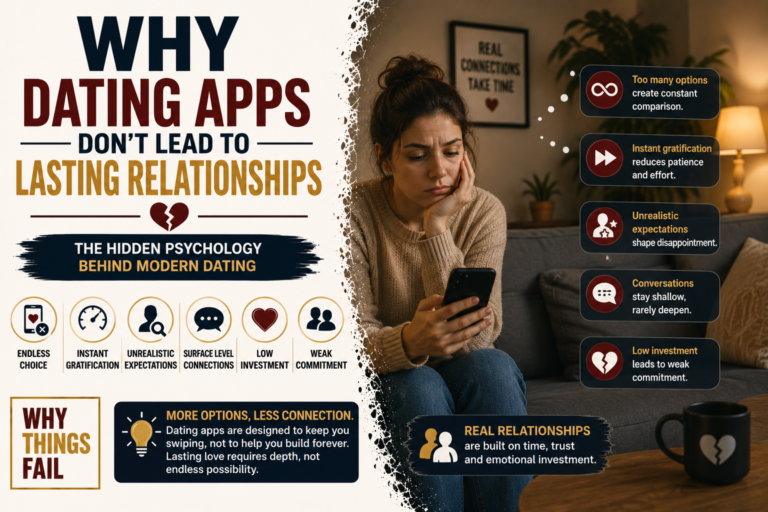
Dating apps do not automatically prevent lasting relationships. However, they often encourage behaviours that make long term commitment more difficult. Endless choice, instant gratification, unrealistic expectations, emotional decision making and weak relationship investment can gradually reduce the likelihood of building stable and meaningful partnerships.
Introduction
Dating apps have transformed modern relationships.
Millions of people now meet potential partners through their smartphones rather than through friends, workplaces or social gatherings. Finding someone new has become faster, easier and more convenient than ever before.
Yet despite this unprecedented access to potential partners, many users report feeling frustrated, emotionally exhausted and increasingly sceptical about finding a lasting relationship.
This presents an interesting contradiction.
If technology has made meeting people easier, why do so many users still struggle to build meaningful long term relationships?
The answer cannot simply be that people are choosing the wrong partners.
Nor can it be explained by technology alone.
Dating apps have changed more than the way people meet. They have changed how people evaluate attraction, make relationship decisions, perceive commitment and respond to uncertainty.
Understanding why dating apps often fail to create lasting relationships therefore requires looking beyond the applications themselves. It requires examining the psychology, incentives and behavioural patterns that influence modern dating.
What Is The Relationship Failure Being Discussed?
Relationship failure in this context does not mean every relationship that begins through a dating app eventually ends.
Many successful marriages and long term partnerships begin online.
The issue is broader.
It concerns why many dating app users experience repeated cycles of short conversations, brief relationships, emotional disappointment and constant searching without reaching lasting commitment.
The technology succeeds in creating introductions.
It often struggles to support deeper emotional investment.
This distinction matters because finding a partner and building a relationship require very different psychological skills.
Meeting someone depends largely on opportunity.
Maintaining a relationship depends on trust, communication, emotional maturity and shared commitment.
Dating apps excel at the first task.
The second remains entirely human.
The Biggest Myth
The most common belief is simple.
More choice leads to better relationships.
At first glance this seems logical.
If someone can meet hundreds or even thousands of potential partners, finding the perfect match should become easier.
Behavioural economics suggests otherwise.
When people face too many choices, decision quality often declines.
Psychologists describe this as choice overload.
Instead of feeling confident, individuals become less satisfied with their decisions because they continue wondering whether an even better option exists.
Dating apps create an environment where alternatives are always visible.
Every swipe suggests another possibility.
Every new match creates another comparison.
Commitment becomes psychologically more difficult because choosing one person often feels like rejecting countless unknown opportunities.
The challenge is therefore not a shortage of options.
It is an abundance of options that continuously compete for attention.
What Usually Happens?
The experience follows a familiar pattern.
A person joins a dating app with genuine intentions.
They receive matches and begin conversations.
Some conversations disappear after a few messages.
Others develop into dates.
A relationship may begin but often ends after weeks or months.
Instead of reflecting on the experience, the user returns to the app where new matches provide fresh optimism.
The cycle begins again.
Each unsuccessful experience gradually influences expectations.
Trust declines.
Patience decreases.
Emotional investment becomes more cautious.
Although every story is different, the behavioural pattern remains remarkably consistent.
The platform continues offering new opportunities while reducing the incentive to fully develop existing connections.
Why Does It Happen?
The reasons extend far beyond technology.
Dating apps expose fundamental aspects of human psychology that have always existed. Their design simply amplifies behaviours that already influence decision making.
The issue is not that people suddenly became incapable of commitment.
It is that the environment increasingly rewards behaviours that compete with commitment.
Choice Overload Reduces Satisfaction
Behavioural researchers have repeatedly shown that excessive choice can make decisions more difficult rather than easier.
Dating apps present an almost unlimited number of potential partners.
Initially this feels empowering.
Eventually it becomes mentally exhausting.
Every decision carries uncertainty.
Should another profile be explored?
Could someone more attractive appear tomorrow?
Was rejecting the previous match a mistake?
Instead of appreciating one meaningful connection, users continue evaluating alternatives.
Relationships require investment after a choice has been made.
Dating apps encourage continued evaluation even after that choice.
This isn’t just a theory research backs it up, though it isn’t fully settled. Studies comparing daters who chose from large versus small pools of potential partners found that those with more options were less satisfied with their choice and more likely to change their mind afterward, and separate research has linked an abundance of visible alternatives to a “rejection mindset,” where people become quicker to dismiss potential partners rather than invest in one. Not every study agrees, however some newer research suggests more options can also increase perceived compatibility with a chosen match, so the effect likely depends on how choice is presented, not choice alone.
Instant Gratification Weakens Patience
Modern applications are designed around immediate rewards.
A new match creates excitement.
A notification produces anticipation.
A compliment provides emotional validation.
These small rewards activate the brain’s reward system.
Over time, users may become more focused on receiving new matches than building deeper relationships.
The excitement of beginning something new can become psychologically stronger than the slower process of developing trust, resolving disagreements and creating emotional security.
Long term relationships require delayed gratification.
Dating platforms naturally encourage immediate gratification.
These incentives often move in opposite directions.
Emotional Decision Making Replaces Careful Judgement
Many dating decisions occur within seconds.
A photograph.
A short biography.
Several interests.
A brief first impression.
These limited signals encourage rapid emotional judgements rather than thoughtful evaluation.
People frequently reject potential partners based on superficial characteristics while overlooking qualities that become important during long term relationships.
Kindness.
Reliability.
Emotional intelligence.
Conflict resolution.
Shared values.
These characteristics rarely reveal themselves within the first few seconds of viewing a profile.
Yet they often determine whether a relationship succeeds years later.
The Fear Of Better Opportunities
One of the strongest psychological forces influencing dating apps is the fear of missing out.
Even after meeting someone compatible, users know thousands of other profiles remain available.
This creates a subtle psychological conflict.
Commitment begins to feel less like gaining one relationship and more like giving up countless future possibilities.
The result is delayed commitment.
People continue searching not because they are unhappy but because they believe someone slightly better might exist.
Ironically, this search often prevents them from fully appreciating genuinely compatible partners already in front of them.
Validation Becomes A Hidden Incentive
Many people download dating apps hoping to find a relationship.
Over time, however, another incentive quietly develops.
Validation.
Receiving matches confirms attractiveness.
Compliments increase confidence.
New conversations provide emotional stimulation.
Without realising it, some users begin seeking validation rather than commitment.
The application becomes less about finding one meaningful relationship and more about repeatedly experiencing positive emotional feedback.
This changes behaviour in subtle ways.
Maintaining existing relationships requires patience, compromise and vulnerability.
Seeking validation requires only another swipe.
These competing incentives gradually influence how people approach dating, often without conscious awareness.
Unrealistic Expectations Create Constant Disappointment
Social media, dating culture and algorithm driven recommendations frequently create unrealistic expectations about compatibility.
Many users begin believing there is a perfect partner waiting to be discovered.
This belief changes how relationships are evaluated.
Instead of asking whether a relationship is healthy and compatible, people ask whether someone even better might exist.
Small disagreements become reasons to leave rather than opportunities to grow together.
Ordinary imperfections become evidence that the relationship is not the right one.
The pursuit of perfection quietly replaces appreciation for compatibility.
This psychological shift explains why many relationships end despite having strong foundations.
The relationship did not necessarily fail because it lacked potential.
It failed because expectations continued rising faster than satisfaction.
Warning Signs
Relationship failure on dating apps rarely begins with one major event. It usually develops through small behavioural patterns that gradually weaken emotional connection.
One warning sign is constantly comparing a current partner with potential alternatives. Instead of investing in the relationship, attention remains focused on what might be available elsewhere. This prevents emotional security from developing.
Another warning sign is losing interest as soon as the excitement of the first few weeks fades. Healthy relationships naturally move from novelty to stability. People who mistake familiarity for incompatibility often leave relationships that could have become stronger over time.
Avoiding meaningful conversations is another indicator. When discussions remain limited to surface level topics, emotional intimacy struggles to develop. Without vulnerability, trust cannot grow.
Many users also become uncomfortable with commitment because they continue viewing relationships as temporary. They keep one foot inside the relationship and the other on the dating app. This mindset reduces emotional investment and increases the likelihood of separation.
Perhaps the clearest warning sign is repeatedly blaming every unsuccessful relationship on bad luck or unsuitable partners without examining personal behaviour. Self reflection becomes difficult when endless alternatives create the illusion that someone else will solve the problem.
These warning signs are frequently ignored because dating apps provide immediate emotional rewards. A disappointing interaction can quickly be replaced by another match, reducing the incentive to understand why previous relationships ended.
What Could Have Prevented It?
The solution is not abandoning technology.
Dating apps simply reflect human behaviour within a digital environment.
The deeper solution involves changing the way people approach relationships.
The first step is recognising that compatibility develops through shared experiences rather than instant chemistry alone. Initial attraction may begin a relationship, but trust, communication and emotional safety sustain it.
Managing expectations is equally important. No relationship remains exciting every day. Stable relationships involve routine, compromise and occasional disagreement. Viewing these experiences as normal rather than as evidence of failure encourages stronger commitment.
Reducing the influence of endless comparison also improves relationship quality. Once a compatible relationship begins, continuing to evaluate alternative partners weakens emotional investment. Commitment requires accepting uncertainty instead of constantly searching for certainty.
Greater self awareness also changes outcomes. People who examine their own communication style, emotional patterns and relationship expectations often identify behaviors contributing to repeated disappointment.
Finally, healthier digital incentives could encourage stronger relationships. Features that reward meaningful conversations rather than endless matching may better align technology with long term relationship success.
Lessons
The investigation into dating apps reveals lessons that extend far beyond romantic relationships.
The first lesson is that more choice does not automatically produce better decisions. Human beings have cognitive limits. Excessive options often create hesitation, dissatisfaction and constant comparison rather than confidence.
The second lesson is that technology shapes behaviour through incentives. When systems reward novelty, speed and frequent engagement, users gradually adopt behaviours supporting those incentives even when they conflict with long term goals.
Another lesson is that meaningful relationships require sustained investment. Emotional security develops slowly through trust, shared experiences and mutual understanding. These qualities cannot be accelerated by algorithms.
Perhaps the most important lesson is that successful relationships depend less on finding a perfect person and more on consistently choosing to build something meaningful with a compatible one.
Failure Pattern
The dominant pattern behind relationship failure on dating apps is Short Term Thinking reinforced by Choice Overload and Emotional Decision Making.
Users become conditioned to expect continuous novelty. New matches provide excitement while existing relationships demand patience, communication and compromise. Over time, the immediate reward becomes more attractive than the delayed reward.
This behavioural pattern appears across many areas of life. Consumers constantly replace products before appreciating them. Investors chase fashionable assets instead of building long term wealth. Businesses pursue rapid expansion while neglecting sustainable growth.
In every case, abundant choice encourages short term satisfaction at the expense of lasting value.
Hidden Lesson
Dating apps do not destroy relationships.
They expose a deeper conflict between human psychology and modern digital incentives.
Relationships require commitment before certainty exists.
Dating platforms encourage continued searching until certainty appears.
That certainty never arrives.
The deeper lesson is that lasting relationships are rarely discovered through endless searching. They are created through consistent emotional investment after the search has ended.
Failure Scorecard
Each area below is scored based on how consistently it appears as a contributing factor across common dating-app relationship patterns not a clinical or diagnostic measure.
| Area | Score | Explanation |
| Decision Making | 5/10 | Decisions are often influenced by appearance and immediate emotions rather than long term compatibility. |
| Emotional Control | 5/10 | Validation, rejection and uncertainty frequently influence behaviour. |
| Long Term Thinking | 4/10 | Immediate attraction often receives greater attention than lasting compatibility. |
| Planning | 4/10 | Many users begin dating without clear relationship intentions or expectations. |
| Adaptability | 6/10 | Some users learn from previous relationships, while others repeat the same behavioural patterns. |
| Self Awareness | 5/10 | Personal behaviours are often overlooked while external factors receive most of the blame. |
| Commitment | 4/10 | Endless alternatives can weaken willingness to invest fully in one relationship. |
| Communication | 6/10 | Healthy communication exists in successful relationships but often develops too late or remains superficial. |
Key Takeaways
- Dating apps increase opportunities to meet people but cannot create commitment.
- Choice overload often reduces satisfaction instead of improving decisions.
- Emotional investment matters more than the number of available matches.
- Constant comparison weakens appreciation for compatible partners.
- Instant gratification competes with the patience required for lasting relationships.
- Validation can quietly become more rewarding than genuine connection.
- Healthy relationships are built through trust, communication and shared experiences.
- Long term commitment requires accepting uncertainty rather than endlessly searching for perfection.
Frequently Asked Questions
Why do dating apps often fail to create lasting relationships?
Dating apps often encourage behaviours such as constant comparison, instant gratification and short term decision making. These behaviours make sustained emotional investment more difficult.
Do dating apps actually reduce relationship success?
Not necessarily. Many successful couples meet through dating apps. The challenge lies in how people use these platforms and how digital incentives influence relationship behaviour.
What is the biggest psychological reason dating apps fail?
Choice overload is one of the biggest factors. Having endless alternatives can reduce commitment, increase comparison and make people less satisfied with compatible partners.
Can lasting relationships begin on dating apps?
Yes. Lasting relationships can and do begin on dating apps. Success depends more on communication, shared values, emotional maturity and commitment than on the platform itself.
Why do people keep returning to dating apps?
Many users return because the apps provide immediate emotional rewards through new matches and validation. These rewards can become psychologically reinforcing even after repeated relationship disappointments.
Conclusion
Dating apps have changed how relationships begin, but they have not changed the psychological foundations that allow relationships to endure. Trust, vulnerability, patience and commitment remain as essential today as they were before digital platforms existed.
The investigation reveals that lasting relationships rarely fail because technology introduced too many choices. They fail when those choices reshape human behaviour, encouraging people to keep searching for a better possibility instead of investing in the meaningful possibility they have already found.