Quick Answer
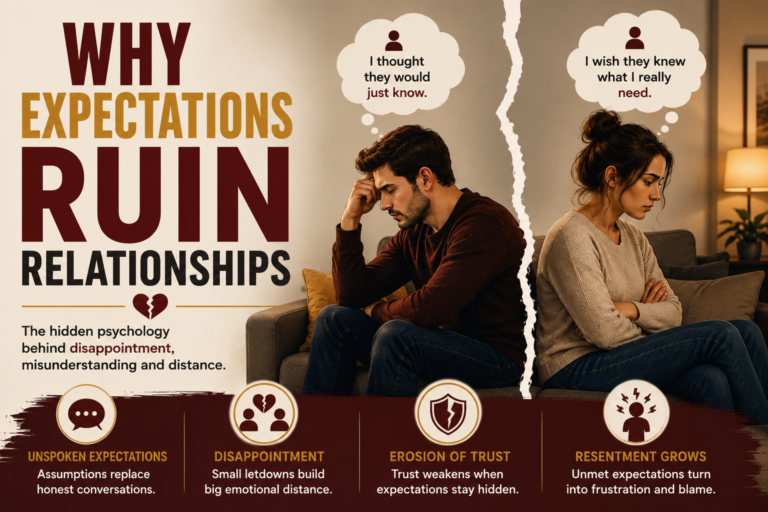
Expectations ruin relationships when they replace honest communication with silent assumptions. People often expect partners, family members or friends to understand their needs without expressing them. When reality fails to match these expectations, disappointment turns into resentment, trust weakens and emotional distance gradually grows.
Introduction
Every relationship begins with expectations.
Some are spoken openly. Others remain unspoken, existing only in the minds of the people involved.
We expect our partner to understand us without explanation. We expect friends to remain loyal. We expect family members to offer unconditional support. We expect effort to be returned with equal effort.
Many of these expectations appear reasonable.
The problem begins when expectations become assumptions rather than conversations.
Relationships rarely collapse because of one major disagreement. More often, they weaken through countless moments of unmet expectations that slowly erode trust, appreciation and emotional connection.
This pattern appears across romantic relationships, marriages, friendships, business partnerships and even professional teams. Different people, different situations and different cultures often produce the same outcome.
Why?
Because the true cause is rarely the expectation itself.
It is the psychology behind how people create expectations, interpret disappointment and respond when reality does not match the story they have created in their minds.
Understanding why expectations ruin relationships requires looking beyond communication advice. It requires examining human behaviour, emotional decision making, cognitive biases and the invisible assumptions that shape every relationship.
What Is Relationship Failure Caused by Expectations?
Relationship failure caused by expectations occurs when emotional assumptions consistently replace clear communication.
Expectations are a natural part of every human relationship. They help people define trust, commitment, respect and shared responsibility.
Failure begins when expectations become invisible rules that only one person knows exist.
One partner expects frequent communication.
The other believes giving personal space demonstrates trust.
One friend expects immediate support during difficult times.
The other assumes helping only when asked is respectful.
Neither person intends to cause harm.
The conflict develops because both individuals are responding to different emotional standards without recognising the difference.
The result is often disappointment that feels personal even though the real problem is misunderstanding.
The Biggest Myth
The most common belief about healthy relationships is simple.
If someone truly loves or cares about you, they should automatically know what you need.
This belief sounds romantic.
Psychologically, it creates one of the most damaging expectations any relationship can carry.
Human beings cannot accurately interpret thoughts, emotions and intentions without communication.
Behavioural psychology shows that people naturally interpret situations through their own experiences, values and emotional needs.
This means two people can experience the same event and assign completely different meanings to it.
A forgotten anniversary may represent carelessness to one partner.
To the other, it may simply reflect stress or distraction.
Neither interpretation exists as objective truth.
The conflict develops because expectations remain invisible until disappointment exposes them.
Healthy relationships are therefore not built on mind reading.
They are built on shared understanding.
What Usually Happens?
Most relationships damaged by expectations follow a predictable pattern.
Two people develop emotional closeness.
Unspoken expectations gradually increase.
Daily interactions begin carrying hidden emotional meaning.
Small disappointments appear.
Rather than discussing them openly, one person assumes the other should already understand.
Resentment slowly replaces curiosity.
Communication becomes defensive.
Trust weakens.
Emotional distance grows even though both individuals may still care deeply about one another.
By the time the relationship appears to fail, the real damage has often been developing quietly for months or even years.
The final argument is rarely the true cause.
It is usually the moment when accumulated disappointment finally becomes impossible to ignore.
Why Do Expectations Ruin Relationships?
This is where the deeper investigation begins.
Relationships are not damaged because people have expectations.
They are damaged because human psychology shapes expectations in ways people rarely recognise.
Most expectations are not created through logic.
They develop through childhood experiences, family dynamics, cultural values, previous relationships, personal insecurities and emotional needs.
People often believe their expectations are obvious because they feel natural.
In reality, they are deeply personal.
People Mistake Their Perspective for Universal Reality
One of the strongest behavioural tendencies is the false consensus effect.
People naturally assume others think, feel and prioritise the same things they do.
Someone who expresses love through acts of service may expect appreciation for practical help.
Someone whose emotional language is quality time may feel ignored despite receiving constant support.
Neither person is intentionally neglecting the other.
Each simply believes their way of showing care is self evident.
The disappointment that follows is not created by lack of love.
It is created by different psychological frameworks.
Silent Expectations Create Silent Resentment
Many people avoid expressing expectations because they fear appearing demanding or controlling.
Instead, they hope the other person will eventually understand without being told.
This creates an emotional contradiction.
The expectation remains invisible.
The disappointment becomes visible.
Behavioural psychology suggests people often judge themselves by their intentions but judge others by their actions.
A partner may believe,
“I wanted them to know how important this was.”
The other person only sees an unexpected emotional reaction without understanding its cause.
As these misunderstandings accumulate, resentment quietly replaces empathy.
The relationship begins carrying emotional debt that neither person fully understands.
Emotional Needs Often Disguise Themselves as Expectations
Many expectations are actually unmet emotional needs.
The desire for reassurance becomes an expectation of constant communication.
The need for security becomes an expectation of complete agreement.
The fear of rejection becomes an expectation that the other person always chooses the relationship over everything else.
These expectations often feel justified because they protect emotional vulnerabilities.
The difficulty is that another person cannot permanently resolve insecurities that developed long before the relationship began.
When emotional healing becomes dependent on another person’s behaviour, disappointment becomes almost inevitable.
Confirmation Bias Reinforces Negative Beliefs
Once disappointment enters a relationship, confirmation bias begins influencing perception.
People start noticing evidence that supports existing frustrations while overlooking evidence that contradicts them.
A forgotten phone call becomes proof that someone no longer cares.
A delayed reply becomes evidence of emotional distance.
Acts of kindness receive less attention because the mind is searching for confirmation of existing disappointment.
This creates a self reinforcing cycle.
Negative expectations produce negative interpretations.
Negative interpretations strengthen negative expectations.
Over time, reality becomes increasingly difficult to separate from emotional assumptions.
Unrealistic Standards Are Strengthened by Modern Culture
Modern society has expanded expectations far beyond what previous generations experienced.
Social media constantly presents carefully selected moments of happiness, romance and success.
Couples compare ordinary relationships with extraordinary online highlights.
Friendships are judged against unrealistic standards of constant availability.
Perfect communication, perfect understanding and perfect emotional support become expected rather than appreciated.
These comparisons quietly redefine what people believe healthy relationships should look like.
Instead of evaluating relationships according to shared values and realistic human limitations, many people evaluate them against idealised images that do not represent everyday life.
As expectations rise, appreciation often declines.
The relationship itself may not become worse.
The standard used to judge it simply becomes impossible to satisfy.
Fear Prevents Honest Conversations
The final psychological layer is fear.
People fear rejection.
They fear conflict.
They fear appearing needy.
They fear damaging the relationship by expressing what they truly need.
Ironically, avoiding these conversations often creates the very outcome they hoped to prevent.
Unspoken expectations remain unresolved.
Misunderstandings become repeated patterns.
Emotional distance gradually replaces emotional safety.
By the time difficult conversations finally happen, both people are often responding to months of accumulated frustration rather than the original issue itself.
Warning Signs
Relationships rarely break without warning. The signs usually appear long before the relationship reaches a crisis. The difficulty is that these signals are often dismissed because they seem too small to matter.
One warning sign is feeling disappointed without clearly knowing why. This often means expectations have remained unspoken while emotional reactions continue growing.
Another warning sign is keeping score. One person begins mentally counting every sacrifice, every apology and every act of kindness while quietly comparing it with what they receive in return. The relationship slowly shifts from cooperation to emotional accounting.
Defensive communication is another important indicator. Simple conversations become arguments because each person believes they are not being understood. Instead of discussing the present issue, they begin defending months of accumulated disappointment.
A decline in appreciation is equally significant. Expectations gradually replace gratitude. Acts of kindness that once strengthened the relationship become viewed as obligations rather than meaningful gestures.
Perhaps the clearest warning sign is assuming negative intentions without seeking clarification. A forgotten message, a delayed response or a cancelled plan immediately becomes evidence that the other person no longer cares. The relationship is no longer guided by trust but by interpretation.
These warning signs are frequently ignored because people focus on individual incidents rather than recognising the larger behavioural pattern developing beneath them.
What Could Have Prevented It?
Most relationships damaged by expectations could not have been saved by greater romance or stronger feelings alone.
They could have been strengthened by better communication systems.
The first step is recognising that expectations should be discussed rather than assumed. Every individual brings different experiences, values and emotional needs into a relationship. Without conversation, those differences remain hidden until disappointment exposes them.
Emotional curiosity also prevents many unnecessary conflicts. Instead of immediately asking, “Why did they do this?” a more useful question becomes, “What might they have been thinking or feeling?” This simple shift reduces judgement and encourages understanding.
Healthy boundaries also protect relationships. Expecting another person to satisfy every emotional need creates pressure that no relationship can consistently sustain. Emotional wellbeing depends partly on personal responsibility and partly on mutual support.
Regular conversations about expectations are equally valuable. Relationships evolve over time. Responsibilities change. Careers develop. Families grow. Expectations that once worked may no longer reflect present circumstances.
Finally, appreciation should remain stronger than expectation. When people notice what is consistently working rather than focusing only on what is missing, emotional resilience increases and disappointment loses much of its influence.
Lessons
The failure created by expectations teaches lessons that extend far beyond relationships.
The first lesson is that assumptions are rarely harmless. They often become invisible agreements that only one person believes exist.
The second lesson is that communication is not simply about speaking. It is about ensuring both people attach the same meaning to words, actions and intentions.
Another lesson is that emotional intelligence matters more than emotional intensity. Strong feelings cannot compensate for poor understanding.
Perhaps the most important lesson is that lasting relationships depend less on finding the perfect person and more on building realistic expectations through continuous communication, empathy and mutual adaptation.
These principles apply equally to marriages, friendships, business partnerships, leadership and teamwork because every relationship is ultimately shaped by shared understanding rather than shared assumptions.
Failure Pattern
The dominant pattern behind relationship failure is Emotional Decision Making combined with Unspoken Expectations.
This pattern repeats because human beings naturally expect others to think as they do. When those expectations remain unspoken, disappointment gradually replaces trust.
Fear prevents honest conversations.
Assumptions replace curiosity.
Resentment replaces appreciation.
Communication becomes reactive instead of constructive.
The same behavioural pattern appears in families, workplaces, partnerships and organisations. Whenever expectations are assumed rather than discussed, misunderstanding becomes increasingly likely.
The relationship does not fail because people stop caring.
It often fails because both people continue caring while interpreting reality through different emotional frameworks.
Hidden Lesson
The greatest threat to a relationship is not conflict.
It is certainty.
The moment people become certain they already know what the other person thinks, feels or intends, curiosity disappears.
Without curiosity, communication becomes weaker.
Without communication, assumptions become stronger.
Without understanding, disappointment becomes predictable.
The deeper truth is that expectations rarely destroy relationships on their own. Relationships are damaged when expectations remain invisible while disappointment becomes increasingly visible.
Failure Scorecard
| Area | Score | Explanation |
| Emotional Discipline | 4/10 | Emotional reactions often replace thoughtful conversations during conflict. |
| Decision Making | 5/10 | Many relationship decisions are influenced by assumptions rather than evidence. |
| Communication | 4/10 | Expectations frequently remain unspoken until frustration has already developed. |
| Long Term Thinking | 6/10 | Short term emotional reactions often outweigh long term relationship goals. |
| Emotional Awareness | 5/10 | Many people recognise disappointment but not the expectations creating it. |
| Emotional Control | 4/10 | Fear, insecurity and frustration commonly influence behaviour. |
| Planning | 5/10 | Few relationships intentionally discuss changing expectations over time. |
| Adaptability | 6/10 | Healthy relationships adapt as circumstances change, while struggling relationships often resist change. |
Key Takeaways
- Expectations become harmful when they remain unspoken.
- Assumptions often create more conflict than actual behaviour.
- Emotional needs should be communicated rather than silently expected.
- Confirmation bias can make ordinary mistakes appear like repeated rejection.
- Appreciation protects relationships more effectively than constant comparison.
- Healthy communication replaces mind reading with mutual understanding.
- Curiosity strengthens trust because it encourages people to seek explanations before making judgements.
- Strong relationships succeed through continuous adjustment rather than perfect compatibility.
Frequently Asked Questions
Why do expectations ruin relationships?
Expectations ruin relationships when people expect others to understand unspoken needs and feelings. Disappointment grows because assumptions replace honest communication.
Are expectations always unhealthy?
No. Healthy expectations such as honesty, respect and mutual effort strengthen relationships. Problems arise when expectations are unrealistic, unspoken or impossible for another person to recognise.
Why do people avoid discussing expectations?
Many people fear conflict, rejection or appearing demanding. As a result, they remain silent and hope the other person will understand without explanation.
Can unrealistic expectations be changed?
Yes. Self awareness, open communication and a willingness to question personal assumptions help people develop more realistic and healthier expectations.
How can couples reduce disappointment?
Couples reduce disappointment by discussing expectations openly, listening without defensiveness, expressing appreciation regularly and recognising that different people naturally communicate care in different ways.
Conclusion
Relationships rarely fail because expectations exist. They fail because expectations silently become standards that only one person understands. Every unmet expectation creates an interpretation, and every interpretation influences future behaviour.
Understanding this changes the way relationship failure is viewed. The real issue is not that people expect too much. It is that they often expect understanding without communication. Once expectations become conversations instead of assumptions, disappointment becomes easier to resolve before it grows into lasting emotional distance.