Quick Answer
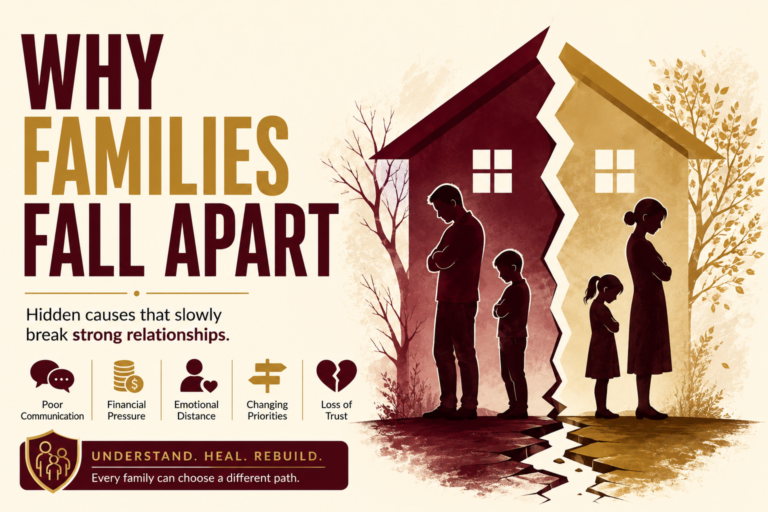
Families rarely fall apart because of one major event. Most family breakdowns develop gradually through unresolved conflict, poor communication, financial pressure, emotional distance, changing priorities and repeated decisions that slowly weaken trust. The visible crisis is often only the final stage of a much deeper process.
Introduction
Strong families rarely collapse overnight.
Most people remember a single argument, a financial crisis or a painful life event as the moment everything changed. Yet these visible events are usually the result of problems that have been developing quietly for years.
Every family experiences disagreements, financial pressure, personal disappointment and changing responsibilities. These challenges are part of ordinary life. What separates resilient families from those that eventually fall apart is not the absence of problems. It is how those problems are understood, managed and resolved.
This topic matters because family stability influences almost every aspect of life. Healthy family relationships support emotional wellbeing, financial security, children’s development and long term resilience. When families break down, the consequences often extend across generations, affecting relationships, careers, financial decisions and mental health.
The obvious explanation is that families separate because people stop loving each other.
The deeper explanation is far more complex.
Family breakdown is usually the outcome of psychological patterns, communication failures, financial stress, emotional decision making and unresolved issues that slowly erode trust. Understanding why families fall apart requires looking beyond individual arguments and examining the behavioural systems that shape everyday relationships.
What Is Family Breakdown?
Family breakdown is not simply divorce or separation.
It refers to the gradual loss of trust, cooperation and emotional connection that once held a family together. A family may continue living under the same roof while experiencing emotional isolation, constant conflict or complete withdrawal from meaningful communication.
In some cases, the breakdown occurs between parents and children.
In others, it develops between spouses, siblings or extended family members.
The common characteristic is that relationships stop functioning as supportive partnerships and become sources of stress, resentment or emotional distance.
The visible separation often happens at the end of the process rather than the beginning.
The Biggest Myth
The most common belief is that families fall apart because of one dramatic event.
People often blame an affair, financial hardship, addiction or a serious argument.
These events certainly accelerate family breakdown, but they rarely create it on their own.
Behavioural psychology suggests that relationships weaken through the accumulation of many small interactions rather than one extraordinary incident.
A conversation avoided.
An apology never offered.
A promise repeatedly broken.
Financial concerns left unspoken.
Emotional needs ignored.
Each individual moment appears insignificant.
Together, they gradually reduce trust until the relationship becomes fragile enough that one major event finally exposes weaknesses that already existed.
The crisis is therefore not usually the cause.
It is the point at which hidden problems become impossible to ignore.
What Usually Happens?
Most family breakdowns follow a similar progression.
Communication becomes less frequent.
Small disagreements remain unresolved.
Stress increases.
Trust gradually weakens.
Family members begin protecting themselves emotionally instead of solving problems together.
Responsibilities become uneven.
Resentment quietly replaces appreciation.
Eventually one significant event, such as financial hardship, infidelity, illness or major life changes, exposes years of unresolved tension.
Although every family’s circumstances are unique, the underlying behavioural pattern remains remarkably consistent.
Families rarely collapse because they experience problems.
They collapse because problems remain unresolved long enough to become part of everyday life.
Why Does It Happen?
Understanding why families fall apart requires moving beyond visible conflict and examining the psychological and behavioural patterns that shape everyday relationships.
Family relationships operate as systems rather than individual interactions.
Every decision influences future behaviour.
Every conversation either strengthens trust or weakens it.
Every unresolved disagreement increases the likelihood of future conflict.
Over time these small interactions determine whether a family becomes more resilient or more fragile.
Poor Communication Gradually Becomes Emotional Distance
Communication problems rarely begin with shouting or constant arguments.
More often they begin with silence.
People avoid difficult conversations because they fear conflict, rejection or emotional discomfort.
Temporary silence feels easier than immediate confrontation.
However, avoided conversations rarely disappear.
Instead they become unresolved emotions.
Resentment slowly replaces understanding because assumptions take the place of honest discussion.
Behavioural psychologists describe this pattern as emotional avoidance.
People believe they are protecting the relationship by avoiding conflict, yet the opposite often occurs.
Without regular communication, misunderstandings increase while trust gradually declines.
Eventually family members stop discussing meaningful issues altogether.
They continue talking about schedules, responsibilities and daily routines while avoiding the emotions that actually determine relationship quality.
Financial Pressure Changes Behaviour
Money is one of the most significant sources of family tension, not because money itself destroys relationships but because financial pressure changes behaviour.
When families experience financial uncertainty, stress increases.
Stress reduces patience.
Reduced patience affects communication.
Arguments become more frequent.
Small disagreements feel much larger because emotional resources are already exhausted.
Financial stress also changes decision making.
Instead of planning together, people begin protecting their own interests.
Transparency decreases.
Trust becomes more difficult to maintain.
Behavioural economists have long observed that financial scarcity narrows attention.
People become focused on immediate problems rather than long term solutions.
This explains why financial hardship often creates emotional conflict even when the underlying issue is economic rather than personal.
Emotional Decision Making Replaces Rational Problem Solving
Families make thousands of decisions every year.
Most appear insignificant.
How disagreements are discussed.
How responsibilities are shared.
How children are disciplined.
How financial priorities are managed.
During periods of stress, these decisions become increasingly emotional.
Fear encourages defensive behaviour.
Anger encourages blame.
Pride discourages compromise.
Instead of solving problems together, family members begin protecting their own emotional position.
Once this pattern becomes established, every disagreement reinforces previous frustrations.
New conflicts are no longer about the present issue alone.
They become connected to years of unresolved disappointment.
Expectations Change Faster Than Relationships
Another hidden cause of family breakdown is changing expectations.
People evolve throughout life.
Careers develop.
Children grow older.
Financial circumstances change.
Personal ambitions shift.
Relationships remain healthy only when expectations evolve alongside these changes.
Problems arise when one person continues expecting yesterday’s relationship while the other has already entered a different stage of life.
One partner may prioritise career growth.
Another may prioritise family time.
Parents and adult children often develop different expectations regarding independence, financial support or caregiving responsibilities.
These differences are not inherently destructive.
They become destructive when they remain unspoken.
Small Decisions Create Long Term Consequences
Family breakdown is rarely the result of dramatic mistakes.
It is more often the consequence of repeated small decisions.
Choosing not to apologise.
Ignoring emotional needs.
Avoiding difficult conversations.
Assuming rather than asking.
Allowing resentment to grow without addressing its cause.
Behavioural science shows that habits shape relationships in much the same way they shape financial outcomes.
Just as small financial decisions influence long term wealth, small relationship decisions influence long term trust.
The final breakdown often appears sudden.
In reality, it reflects years of accumulated behavioural patterns that gradually weakened the family’s ability to resolve conflict, adapt to change and maintain emotional connection.
Warning Signs
Family breakdown rarely begins with dramatic conflict. It usually starts with subtle changes that become normal over time.
One warning sign is declining communication. Conversations become limited to daily responsibilities while meaningful discussions disappear. Family members stop sharing concerns because they assume they will not be understood.
Another warning sign is unresolved resentment. Small disappointments remain unspoken until they accumulate into lasting frustration. Each unresolved issue reduces trust and increases emotional distance.
A growing lack of empathy is equally concerning. Family members become more interested in defending their own perspective than understanding someone else’s experience. Every disagreement becomes a debate to win rather than a problem to solve.
Financial secrecy is another indicator. Hidden debt, undisclosed spending or avoiding discussions about money often signals declining trust rather than financial difficulty alone.
Emotional withdrawal is perhaps the strongest warning sign. Family members may still live together while feeling increasingly disconnected. They stop celebrating achievements, sharing concerns or supporting one another during difficult moments.
These warning signs are frequently ignored because they develop gradually. People adapt to unhealthy patterns until those patterns begin defining the relationship itself.
What Could Have Prevented It?
Most family breakdowns cannot be prevented through one grand gesture.
They are prevented through consistent behaviour that strengthens trust before relationships become fragile.
Open communication remains the most effective safeguard. Difficult conversations should occur before frustration becomes resentment. Honest discussion allows misunderstandings to be corrected before they grow into lasting conflict.
Shared financial planning also strengthens relationships. Families that openly discuss income, spending, saving and future goals reduce uncertainty and create a stronger sense of partnership during periods of financial pressure.
Regular emotional connection is equally important. Relationships require intentional time, active listening and mutual appreciation. Emotional neglect rarely appears dangerous in the short term, yet over many years it quietly weakens the foundation of family life.
Another protective factor is recognising that change is inevitable. Families evolve as careers develop, children mature and responsibilities shift. Expectations must evolve alongside these changes rather than remaining fixed in the past.
Perhaps the most important prevention strategy is viewing disagreements as opportunities to improve understanding rather than opportunities to assign blame. Families that solve problems together become more resilient because conflict strengthens communication instead of damaging it.
Lessons
Family breakdown teaches lessons that extend far beyond relationships.
The first lesson is that trust is built gradually and lost gradually. Most people notice the final crisis while overlooking the hundreds of small interactions that created it.
Another lesson is that communication is not measured by how often people speak but by how honestly they understand one another. Frequent conversation without emotional openness rarely strengthens relationships.
Financial pressure also demonstrates that external problems often expose internal weaknesses. Money does not usually create relationship failure. It reveals how effectively families cooperate under stress.
Perhaps the most important lesson is that strong relationships depend upon consistent daily behaviour rather than occasional expressions of affection. Respect, honesty and accountability become meaningful only when they are repeated over time.
Failure Pattern
The dominant pattern behind family breakdown is Emotional Decision Making combined with Poor Communication and Lack of Planning.
This pattern repeats because people naturally avoid uncomfortable conversations. Temporary comfort often feels more attractive than immediate honesty. Unfortunately, avoided problems rarely disappear.
Instead, they accumulate.
Misunderstandings become assumptions.
Assumptions become resentment.
Resentment becomes emotional distance.
Eventually the relationship loses the trust required to resolve future conflicts.
The same behavioural pattern appears in business partnerships, investment decisions and organisational failures. Small unresolved problems gradually become systemic weaknesses until one visible event exposes years of hidden deterioration.
Hidden Lesson
Families rarely fall apart because love disappears.
They fall apart because trust gradually loses the daily habits that once protected it.
The deeper truth is that relationships are systems rather than emotions. Love may begin a family, but everyday decisions determine whether that family remains strong.
By the time people recognise the crisis, the behaviours responsible for it have often existed for many years.
The visible separation is simply the final consequence of invisible patterns that were left unchanged.
Failure Scorecard
| Area | Score | Explanation |
| Financial Discipline | 6/10 | Financial pressure often exposes communication weaknesses rather than creating them. |
| Decision Making | 5/10 | Emotional reactions frequently replace thoughtful discussion during conflict. |
| Risk Management | 5/10 | Families often ignore small issues until they become significant relationship risks. |
| Long Term Thinking | 4/10 | Immediate emotional comfort is often prioritised over lasting relationship health. |
| Emotional Awareness | 5/10 | Feelings are often assumed rather than openly discussed. |
| Emotional Control | 4/10 | Anger, pride and fear frequently influence responses during conflict. |
| Planning | 5/10 | Shared goals and expectations are often left undefined as circumstances change. |
| Adaptability | 6/10 | Families that adapt together generally remain stronger during major life transitions. |
Key Takeaways
- Families usually fall apart through gradual behavioural change rather than one dramatic event.
- Poor communication often creates greater damage than the original disagreement.
- Financial stress reveals relationship weaknesses that already exist.
- Emotional avoidance allows small problems to become lasting resentment.
- Trust depends upon consistent daily behaviour rather than occasional promises.
- Healthy families adapt their expectations as life circumstances change.
- Solving conflict together strengthens relationships more than avoiding conflict.
- Strong relationships are sustained by systems of trust, communication and shared responsibility.
Frequently Asked Questions
Why do families fall apart even when they love each other?
Love alone does not sustain a family. Poor communication, unresolved conflict, financial pressure and emotional distance can gradually weaken trust despite genuine affection.
What is the biggest reason families break down?
The most common cause is the accumulation of unresolved issues. Small problems ignored over many years often become more damaging than one major crisis.
Can financial problems destroy a family?
Financial hardship rarely destroys healthy relationships by itself. It usually exposes weaknesses in communication, planning and emotional cooperation that already existed.
Why are warning signs often ignored?
Warning signs develop gradually. Family members adapt to unhealthy routines and assume they are temporary until the relationship reaches a breaking point.
Can family relationships recover after serious conflict?
Recovery is possible when family members acknowledge underlying behavioural patterns, rebuild trust through consistent actions and address problems openly rather than avoiding them.
Conclusion
Families rarely fall apart because of a single mistake. They weaken through repeated behavioural choices that slowly reduce trust, communication and emotional connection until the relationship can no longer absorb additional pressure.
Understanding this changes the way family breakdown is viewed. It becomes less about one defining moment and more about recognising that lasting relationships are shaped by countless ordinary decisions whose importance often becomes visible only in hindsight.