Quick Answer
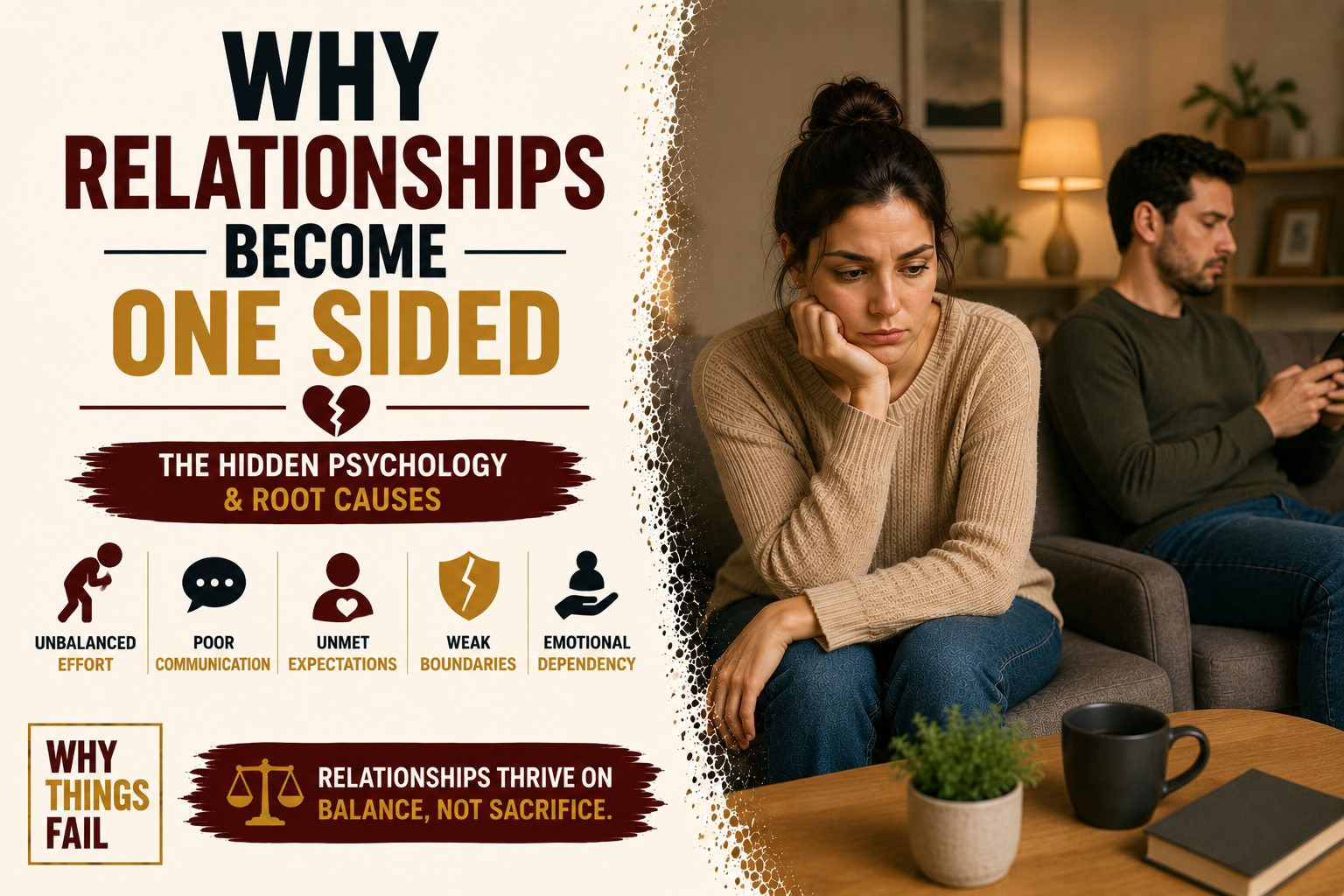
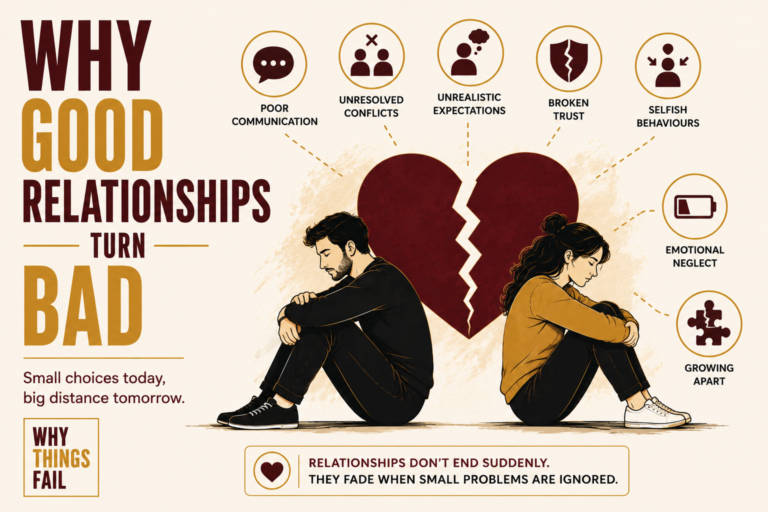
Good relationships rarely fail because of one argument or one mistake. They usually deteriorate through repeated emotional decisions, poor communication, unrealistic expectations and unresolved conflicts that gradually weaken trust, respect and emotional connection over time.
Introduction
Every broken relationship has a visible ending.
Some end after a serious argument. Others collapse because of betrayal, emotional distance or constant conflict. From the outside, it often appears that one event suddenly destroyed what once seemed like a happy relationship.
Reality is usually far more complex.
Healthy relationships rarely become unhealthy overnight. The ending is often the final stage of a much longer process that began months or even years earlier through small behavioural changes that neither person fully recognised.
This pattern appears in romantic relationships, marriages, friendships, family relationships and even business partnerships. Although every relationship is unique, the reasons they fail are surprisingly consistent.
This raises an important question.
Why do relationships that once felt secure gradually become strained, distant and eventually broken?
Many people blame a single disagreement, personality difference or external circumstance.
Those explanations only describe the surface.
The deeper causes are found in human psychology, emotional decision making, communication patterns and the gradual erosion of trust.
Understanding why good relationships turn bad is not simply about understanding conflict.
It is about understanding how small emotional decisions accumulate until they permanently change the relationship itself.
What Is Relationship Failure?
Relationship failure is often misunderstood.
Many people believe a relationship fails only when two people separate.
In reality, the relationship usually begins failing long before the separation occurs.
Relationship failure happens when trust, emotional safety, communication and mutual respect gradually decline until the relationship can no longer function in a healthy way.
Two people may continue living together while feeling emotionally disconnected.
Friends may remain in contact despite growing resentment.
Business partners may continue working together while trust steadily disappears.
The relationship still exists.
Its foundation no longer does.
Failure therefore reflects the gradual breakdown of emotional connection rather than the final decision to end the relationship.
The Biggest Myth
The most common belief is simple.
Good relationships fail because people stop loving each other.
This explanation feels logical because love is often viewed as the foundation of every successful relationship.
However, behavioural psychology suggests something different.
Love alone rarely determines whether a relationship survives.
Many people still care deeply for one another while experiencing constant conflict, emotional distance or resentment.
Relationships are sustained by repeated behaviours rather than occasional emotions.
Trust must be reinforced.
Communication must remain open.
Respect must be maintained during disagreements.
Emotional safety must continue even when opinions differ.
When these behaviours gradually disappear, affection alone is often unable to prevent the relationship from deteriorating.
The question therefore changes.
Instead of asking,
“Why did they stop loving each other?”
A more useful question becomes,
“What behaviours slowly weakened the relationship until love could no longer protect it?”
What Usually Happens?
Most relationship breakdowns follow a predictable pattern.
The relationship begins with excitement, optimism and emotional closeness.
Over time, daily responsibilities increase.
Work, financial pressures, parenting, family obligations and personal stress begin demanding greater attention.
Small misunderstandings remain unresolved.
Communication becomes less frequent.
Assumptions replace honest conversations.
Emotional connection weakens.
Minor disappointments slowly become recurring frustrations.
Eventually one significant disagreement appears to end the relationship.
In reality, that final conflict is usually the moment hidden problems become impossible to ignore.
The relationship was already weakening long before the final argument.
Why Does It Happen?
Understanding relationship failure requires looking beyond individual disagreements.
Conflict is rarely the true cause.
It is more often the symptom of deeper emotional and behavioural patterns that have been developing over time.
Relationships succeed because two people consistently invest emotional effort into maintaining trust, communication and understanding.
When that investment declines, the relationship gradually becomes more vulnerable.
Emotional Assumptions Replace Honest Communication
One of the earliest changes in struggling relationships is the belief that the other person should automatically understand thoughts and feelings.
Instead of expressing disappointment, people expect their partner, friend or family member to recognise it without explanation.
When those expectations remain unmet, frustration grows silently.
Behavioural psychology shows that people naturally assume others interpret situations in the same way they do.
This is known as the false consensus effect.
In reality, every individual experiences situations through different memories, values and expectations.
Without clear communication, both people begin creating their own version of reality.
Neither believes they are misunderstanding the other.
Both believe they are simply reacting to obvious behaviour.
The result is growing emotional distance despite genuine intentions.
Small Problems Become Emotional Debt
Most relationships do not collapse because of one major disagreement.
They collapse because unresolved disappointments accumulate over time.
An ignored conversation.
A forgotten promise.
Repeated criticism.
Lack of appreciation.
Each event appears insignificant on its own.
Together they create what psychologists often describe as emotional debt.
Every unresolved disappointment reduces trust slightly.
Every avoided conversation increases emotional distance.
Eventually ordinary disagreements become emotionally charged because they activate years of accumulated frustration rather than one isolated issue.
The argument is rarely about today’s problem.
It becomes about everything that remained unresolved yesterday.
Overconfidence Creates Relationship Neglect
Confidence strengthens new relationships.
Overconfidence weakens established ones.
Once people feel secure, they often begin assuming the relationship will continue thriving without deliberate effort.
Expressions of gratitude become less frequent.
Meaningful conversations become shorter.
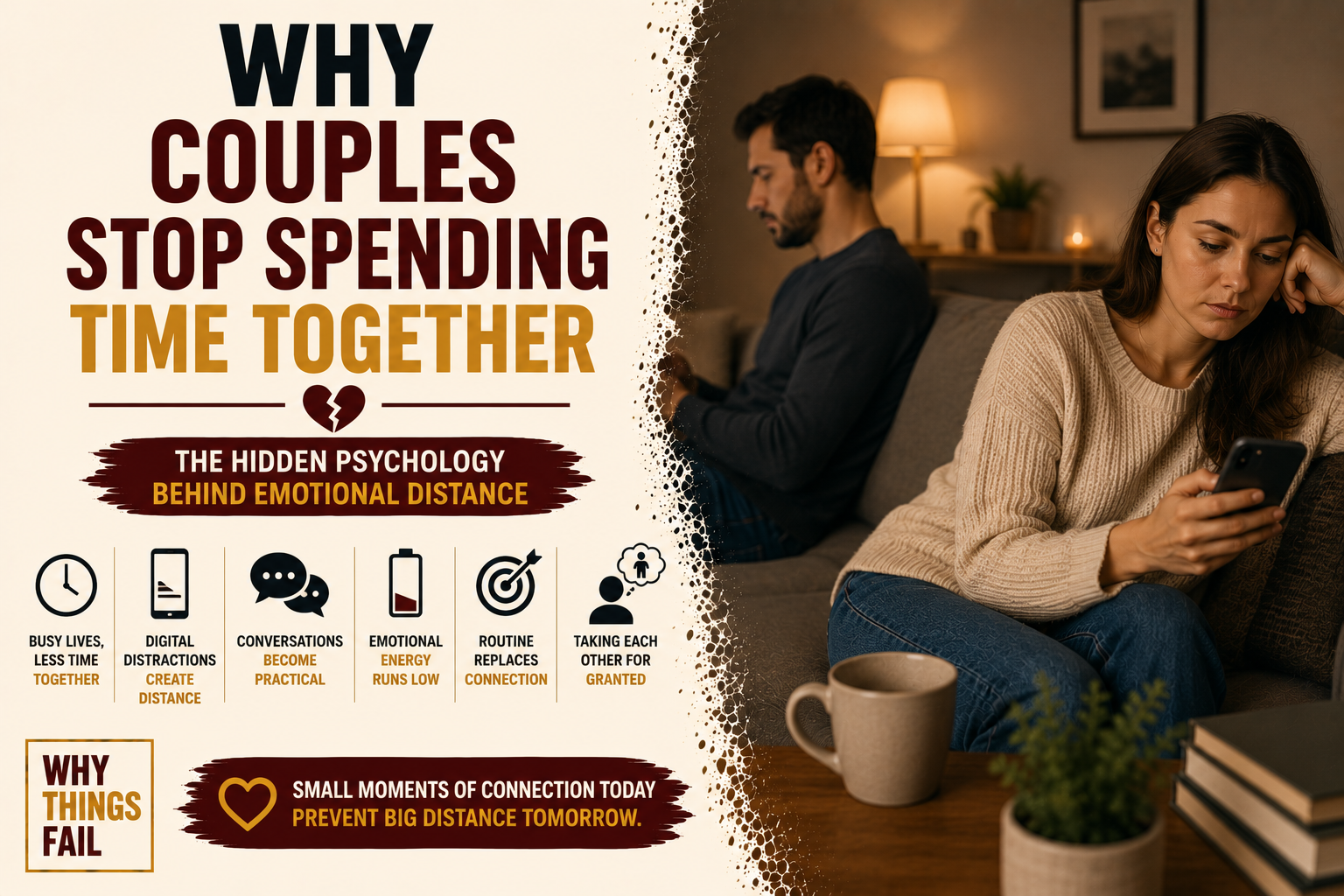
Quality time gradually disappears.
Acts of appreciation become occasional instead of consistent.
Behavioural economists refer to this as habituation.
People naturally adapt to positive experiences until they no longer consciously value them.
The relationship becomes familiar.
Familiarity quietly reduces intentional effort.
Ironically, the stronger the relationship once appeared, the easier it becomes to neglect the behaviours that created that strength.
Emotional Decision Making Replaces Rational Thinking
Conflict changes the way people process information.
Strong emotions narrow attention.
Instead of seeking understanding, people begin defending themselves.
The objective shifts from solving the problem to proving who is right.
Fear of rejection encourages silence.
Anger encourages criticism.
Pride discourages apology.
Each emotional response feels justified in the moment, yet each one weakens trust.
Over time these reactions become habits.
Healthy communication is replaced by emotional protection.
The relationship gradually becomes less about cooperation and more about self preservation.
Short Term Relief Creates Long Term Damage
Many relationship decisions provide immediate emotional relief while creating lasting consequences.
Avoiding a difficult conversation prevents temporary discomfort.
Withdrawing emotionally reduces the risk of further conflict.
Ignoring problems feels easier than addressing them.
In the short term these choices appear sensible.
In the long term they allow misunderstanding and resentment to grow.
Behavioural psychology explains this through present bias.
People naturally prioritise immediate emotional comfort over future relationship health.
The difficult conversation that could have strengthened trust today becomes the unresolved issue that damages trust months later.
External Pressures Change Internal Relationships
Many people believe relationship problems originate entirely within the relationship.
In reality, external pressures often shape internal behaviour.
Financial stress.
Career uncertainty.
Health concerns.
Parenting responsibilities.
Family expectations.
These pressures increase emotional exhaustion.
When people become mentally overwhelmed, patience declines.
Empathy decreases.
Communication becomes shorter.
Small disagreements feel larger because emotional resources have already been depleted elsewhere.
The relationship becomes the place where accumulated stress is expressed rather than resolved.
This explains why many good relationships begin deteriorating during periods of significant life change.
The relationship itself may not be the original problem.
It simply becomes the environment where unresolved external pressures are experienced most intensely.
Warning Signs
Relationship failure rarely begins with dramatic events. The earliest warning signs are usually subtle and easy to dismiss because neither person believes the relationship is genuinely at risk.
One warning sign is the gradual decline of meaningful communication. Conversations become limited to daily responsibilities rather than thoughts, emotions and personal experiences. People continue talking, but they stop feeling understood.
Another warning sign is growing emotional defensiveness. Every disagreement becomes a debate about who is right instead of an opportunity to understand each other. Curiosity is replaced by judgement.
Consistent criticism is another indicator. Constructive feedback strengthens relationships, but repeated criticism gradually attacks personal identity rather than addressing behaviour. Over time, appreciation becomes less common while faults become easier to notice.
Avoiding conflict may also appear healthy, but constant avoidance often signals emotional withdrawal rather than harmony. Difficult conversations are postponed until unresolved issues become impossible to ignore.
Another overlooked warning sign is emotional indifference. Anger still reflects emotional investment. Indifference often indicates that hope, curiosity and emotional engagement have already begun to disappear.
These warning signs are frequently ignored because they develop gradually. Both people adapt to small changes until unhealthy behaviour begins to feel normal.
What Could Have Prevented It?
Most relationship failures cannot be prevented by eliminating conflict.
Conflict is a natural part of every meaningful relationship.
What prevents failure is the ability to manage conflict without damaging trust.
Honest communication remains the strongest protective factor. Discussing disappointments while they are still small prevents emotional debt from accumulating over months or years.
Regular expressions of appreciation are equally important. Gratitude reminds people that they are valued beyond their daily responsibilities. Relationships often weaken not because affection disappears, but because appreciation is no longer expressed consistently.
Emotional accountability also strengthens relationships. Accepting responsibility for personal behaviour reduces defensiveness and encourages mutual respect. Healthy relationships are built by two people who seek solutions rather than assigning blame.
Managing external stress is another important safeguard. Financial pressure, demanding careers and family responsibilities should be recognised as shared challenges rather than personal failures. Viewing problems as something both people face together strengthens cooperation instead of creating division.
Finally, successful relationships require intentional maintenance. Trust, respect and emotional intimacy are not permanent achievements. They are behaviours that must be repeated consistently throughout the relationship.
Lessons
The failure of good relationships reveals lessons that extend beyond marriage or romance.
The first lesson is that relationships rarely fail because of one major event. They usually decline through repeated small decisions that gradually weaken emotional connection.
The second lesson is that communication is less about speaking and more about understanding. Many conflicts continue because people focus on defending their own perspective instead of exploring another person’s experience.
Another lesson is that emotional habits shape relationship quality more than emotional intensity. Grand gestures cannot compensate for everyday neglect. Small acts of respect, appreciation and honesty consistently influence long term trust.
Perhaps the most important lesson is that strong relationships depend on deliberate effort rather than automatic stability. Emotional connection grows through consistent attention, not through assumption.
Failure Pattern
The dominant pattern behind relationship failure is Emotional Neglect combined with Poor Communication and Short Term Thinking.
This pattern appears repeatedly because people naturally prioritise immediate emotional comfort over difficult conversations. They postpone uncomfortable discussions, assume problems will resolve themselves and underestimate the long term effect of repeated disappointment.
Over time, emotional distance replaces emotional closeness.
Trust becomes weaker.
Communication becomes defensive.
Understanding becomes less important than self protection.
The same behavioural pattern appears in friendships, family relationships, business partnerships and professional teams. The environment changes, but the psychology remains remarkably similar.
Hidden Lesson
Good relationships rarely collapse because love suddenly disappears.
They decline because the behaviours that once protected love gradually disappear.
The deepest lesson is that relationships are maintained through ordinary daily choices rather than extraordinary moments. Respect during disagreement, honest communication, empathy and appreciation appear small individually, yet together they determine whether trust grows or slowly disappears.
By the time a relationship ends, the final disagreement is often only the visible consequence of invisible behavioural patterns that developed over a long period.
Failure Scorecard
| Area | Score | Explanation |
| Communication | 4/10 | Honest conversations gradually decline and assumptions replace clarity. |
| Decision Making | 5/10 | Emotional reactions often replace thoughtful responses during conflict. |
| Emotional Awareness | 4/10 | Feelings remain unspoken until frustration becomes overwhelming. |
| Long Term Thinking | 5/10 | Immediate emotional comfort is often prioritised over lasting relationship health. |
| Relationship Knowledge | 6/10 | Many people understand relationships emotionally but not behaviourally. |
| Emotional Control | 4/10 | Anger, pride and defensiveness frequently influence communication. |
| Planning | 5/10 | Few relationships intentionally create habits that strengthen trust over time. |
| Adaptability | 6/10 | Strong relationships adjust to changing life circumstances instead of resisting them. |
Key Takeaways
- Good relationships usually fail gradually rather than suddenly.
- Poor communication often causes greater damage than disagreement itself.
- Small unresolved disappointments accumulate into lasting resentment.
- Emotional assumptions frequently replace honest conversations.
- External stress can quietly weaken healthy relationships.
- Appreciation is one of the simplest ways to strengthen trust.
- Conflict handled with respect often strengthens relationships rather than weakening them.
- Long term relationship success depends on consistent behaviour more than strong emotions.
Frequently Asked Questions
Why do good relationships suddenly turn bad?
Most relationships do not change suddenly. Emotional distance, poor communication and unresolved conflict usually develop over time before becoming visible through one significant disagreement.
What is the biggest reason relationships fail?
The biggest reason is the gradual breakdown of trust through poor communication, emotional neglect and unresolved resentment rather than one isolated event.
Can a healthy relationship recover after serious problems?
Yes. Recovery is possible when both people acknowledge underlying behavioural patterns, communicate honestly and consistently rebuild trust through their actions.
Why do couples ignore warning signs?
Warning signs often develop slowly. People adapt to small behavioural changes and assume the relationship will improve naturally, making deeper problems difficult to recognise until emotional distance has already grown.
Is love enough to keep a relationship healthy?
Love provides the foundation, but trust, communication, respect, empathy and consistent effort determine whether a relationship remains healthy over the long term.
Conclusion
Good relationships rarely fail because of one conversation, one disagreement or one mistake. They fail when repeated behavioural patterns gradually replace trust with assumption, appreciation with neglect and understanding with emotional self protection.
Understanding this changes the way relationship failure is viewed. It is no longer simply the story of two people growing apart. It becomes an investigation into how ordinary decisions, repeated over time, quietly shape the strongest relationships until the ending becomes predictable long before it becomes visible.