Quick Answer
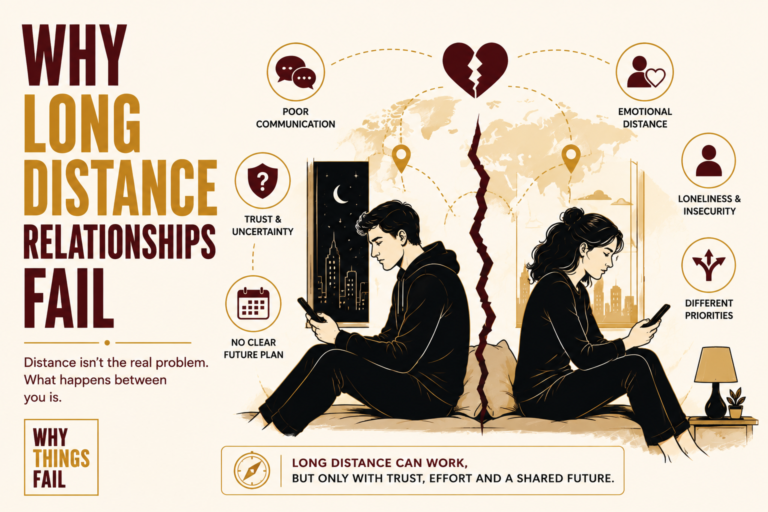
Long distance relationships usually fail because emotional needs, communication patterns, trust, uncertainty and future expectations gradually become misaligned. Distance itself is rarely the real problem. The deeper causes are often unmet emotional needs, poor conflict resolution, inconsistent communication and the absence of a shared long term plan.
Introduction
Long distance relationships have become increasingly common in a world where education, careers and personal ambitions often require people to live in different cities or countries. Technology has made communication easier than ever before. Video calls, instant messaging and social media allow couples to stay connected throughout the day.
Yet despite these advances, many long distance relationships still come to an end.
This raises an important question.
If couples can communicate instantly, why does physical distance continue to place so much pressure on relationships?
The obvious explanation is geography.
The deeper explanation is human psychology.
Relationships are not sustained by communication alone. They depend upon trust, emotional security, shared experiences, conflict resolution and confidence in a shared future. Distance changes how each of these elements develops.
Understanding why long distance relationships fail requires looking beyond kilometres and time zones. It requires examining how people respond to uncertainty, loneliness, unmet expectations and emotional stress over time.
What Is A Long Distance Relationship Failure?
A long distance relationship does not fail simply because two people live apart.
Many couples maintain healthy relationships across countries for years before eventually building a life together.
Failure occurs when emotional connection gradually weakens until the relationship can no longer meet the needs of one or both partners.
Sometimes this happens suddenly after a major disagreement.
More often it develops slowly.
Small misunderstandings remain unresolved.
Communication becomes less meaningful.
Trust begins to weaken.
Future plans become uncertain.
Eventually the relationship feels more like an obligation than a partnership.
The ending is often seen as one unexpected event.
In reality, it is usually the result of many small emotional decisions that accumulated over time.
The Biggest Myth
The most common belief is simple.
Long distance relationships fail because of distance.
Distance certainly creates challenges.
However, distance alone rarely destroys healthy relationships.
Many couples separated by thousands of miles remain deeply committed for years. At the same time, many couples living in the same city experience emotional disconnection despite seeing each other every day.
This suggests that geography is not the primary cause.
Distance acts as pressure.
Pressure exposes weaknesses that already exist within communication, trust, emotional security and future planning.
Just as financial markets expose poor investment decisions, physical separation exposes weaknesses within a relationship.
The distance is not the cause.
It is the environment that reveals existing vulnerabilities.
What Usually Happens?
Most long distance relationships follow a predictable pattern.
The relationship begins with excitement and commitment.
Frequent messages and video calls strengthen emotional connection.
Over time, daily routines begin changing.
Work becomes busier.
Study commitments increase.
Time zone differences become more noticeable.
Communication becomes less frequent.
Small misunderstandings become more common.
One partner begins feeling emotionally neglected.
The other feels increasingly pressured.
Neither intends to damage the relationship.
Both believe they are doing their best.
Gradually uncertainty replaces confidence.
Without recognising it, both partners begin responding emotionally instead of communicating openly.
Why Do Long Distance Relationships Fail?
Understanding relationship failure requires looking beyond communication frequency.
Many couples speak every day and still become emotionally disconnected.
The deeper causes lie within human behaviour, emotional psychology and the way uncertainty changes decision making.
Emotional Needs Gradually Change
People often assume emotional needs remain constant throughout a relationship.
They do not.
Life circumstances change.
Career demands increase.
Personal stress grows.
Family responsibilities evolve.
The emotional support one partner needed six months ago may be very different today.
When these changing needs are not discussed openly, both partners continue behaving as though nothing has changed.
One person feels unsupported.
The other believes they are giving enough.
Neither recognises the growing emotional gap.
The relationship weakens not because of lack of love but because emotional expectations quietly become misaligned.
Uncertainty Creates Emotional Fatigue
Behavioural psychologists have long recognised that uncertainty creates significant mental stress.
Long distance relationships contain uncertainty almost every day.
When will we meet again?
Where will we eventually live?
Who will relocate?
Can we continue this lifestyle for another year?
Will our future plans actually happen?
These unanswered questions create ongoing emotional pressure.
Unlike temporary uncertainty, long term uncertainty slowly drains emotional energy.
Partners begin seeking reassurance more frequently.
When reassurance is delayed, anxiety increases.
Over time this cycle creates emotional exhaustion even when both partners remain committed.
The relationship gradually becomes associated with stress rather than comfort.
Trust Depends Upon Predictability
Trust is often misunderstood.
Many people believe trust simply means believing a partner will remain faithful.
Trust is much broader.
It is confidence that another person’s behaviour will remain reliable and emotionally consistent.
Distance naturally reduces visibility into everyday life.
Partners cannot observe ordinary routines, body language or daily interactions.
The brain therefore begins filling missing information with assumptions.
When communication remains consistent, positive assumptions usually develop.
When communication becomes irregular, uncertainty encourages negative assumptions instead.
A delayed reply suddenly feels meaningful.
A cancelled phone call feels suspicious.
A forgotten message appears intentional.
These interpretations may have little connection to reality.
Nevertheless, they influence emotional reactions.
Trust weakens because uncertainty allows imagination to replace evidence.
Communication Quality Matters More Than Communication Frequency
Many couples believe successful long distance relationships require constant communication.
Quantity alone rarely strengthens emotional intimacy.
Meaningful conversations build relationships.
Habitual conversations simply maintain contact.
As routines become repetitive, discussions often focus only on daily activities.
“What did you eat?”
“How was work?”
“What time are you sleeping?”
These conversations maintain communication but do not necessarily strengthen emotional connection.
Over time deeper discussions become less frequent.
Personal fears remain unspoken.
Future expectations remain unclear.
Emotional needs remain hidden.
Partners begin talking every day while understanding each other less.
The relationship appears healthy from the outside.
Internally emotional intimacy gradually declines.
Conflict Becomes More Difficult To Resolve
Conflict is a normal part of every healthy relationship.
Distance changes how conflict develops.
Small disagreements cannot always be resolved through physical reassurance.
There is no comforting hug.
No shared silence.
No opportunity to observe facial expressions completely.
Messages are interpreted through emotion rather than context.
A short reply may simply reflect exhaustion.
The receiving partner interprets rejection.
Video calls reduce some misunderstanding but cannot completely replace physical presence.
As a result, minor disagreements sometimes become larger emotional conflicts because both partners interpret uncertainty differently.
Idealisation Creates Unrealistic Expectations
Another overlooked reason long distance relationships fail is idealisation.
Limited time together encourages partners to imagine the relationship rather than experience ordinary daily life.
Visits become special occasions.
Problems temporarily disappear.
Reality is replaced by anticipation.
This creates unrealistic expectations.
When couples eventually spend longer periods together, ordinary disagreements suddenly appear surprising.
The relationship struggles not because love disappeared but because expectations were built upon limited experiences rather than everyday reality.
Social Comparison Quietly Changes Relationship Satisfaction
Social media has introduced another behavioural influence.
People constantly observe friends travelling together, celebrating anniversaries and sharing everyday experiences.
Long distance couples naturally compare their own relationship with these visible moments.
Behavioural economists describe this as relative comparison.
People rarely evaluate happiness objectively.
Instead they compare themselves with others.
Even a healthy relationship can begin feeling inadequate when constantly measured against carefully selected moments from someone else’s life.
The emotional pressure does not come from the relationship itself.
It comes from comparison.
Absence Changes Emotional Investment
Human relationships depend upon shared experiences.
Cooking together.
Walking together.
Watching films.
Meeting family.
Solving everyday problems.
These ordinary moments quietly strengthen emotional attachment.
Distance reduces opportunities for these experiences.
Communication continues.
Shared living does not.
Without intentionally creating meaningful shared experiences, emotional investment may gradually decline despite genuine commitment.
The relationship remains emotionally important.
It simply becomes increasingly difficult to feel naturally connected through conversation alone.
Warning Signs
Long distance relationships rarely end without warning. The challenge is that these warning signs often appear gradually, making them easy to dismiss as temporary problems rather than indicators of deeper emotional change.
One of the earliest signs is a noticeable decline in meaningful communication. Conversations become shorter, predictable and focused only on daily routines. Partners still communicate regularly, but emotional depth begins to disappear.
Another warning sign is avoiding difficult conversations. Instead of discussing concerns about trust, loneliness or the future, both partners remain silent to avoid conflict. While this creates temporary peace, unresolved emotions continue growing beneath the surface.
Changes in emotional availability also deserve attention. One partner may become less enthusiastic about phone calls, delay responding to messages or show less curiosity about the other’s life. These changes are often explained as work pressure or personal stress, but when they become consistent, they may signal emotional withdrawal.
A growing lack of future planning is another important indicator. Couples who once discussed living together, career decisions or future goals begin avoiding those conversations altogether. Without a shared destination, the relationship gradually loses direction.
Perhaps the most overlooked warning sign is emotional independence becoming emotional detachment. Healthy independence allows both partners to grow individually. Emotional detachment occurs when one or both partners no longer feel the need to share experiences, seek support or include each other in important decisions.
These warning signs are often ignored because they develop slowly. Both partners hope the relationship will naturally improve once circumstances change, even though the underlying issues remain unresolved.
What Could Have Prevented It?
Most long distance relationships cannot be strengthened by communicating more often alone.
They become stronger when communication becomes more intentional.
A clear shared vision of the future provides emotional stability during periods of uncertainty. Couples who openly discuss where they intend to live, how long the distance will continue and what milestones they expect to reach are generally better equipped to handle temporary separation.
Honest communication is equally important. Rather than discussing only daily events, successful couples create space for conversations about emotional needs, fears, expectations and changing priorities. These discussions reduce misunderstanding before it develops into resentment.
Consistency also builds trust. Predictable communication patterns reduce unnecessary uncertainty and prevent assumptions from replacing reality. Trust grows through reliability rather than constant reassurance.
Conflict should also be viewed differently. Disagreements are not signs of failure. Avoiding them often creates greater emotional distance. Couples who address concerns respectfully and early usually prevent small misunderstandings from becoming major relationship problems.
Most importantly, both partners must continue building shared experiences despite the distance. Watching films together, celebrating important milestones, planning future visits and working towards common goals reinforce the sense that the relationship is progressing rather than standing still.
Distance becomes far more manageable when both people believe they are moving towards the same future.
Lessons
Long distance relationships reveal broader truths about human behaviour and emotional connection.
The first lesson is that relationships are sustained by emotional security rather than physical proximity alone. Distance magnifies existing strengths and weaknesses but rarely creates them from nothing.
The second lesson is that uncertainty requires deliberate communication. When important questions remain unanswered, the human mind naturally fills those gaps with assumptions, many of which are negative.
Another lesson is that consistency often matters more than intensity. Grand romantic gestures may create memorable moments, but small acts of reliability build lasting trust.
Perhaps the most valuable lesson is that healthy relationships require continual adaptation. Emotional needs, personal circumstances and future goals evolve over time. Couples who regularly discuss these changes remain emotionally connected even when separated by geography.
Failure Pattern
The dominant pattern behind long distance relationship failure is Emotional Disconnection caused by Uncertainty and Poor Communication.
This pattern repeats because uncertainty changes behaviour. Partners begin seeking reassurance more frequently, while increasing responsibilities reduce the ability to provide that reassurance consistently.
Misunderstandings become assumptions.
Assumptions become doubt.
Doubt weakens trust.
Reduced trust changes communication.
Weaker communication increases emotional distance.
The cycle gradually reinforces itself.
The same behavioural pattern appears in friendships, family relationships, business partnerships and professional teams. When uncertainty increases and communication decreases, trust naturally begins to decline.
Hidden Lesson
The greatest challenge in a long distance relationship is not the distance itself.
It is maintaining emotional certainty when physical certainty is impossible.
Distance simply exposes whether a relationship is supported by trust, shared purpose and emotional resilience or whether it depends primarily on physical presence.
Many relationships do not fail because two people stop loving each other.
They fail because uncertainty quietly replaces confidence, and neither partner fully recognises the change until emotional distance has become greater than physical distance.
Failure Scorecard
| Area | Score | Explanation |
| Communication | 5/10 | Many couples communicate frequently but struggle to discuss emotional needs openly. |
| Decision Making | 6/10 | Important relationship decisions are often delayed because uncertainty feels easier than commitment. |
| Trust Management | 5/10 | Trust weakens when assumptions replace honest communication. |
| Long Term Thinking | 4/10 | Relationships without a realistic shared future often lose direction over time. |
| Emotional Awareness | 6/10 | Many partners recognise emotional changes only after significant disconnection has already developed. |
| Emotional Control | 5/10 | Loneliness, anxiety and insecurity often influence reactions more than objective evidence. |
| Planning | 4/10 | Many couples fail to create a realistic timeline for eventually closing the distance. |
| Adaptability | 7/10 | Couples who adjust expectations and communication styles are generally better equipped to sustain the relationship. |
Key Takeaways
- Distance rarely ends relationships by itself.
- Emotional uncertainty often causes more damage than physical separation.
- Meaningful communication matters more than constant communication.
- Trust grows through consistent behaviour rather than repeated reassurance.
- Unresolved misunderstandings gradually become emotional barriers.
- A shared long term vision provides stability during uncertain periods.
- Comparing relationships with others often creates unnecessary dissatisfaction.
- Emotional discipline and honest conversations strengthen relationships more than physical proximity alone.
Frequently Asked Questions
Why do long distance relationships fail most often?
They usually fail because uncertainty, inconsistent communication, emotional disconnection and the absence of a shared future gradually weaken trust and commitment rather than because of distance alone.
Can long distance relationships actually work?
Yes. Research and real life experience show that many long distance relationships succeed when both partners communicate openly, maintain trust and work towards a realistic plan for eventually living together.
What is the biggest mistake in a long distance relationship?
The biggest mistake is assuming that regular communication automatically creates emotional intimacy. Conversations must also address feelings, expectations and future goals.
How important is trust in a long distance relationship?
Trust is fundamental because partners cannot rely on physical presence. Consistent behaviour, honesty and reliability become the foundation of emotional security.
Does physical distance reduce love?
Not necessarily. Distance does not automatically reduce love, but prolonged uncertainty and emotional disconnection can weaken the relationship if they remain unaddressed.
Conclusion
Long distance relationships do not usually fail because two people live apart. They fail when uncertainty quietly changes communication, trust and emotional connection until the relationship no longer provides the security both partners need.
Understanding these deeper behavioural patterns reveals that geography is only the visible challenge. The real test lies in how people manage uncertainty, sustain emotional intimacy and continue choosing each other despite the absence of physical closeness.