Quick Answer
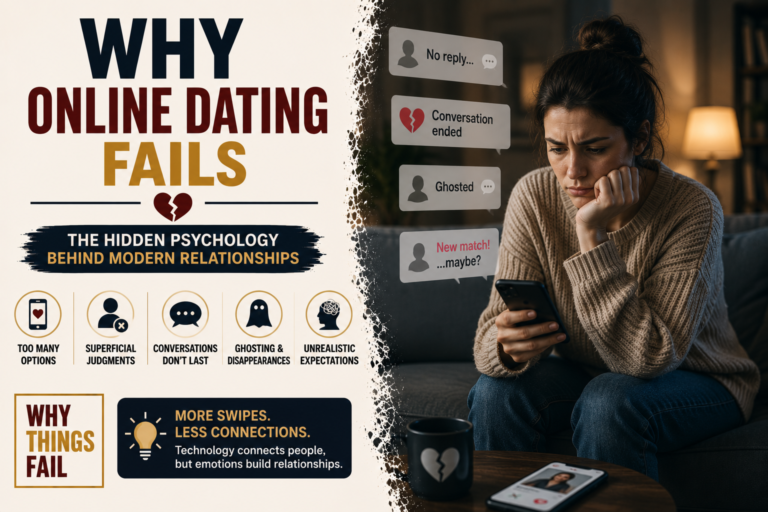
Online dating often fails not because people cannot find matches, but because modern dating platforms amplify human biases, unrealistic expectations and emotional decision making. Success depends less on finding more options and more on making better relationship decisions.
Introduction
Online dating has transformed how people meet, communicate and form relationships. Millions of people now use dating apps and matchmaking platforms with the hope of finding meaningful connections. The convenience is undeniable. Within minutes, users can browse hundreds of potential partners who share similar interests, values or lifestyles.
Yet despite having more opportunities than any previous generation, many people report frustration, disappointment and emotional exhaustion.
Conversations disappear without explanation.
Promising relationships end after only a few dates.
Matches become endless, but genuine commitment feels increasingly rare.
This creates an important question.
Why does online dating fail so often when technology has made meeting new people easier than ever before?
The common explanation is that people simply have not found the right person.
The deeper explanation is far more complex.
Online dating is not only shaped by technology. It is shaped by human psychology, decision making, social incentives and behavioural patterns that influence how people evaluate relationships.
Understanding why online dating fails requires looking beyond dating applications themselves. It requires examining how abundance, uncertainty and modern expectations influence the choices people make before a relationship has even begun.
What Is Online Dating Failure?
Online dating failure does not simply mean remaining single.
Nor does it mean that every relationship formed online is unsuccessful.
Many long lasting marriages and committed partnerships begin through online dating platforms.
Failure occurs when repeated patterns prevent people from forming healthy and sustainable relationships despite having regular opportunities to meet compatible partners.
Some individuals repeatedly choose emotionally unavailable partners.
Others abandon promising relationships because they believe someone better may appear with another swipe.
Some become emotionally exhausted after repeated rejection and eventually stop trying altogether.
In each case, the problem extends beyond one unsuccessful relationship.
It reflects a repeated cycle of decisions and behaviours that gradually reduce the likelihood of forming meaningful connections.
The Biggest Myth
The biggest myth surrounding online dating is simple.
More choices automatically increase the chances of finding the perfect partner.
At first glance, this belief appears logical.
If someone can meet thousands of potential partners instead of only a handful, finding compatibility should become easier.
Behavioural research suggests the opposite can also occur.
When people are presented with too many choices, decision quality often declines.
Psychologists describe this as choice overload.
Instead of appreciating strong potential matches, individuals begin comparing every person with countless alternatives they have not yet met.
Each conversation is judged against the possibility that someone even better may appear tomorrow.
This mindset quietly changes how relationships develop.
People become less willing to invest time, patience and emotional energy because another option always seems available.
The result is not greater satisfaction.
It is greater uncertainty.
What Usually Happens?
The journey often begins with optimism.
A new user creates a profile, uploads carefully selected photographs and begins matching with people who appear attractive and compatible.
Early conversations feel exciting.
Notifications create anticipation.
The possibility of finding a meaningful relationship appears realistic.
Gradually, however, the experience changes.
Conversations become repetitive.
Some matches disappear without explanation.
Others lose interest after only a few messages.
Dates that initially appear promising fail to develop into long term relationships.
Instead of reflecting on compatibility, many users simply continue swiping.
The process repeats itself.
Although every individual experiences different circumstances, the overall pattern remains surprisingly consistent.
The technology continues offering new opportunities.
The emotional experience becomes increasingly exhausting.
Why Does Online Dating Fail?
Online dating platforms do not create relationship problems by themselves.
Instead, they amplify psychological tendencies that already exist.
Human beings evolved to build trust gradually through repeated interaction within relatively small social groups.
Digital platforms present a completely different environment.
People make important relationship decisions within seconds based on limited information, carefully selected photographs and brief personal descriptions.
These conditions encourage rapid judgement rather than thoughtful understanding.
As a result, behavioural biases become stronger while meaningful emotional connection becomes more difficult.
Choice Overload Weakens Commitment
One of the most significant psychological challenges is the abundance of options.
Modern dating applications provide access to hundreds or even thousands of potential partners.
Although this appears beneficial, behavioural economics demonstrates that excessive choice often reduces satisfaction.
When alternatives seem unlimited, commitment becomes psychologically difficult.
Choosing one person feels like giving up countless other possibilities.
Instead of asking whether a relationship is healthy and compatible, many users begin asking whether someone slightly better may appear after another swipe.
This constant comparison creates unrealistic expectations.
No real relationship can compete with an imaginary perfect partner who exists only as a possibility.
Instant Gratification Changes Relationship Behaviour
Many dating platforms are designed around immediate rewards.
A new match produces excitement.
A message creates anticipation.
A notification provides emotional validation.
These small rewards activate psychological mechanisms associated with anticipation and novelty.
Over time, some users become more attracted to the excitement of matching than the slower process of building trust.
Long term relationships require patience, vulnerability and gradual emotional investment.
Digital environments often reward speed instead.
This creates a conflict between how healthy relationships naturally develop and how dating platforms encourage interaction.
Fear Of Rejection Changes Authentic Behaviour
Rejection has always been part of dating.
Online platforms increase both its frequency and visibility.
Messages remain unanswered.
Conversations suddenly stop.
Matches disappear without explanation.
Repeated exposure to these experiences changes behaviour.
Some people become emotionally guarded.
Others attempt to present an idealised version of themselves rather than their authentic personality.
Instead of asking whether they genuinely connect with another person, they become preoccupied with appearing desirable.
Authenticity gradually gives way to performance.
Ironically, this makes genuine emotional connection even more difficult.
Confirmation Bias Reinforces Poor Relationship Choices
People naturally notice information that confirms existing beliefs.
Someone who believes meaningful relationships are impossible may unconsciously interpret every unsuccessful conversation as evidence supporting that conclusion.
Similarly, individuals attracted to emotionally unavailable partners often repeat the same dating patterns without recognising the underlying behaviour.
Each unsuccessful relationship appears different on the surface.
Psychologically, the decision making process remains remarkably similar.
Until these behavioural patterns are recognised, online dating becomes a cycle of repeated experiences rather than meaningful learning.
Unrealistic Expectations Create Constant Disappointment
Social media, entertainment and dating culture frequently present idealised images of romance.
Many users therefore approach online dating with expectations that no real relationship can consistently satisfy.
Minor imperfections become reasons to move on.
Small disagreements are interpreted as signs of incompatibility.
Natural differences in personality receive less patience because another potential match is always available.
Healthy relationships develop through communication, compromise and shared experiences.
Perfect relationships exist only in imagination.
When expectations become unrealistic, disappointment becomes almost inevitable regardless of who the partner is.
Emotional Fatigue Quietly Changes Decision Making
Perhaps the least discussed reason online dating fails is emotional fatigue.
Repeated introductions.
Repeated conversations.
Repeated disappointment.
Repeated hope followed by uncertainty.
Over time these experiences reduce emotional energy.
People become less curious.
Less patient.
Less willing to invest in getting to know someone deeply.
Psychologists recognise that repeated emotional strain often reduces decision quality.
Rather than evaluating individuals thoughtfully, users begin making quicker decisions based on convenience, appearance or immediate emotional reactions.
The platform remains the same.
The psychology of the user gradually changes.
By the time many people believe online dating no longer works, the real issue is often not the technology itself but the accumulated emotional effects of using it for extended periods.
Warning Signs
Online dating rarely fails without warning. The challenge is that these warning signs often feel normal because they have become part of modern dating culture.
One early warning sign is treating every new match as disposable. When conversations become easy to replace, people invest less effort in understanding one another. Relationships begin to resemble endless interviews rather than meaningful human connections.
Another warning sign is making decisions almost entirely from photographs. Physical attraction matters, but lasting relationships depend upon trust, communication, emotional maturity and shared values. Judging compatibility within seconds encourages superficial decisions while overlooking qualities that become important over time.
Constantly searching for validation is another indicator. Some users open dating applications not because they want a relationship but because matches and compliments provide temporary reassurance. The platform becomes a source of emotional validation instead of genuine connection.
Repeated ghosting is equally significant. Whether someone frequently disappears from conversations or repeatedly experiences being ghosted, it often signals poor communication, emotional avoidance or unrealistic expectations. Ignoring these patterns allows unhealthy behaviour to continue.
Perhaps the strongest warning sign is emotional exhaustion. When dating begins to feel like a repetitive task rather than an opportunity to know another person, decision making becomes rushed and increasingly cynical. Emotional fatigue quietly reduces empathy, patience and curiosity, making successful relationships even less likely.
People ignore these warning signs because they believe the next match will solve the problem. In reality, changing partners rarely changes behavioural patterns.
What Could Have Prevented It?
Most online dating failures cannot be prevented by downloading another application or matching with more people.
The solution lies in improving the quality of relationship decisions rather than increasing the quantity of opportunities.
A healthier approach begins with realistic expectations. Every meaningful relationship develops through uncertainty, communication and gradual trust. Expecting immediate certainty often causes people to leave promising relationships before they have time to mature.
Self awareness is equally important. Understanding personal attachment patterns, emotional triggers and recurring relationship choices allows individuals to recognise behaviours that repeatedly produce disappointment.
Clear communication also reduces unnecessary misunderstandings. Expressing intentions honestly and discussing expectations early creates stronger foundations than relying on assumptions or mixed signals.
Limiting endless comparisons can also improve relationship quality. Focusing on one promising connection instead of continually evaluating countless alternatives encourages deeper emotional investment.
Finally, recognising that compatibility develops rather than simply appears changes the entire dating experience. Successful relationships are usually built through consistent effort, mutual respect and shared experiences instead of perfect first impressions.
Lessons
The reasons online dating fails reveal broader lessons about human behaviour, decision making and modern society.
The first lesson is that more choice does not always produce better outcomes. Abundance often increases comparison, uncertainty and dissatisfaction instead of improving decision quality.
The second lesson is that technology cannot remove the emotional complexity of relationships. Applications can introduce people, but they cannot replace trust, vulnerability or emotional maturity.
Another lesson is that people often search for certainty where uncertainty is unavoidable. Healthy relationships develop through patience and communication rather than instant confidence.
Perhaps the most valuable lesson is that successful relationships depend less on finding flawless partners and more on making thoughtful decisions with imperfect human beings.
Failure Pattern
The dominant pattern behind online dating failure is Emotional Decision Making combined with Short Term Thinking.
Many users pursue immediate attraction instead of long term compatibility. Excitement replaces patience. Novelty becomes more rewarding than commitment. Endless choice encourages constant comparison, making satisfaction increasingly difficult.
This pattern extends beyond dating.
Consumers continually seek newer products despite already owning functional ones.
Employees frequently change jobs searching for immediate fulfilment.
Investors chase short term gains while ignoring sustainable growth.
In every situation, the pursuit of something potentially better weakens appreciation for something already valuable.
Online dating simply reflects this broader pattern of modern decision making.
Hidden Lesson
The greatest obstacle in online dating is rarely the technology.
It is the assumption that the perfect relationship is waiting just one more swipe away.
This belief quietly discourages commitment because every relationship is compared with an imaginary alternative that has never been tested in reality.
The deeper truth is that meaningful relationships are rarely discovered fully formed.
They are developed through communication, trust, shared experiences and the willingness to grow together despite imperfections.
Failure Scorecard
| Area | Score | Explanation |
| Decision Making | 5/10 | Many choices are influenced by appearance and immediate emotion rather than long term compatibility. |
| Emotional Control | 4/10 | Rejection, comparison and validation seeking often influence behaviour. |
| Long Term Thinking | 4/10 | Immediate attraction frequently receives greater importance than lasting compatibility. |
| Self Awareness | 5/10 | Many users repeat relationship patterns without recognising them. |
| Communication | 5/10 | Unclear expectations and avoidance frequently damage promising relationships. |
| Planning | 6/10 | Many people begin dating with limited clarity about their relationship goals. |
| Adaptability | 6/10 | Successful relationships require flexibility, while rigid expectations often create disappointment. |
| Relationship Knowledge | 6/10 | Information about relationships is widely available, but emotional understanding often remains limited. |
Key Takeaways
- Online dating fails more because of human behaviour than technology.
- Unlimited choice often reduces satisfaction rather than increasing it.
- Emotional maturity matters more than finding endless new matches.
- Constant comparison weakens commitment.
- Authentic communication creates stronger relationships than carefully managed online personas.
- Emotional fatigue gradually reduces decision quality.
- Healthy relationships require patience, trust and realistic expectations.
- Behavioural patterns often repeat until they are consciously recognised and changed.
Frequently Asked Questions
Why does online dating fail for so many people?
Online dating often fails because behavioural biases, unrealistic expectations and emotional decision making interfere with healthy relationship development. Technology increases opportunities but cannot replace trust, communication and compatibility.
Does having more matches increase the chance of finding love?
Not necessarily. Behavioural research suggests that excessive choice can create decision fatigue and constant comparison, making commitment more difficult.
Why do conversations suddenly stop on dating apps?
Many conversations end because of changing interest, emotional avoidance, fear of commitment or the availability of countless alternative matches. Ghosting has become a common behavioural pattern in digital dating environments.
Can online dating lead to successful relationships?
Yes. Many successful long term relationships begin online. Success depends less on the platform itself and more on realistic expectations, honest communication and emotionally healthy decision making.
What is the biggest mistake people make in online dating?
The biggest mistake is continually searching for a perfect partner instead of investing time in developing a healthy relationship with someone who shares compatible values and goals.
Conclusion
Online dating has transformed how relationships begin, but it has not changed the psychology that determines whether they succeed. Technology can create introductions, yet it cannot replace trust, emotional maturity or thoughtful decision making.
Understanding why online dating fails reveals a broader truth about human behaviour. Lasting relationships are rarely limited by the number of opportunities available. They are shaped by the quality of the decisions people make once those opportunities appear.