Quick Answer
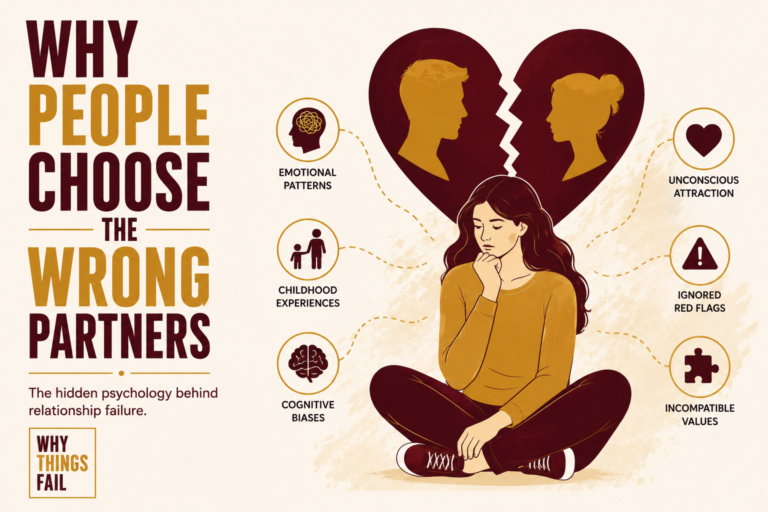
People often choose the wrong partners not because they intentionally seek unhealthy relationships, but because emotional needs, childhood experiences, cognitive biases and unconscious behavioural patterns influence attraction more than rational judgement. The wrong relationship is usually the result of repeated psychological patterns rather than a single poor decision.
Introduction
Every failed relationship raises the same difficult question.
Why did I choose the wrong person?
People often assume unsuccessful relationships happen because of bad luck, poor timing or simply meeting the wrong individual. Yet when similar patterns repeat across different relationships, coincidence becomes an incomplete explanation.
Many intelligent, successful and emotionally aware people repeatedly enter relationships that leave them unhappy, emotionally exhausted or incompatible with their long term goals. They promise themselves the next relationship will be different, only to find themselves facing familiar problems once again.
This repetition suggests that relationship failure is rarely random.
It follows recognisable behavioural and psychological patterns.
Modern psychology shows that attraction is influenced by far more than physical appearance or shared interests. Attachment style, childhood experiences, emotional needs, cognitive biases, family dynamics, self perception and social expectations all influence who we choose and why we remain in relationships that no longer serve us.
Understanding why people choose the wrong partners therefore requires looking beyond romance.
It requires understanding human behaviour.
What Is Choosing The Wrong Partner?
Choosing the wrong partner does not simply mean entering a relationship that eventually ends.
Healthy relationships sometimes fail because people grow in different directions or life circumstances change.
Choosing the wrong partner refers to selecting someone whose values, emotional maturity, communication style or long term goals consistently conflict with one’s own wellbeing.
The problem is rarely obvious at the beginning.
Many unhealthy relationships begin with excitement, emotional intensity and strong attraction.
The incompatibility usually becomes visible only after trust develops and daily life begins replacing initial excitement.
Relationship failure therefore develops gradually through repeated behavioural choices rather than one dramatic mistake.
The Biggest Myth
One of the most common beliefs about relationships is that people fall in love purely because of compatibility.
Research in psychology suggests something more complex.
People are often attracted to what feels emotionally familiar rather than what is emotionally healthy.
Familiarity creates comfort.
Comfort creates attraction.
Unfortunately, familiar emotional patterns are not always beneficial.
Someone who grew up experiencing inconsistent affection may unconsciously feel drawn towards emotionally unavailable partners.
Someone raised in highly critical environments may mistake criticism for genuine care because it resembles familiar emotional experiences.
This explains why intelligent people sometimes choose partners whose behaviour appears obviously unhealthy to friends and family.
Their decisions are influenced less by objective compatibility and more by deeply established emotional patterns.
The heart does not always seek what is healthiest.
It often seeks what feels familiar.
What Usually Happens?
Most unhealthy relationships follow a remarkably similar progression.
The relationship begins with strong emotional attraction.
Positive qualities receive significant attention while warning signs are overlooked.
Emotional investment increases.
Minor incompatibilities become easier to justify.
Over time, communication problems, conflicting values or unhealthy behaviours become more frequent.
Rather than reassessing compatibility, many people invest even more effort into making the relationship succeed because leaving feels emotionally painful.
Eventually the relationship ends or continues in an unhealthy cycle where both individuals experience frustration, disappointment and emotional exhaustion.
Although every relationship is unique, the behavioural sequence remains surprisingly consistent.
The problem is rarely choosing one unsuitable partner.
It is repeatedly following the same decision making process.
Why Do People Choose The Wrong Partners?
Understanding relationship failure requires moving beyond simple explanations such as poor judgement or bad luck.
Relationships involve one of the most emotionally complex forms of human decision making.
Unlike business or investing, relationship decisions combine emotion, identity, belonging, biology, social expectations and personal history.
The result is that attraction frequently develops before objective evaluation begins.
Emotional Familiarity Often Feels Like Compatibility
The human brain naturally seeks familiarity because familiar experiences require less psychological effort to process.
Behavioural psychologists have found that people often mistake emotional familiarity for emotional safety.
This creates an important distinction.
A relationship may feel comfortable not because it is healthy but because it resembles emotional experiences established much earlier in life.
Attachment theory suggests that childhood relationships with parents or primary caregivers influence expectations about love, trust and emotional security.
Individuals who experienced inconsistent affection may unconsciously normalise uncertainty within adult relationships.
Instead of recognising emotional inconsistency as a warning sign, they interpret it as part of love itself.
The relationship therefore feels emotionally meaningful even when it repeatedly creates anxiety.
Attraction Is Influenced By Emotion More Than Logic
Most people believe they carefully evaluate potential partners.
In reality, attraction usually develops before rational analysis begins.
Emotional responses influence first impressions within moments.
Later, the brain searches for reasons that justify those emotional reactions.
Behavioural economists describe this process as confirmation bias.
Once attraction exists, people naturally focus on qualities supporting their decision while minimising evidence that suggests incompatibility.
Warning signs become temporary flaws.
Broken promises become misunderstandings.
Repeated unhealthy behaviour becomes something that will supposedly improve with time.
Instead of objectively assessing the relationship, individuals begin protecting the emotional investment they have already made.
Fear Of Loneliness Distorts Decision Making
Human beings possess a powerful need for belonging.
This need has deep evolutionary roots because social connection historically increased survival.
Modern relationships continue reflecting this psychological reality.
For many people, remaining in an unhealthy relationship feels less frightening than facing uncertainty alone.
Fear therefore changes decision making.
Instead of asking whether the relationship creates long term wellbeing, individuals ask whether they can tolerate the possibility of losing it.
This shift encourages compromise beyond healthy limits.
Unmet emotional needs, incompatible values and poor communication gradually become accepted as normal because loneliness appears even more uncomfortable.
The decision is therefore driven less by compatibility than by avoiding emotional uncertainty.
Idealisation Creates Unrealistic Expectations
The early stages of relationships often involve idealisation.
Partners focus on desirable characteristics while overlooking behaviours that may later become significant problems.
Neuroscience suggests that romantic attraction influences the brain’s reward system, increasing optimism and reducing critical evaluation during early relationship development.
This psychological process helps explain why warning signs frequently appear obvious only after relationships become established.
People do not deliberately ignore reality.
Their perception is temporarily influenced by emotional attachment.
As emotional intensity decreases, previously overlooked behaviours become increasingly difficult to ignore.
By this stage, emotional commitment, shared experiences and future expectations often make leaving considerably more difficult than recognising the warning signs earlier.
Social Expectations Influence Relationship Choices
Relationship decisions rarely occur in isolation.
Family expectations, cultural values, friendship groups and social media all influence perceptions of what successful relationships should look like.
Many individuals feel pressure to reach particular life milestones such as marriage, starting a family or maintaining long term relationships.
These expectations can unintentionally encourage rushed decisions.
Instead of evaluating long term compatibility, attention shifts towards achieving socially accepted outcomes.
External approval gradually becomes more influential than internal certainty.
This creates relationships built around expectation rather than genuine compatibility.
Emotional Investment Creates Escalation Of Commitment
One of the strongest behavioural patterns observed in psychology is the reluctance to abandon previous investments.
The more time, emotion and energy people invest into a relationship, the more difficult it becomes to leave.
Psychologists refer to this as escalation of commitment.
People remain committed because leaving would require accepting that previous decisions may have been mistaken.
Instead of objectively evaluating the relationship as it exists today, they continue focusing on the effort already invested.
Months become years.
Years become shared responsibilities.
Eventually the relationship continues not because it creates happiness but because ending it appears emotionally and psychologically expensive.
This explains why many unhealthy relationships persist long after both individuals recognise the underlying problems.
The decision is no longer driven by hope alone.
It is driven by the difficulty of letting go of the past.
Warning Signs
Unhealthy relationships rarely fail without warning. In most cases, the warning signs appear early, but emotional attachment gradually makes them easier to ignore.
One of the first warning signs is consistently explaining away behaviour that causes discomfort. A partner repeatedly breaks promises, avoids accountability or dismisses concerns, yet these actions are justified as temporary stress or misunderstandings. Rationalisation becomes more common than honest evaluation.
Another warning sign is feeling responsible for changing the other person. Relationships built on potential rather than present reality often create disappointment. People begin believing that enough patience, love or sacrifice will eventually transform unhealthy behaviour.
Poor communication is another significant indicator. Difficult conversations are avoided because they may create conflict. Instead of resolving problems, both individuals begin managing symptoms while the underlying issues remain unchanged.
Another overlooked warning sign is sacrificing personal values to maintain harmony. Individuals gradually ignore their own needs, boundaries or ambitions because preserving the relationship becomes the primary objective.
Perhaps the clearest warning sign is repeatedly experiencing emotional uncertainty. Healthy relationships may involve occasional disagreement, but they do not require constant anxiety about commitment, trust or emotional security.
These warning signs are frequently ignored because emotions develop faster than objective judgement. Once people become emotionally invested, recognising uncomfortable truths becomes psychologically difficult.
What Could Have Prevented It?
Relationship failure is rarely prevented by finding a perfect partner.
It is more often prevented by improving the quality of decisions before emotional attachment becomes overwhelming.
Greater self awareness is one of the most effective safeguards. Individuals who understand their attachment style, emotional needs and recurring behavioural patterns are better equipped to recognise unhealthy attraction before it develops into long term commitment.
Taking time before making major relationship decisions also improves judgement. Emotional intensity naturally encourages rapid commitment, while careful observation allows consistent behaviour to become visible. Character is revealed through repeated actions rather than early promises.
Clear personal boundaries provide another important layer of protection. Boundaries are not designed to control another person. They define what behaviour is acceptable and what compromises threaten long term wellbeing.
Open communication also plays an essential role. Discussing values, financial expectations, family goals, conflict resolution and emotional needs early in the relationship reduces the likelihood of discovering major incompatibilities after significant emotional investment.
Most importantly, people benefit from recognising that attraction alone is an unreliable guide for choosing a life partner. Attraction begins relationships, but compatibility, trust, emotional maturity and shared values determine whether those relationships remain healthy over time.
Lessons
The reasons people choose the wrong partners reveal lessons that extend far beyond romantic relationships.
The first lesson is that human beings often make emotional decisions before they make rational ones. This pattern appears in investing, business partnerships, career choices and personal relationships because the brain naturally seeks familiarity before objectivity.
Another lesson is that awareness does not automatically change behaviour. Many people recognise unhealthy patterns only after they have repeated them several times. Lasting change begins when individuals examine the beliefs and experiences that continue influencing present decisions.
The investigation also demonstrates that compatibility is not measured by attraction alone. Long term relationships depend on communication, shared values, emotional stability, mutual respect and the ability to navigate uncertainty together.
Perhaps the most important lesson is that successful relationships are built through conscious decision making rather than emotional momentum. Choosing wisely often requires slowing down when emotions encourage moving faster.
Failure Pattern
The dominant pattern behind relationship failure is Emotional Decision Making reinforced by Familiarity and Fear Of Loneliness.
This pattern appears repeatedly because people naturally seek emotional comfort even when that comfort originates from unhealthy experiences. Familiar behaviour feels predictable, while emotionally healthy relationships may initially feel unfamiliar.
Fear of being alone encourages compromise beyond reasonable limits. Emotional investment then creates escalation of commitment, making it increasingly difficult to leave despite growing evidence of incompatibility.
The same behavioural pattern appears in business partnerships, investments and entrepreneurship. People become committed to previous decisions, ignore warning signs and continue investing resources because admitting a mistake feels more painful than continuing it.
The problem is rarely one poor decision.
It is the repeated tendency to allow emotions to outweigh objective evaluation.
Hidden Lesson
The greatest relationship risk is not meeting the wrong person.
It is misunderstanding why that person feels right.
People often believe attraction reflects compatibility. In reality, attraction frequently reflects emotional familiarity, unresolved experiences and unconscious expectations developed long before the relationship began.
The deeper truth is that people usually choose partners according to the stories they believe about love, trust and themselves. Until those stories are examined, the same relationship patterns often repeat with different individuals.
Failure Scorecard
| Area | Score | Explanation |
| Decision Making | 4/10 | Emotional attraction frequently overrides objective evaluation of long term compatibility. |
| Emotional Control | 5/10 | Fear, attachment and hope often influence relationship choices more than evidence. |
| Risk Management | 4/10 | Warning signs are recognised but rarely acted upon before emotional investment increases. |
| Long Term Thinking | 5/10 | Immediate emotional satisfaction often receives greater attention than future compatibility. |
| Self Awareness | 5/10 | Many individuals recognise recurring patterns only after repeated relationship failures. |
| Communication | 6/10 | Difficult conversations are often delayed until problems become deeply established. |
| Planning | 4/10 | Long term values and expectations are frequently discussed too late in the relationship. |
| Adaptability | 6/10 | People can learn healthier relationship patterns once underlying psychological causes are understood. |
Key Takeaways
- People often choose familiar partners rather than compatible partners.
- Attraction is influenced by psychology as much as personality.
- Fear of loneliness can distort relationship decisions.
- Early warning signs usually appear before major relationship problems develop.
- Emotional investment makes unhealthy relationships more difficult to leave.
- Shared values are more important than initial chemistry for long term success.
- Self awareness reduces the likelihood of repeating unhealthy relationship patterns.
- Healthy relationships are built through consistent behaviour rather than emotional intensity.
Frequently Asked Questions
Why do people keep choosing the wrong partners?
People often repeat relationship patterns because unconscious emotional experiences, attachment styles and behavioural habits influence attraction more than objective judgement.
Can someone break unhealthy relationship patterns?
Yes. Greater self awareness, understanding attachment styles and recognising recurring behavioural patterns can significantly improve relationship decisions over time.
Is strong chemistry a sign of compatibility?
Not necessarily. Strong attraction may reflect emotional familiarity rather than genuine compatibility. Healthy long term relationships require shared values, trust, communication and mutual respect.
Why do people ignore red flags?
Emotional attachment, optimism, fear of loneliness and confirmation bias encourage people to minimise behaviours that conflict with their expectations of the relationship.
What matters most when choosing a life partner?
Long term compatibility depends on emotional maturity, shared values, trust, communication, accountability and the ability to resolve conflict constructively rather than relying solely on attraction.
Conclusion
People rarely choose the wrong partners because they lack intelligence or good intentions. They do so because human relationships are shaped by unconscious emotional patterns, behavioural biases and deeply rooted psychological needs that often operate beneath conscious awareness.
Understanding these hidden influences transforms relationship failure from a question of luck into one of behavioural insight. The most important relationship decisions are rarely determined by who enters our lives, but by the unseen beliefs and emotional patterns that influence why we choose them.