Quick Answer
People ignore red flags in relationships because emotions often influence judgement more than logic. Hope, attachment, fear of loneliness, confirmation bias and psychological investment can cause individuals to minimise warning signs even when the relationship is becoming unhealthy. Understanding these behavioural patterns helps explain why relationship failure is often predictable long before it happens.
Introduction
Most unhealthy relationships do not begin with obvious abuse, manipulation or betrayal.
They often begin with attraction, excitement and optimism.
The early stages of a relationship encourage people to focus on potential rather than reality. Kind gestures receive greater attention than concerning behaviour. Small warning signs are dismissed as misunderstandings or temporary problems. Over time, these overlooked moments gradually develop into larger patterns that become increasingly difficult to ignore.
This raises an important question.
Why do intelligent and emotionally aware people remain in relationships that repeatedly show clear warning signs?
The simplest explanation is that love makes people irrational.
The deeper explanation is far more complex.
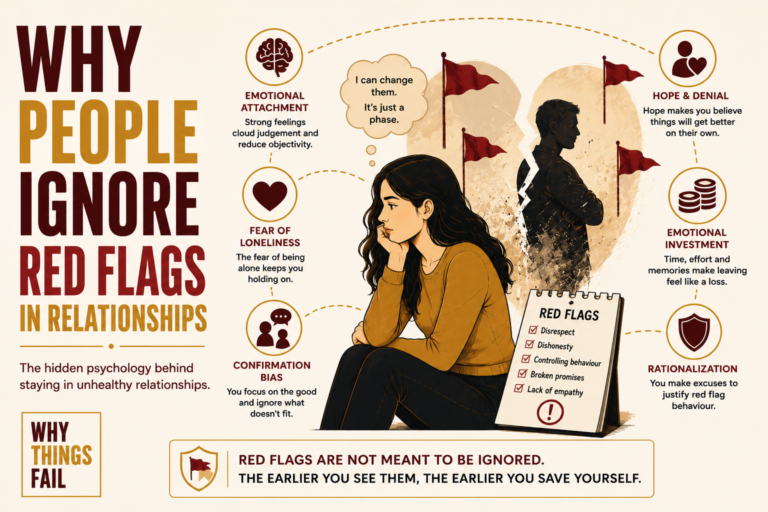
Human relationships are shaped by emotions, psychological attachment, cognitive biases and social influences. People rarely ignore red flags because they fail to notice them. More often, they notice them but unconsciously create explanations that allow the relationship to continue.
Understanding why people ignore red flags is not simply about recognising unhealthy behaviour.
It is about understanding how human psychology influences judgement when emotions and attachment become deeply involved.
What Is It?
Ignoring red flags in a relationship means overlooking behaviours that consistently suggest future emotional harm, unhealthy communication, manipulation or incompatibility.
A single disagreement is not necessarily a red flag.
Neither is an isolated mistake.
The concern arises when behaviours become recurring patterns.
These patterns may include dishonesty, controlling behaviour, disrespect, emotional inconsistency, excessive jealousy, poor communication, broken trust or repeated boundary violations.
The challenge is that relationships rarely deteriorate overnight.
They change gradually.
Each overlooked warning sign increases emotional investment, making objective judgement progressively more difficult.
Relationship failure therefore begins long before the relationship actually ends.
It often begins with the repeated decision to explain away behaviours that deserve closer attention.
The Biggest Myth
One of the most common beliefs about unhealthy relationships is that people ignore red flags because they are naive or emotionally weak.
Research in psychology suggests something different.
Most people do recognise warning signs.
The difficulty lies in interpreting what those signs mean.
When emotional attachment develops, the brain naturally seeks consistency between beliefs and reality.
If someone believes they have found a loving partner, information that contradicts that belief creates psychological discomfort.
Rather than changing the belief, many people change the explanation.
Controlling behaviour becomes concern.
Jealousy becomes affection.
Broken promises become temporary mistakes.
Emotional distance becomes stress from work.
This psychological process allows the relationship to remain emotionally stable even while warning signs continue increasing.
The issue is therefore not ignorance.
It is interpretation.
What Usually Happens?
Most unhealthy relationships follow a predictable progression.
The relationship begins with excitement and emotional connection.
Positive experiences create trust.
Small warning signs appear.
These signs are explained away because they seem inconsistent with the positive image already formed.
Emotional investment increases.
Shared experiences, future plans and personal sacrifices strengthen attachment.
Warning signs become more frequent.
Instead of questioning the relationship, many people work harder to preserve it.
Only when emotional stress becomes overwhelming do they begin recognising that the behaviours they ignored were not isolated incidents but consistent patterns.
By this stage, leaving often feels far more difficult than staying.
Why Does It Happen?
This is where relationship failure becomes less about romance and more about psychology.
Ignoring red flags is rarely a conscious decision.
It is usually the result of several psychological processes working together.
Emotional Attachment Changes Risk Perception
Strong emotional attachment influences how the brain evaluates information.
People naturally assign greater importance to experiences that support emotional security than those that threaten it.
When someone feels loved, accepted or emotionally connected, negative information receives less attention.
The brain attempts to preserve emotional stability by reducing the perceived seriousness of warning signs.
This explains why friends and family often recognise problems long before the person inside the relationship does.
Their judgement is not influenced by emotional attachment.
Confirmation Bias Reinforces Existing Beliefs
Confirmation bias is one of the strongest psychological forces affecting relationships.
Once people believe they have found the right partner, they begin searching for evidence that confirms this belief.
Positive experiences become proof that the relationship is healthy.
Negative experiences become exceptions.
Every apology strengthens hope.
Every temporary improvement becomes evidence that meaningful change is possible.
Contradictory evidence is not ignored completely.
Instead, it is given less importance than information supporting the existing belief.
Over time, this selective interpretation creates a version of reality that feels emotionally comfortable even when objective evidence suggests otherwise.
The Sunk Cost Effect Makes Leaving Feel Like Failure
Behavioural economists describe the sunk cost effect as the tendency to continue investing in something because of the time, effort or emotion already invested.
Relationships are especially vulnerable to this bias.
Months or years spent building emotional intimacy create a powerful psychological commitment.
People begin thinking differently.
“I have already invested so much.”
“We have been together for years.”
“We have overcome difficult times before.”
Ending the relationship begins to feel like wasting everything that came before.
Ironically, the longer someone remains in an unhealthy relationship, the stronger this psychological pressure often becomes.
The past starts controlling decisions about the future.
Fear Of Loneliness Changes Decision Making
Fear is not limited to fear of conflict.
Many people fear uncertainty more than familiarity.
An unhealthy relationship may create emotional pain, but it also provides predictability.
Leaving introduces uncertainty.
Will I find someone else?
Will I regret leaving?
Will I be happier alone?
The human brain often prefers familiar discomfort over uncertain change.
This tendency explains why many people remain in relationships they know are unhealthy.
The immediate emotional certainty feels less frightening than an unknown future.
Hope Often Becomes Stronger Than Evidence
Hope is one of the most valuable human emotions.
It encourages resilience and perseverance.
However, hope can also distort judgement.
People often confuse potential with reality.
They focus on who their partner could become rather than who their partner consistently is.
Promises receive greater attention than repeated behaviour.
Future possibilities outweigh present experiences.
This explains why many unhealthy relationships continue despite repeated disappointments.
Hope encourages people to believe that meaningful change is just one conversation, one apology or one important event away.
Behavioural psychology suggests that consistent behaviour predicts future behaviour far more reliably than repeated promises.
Social Pressure Encourages Silence
Relationships rarely exist in isolation.
Family expectations, cultural values, marriage, children, shared finances and social identity all influence decision making.
Leaving a relationship may involve disappointing relatives, changing living arrangements, dividing finances or explaining the situation to friends.
These external pressures increase the psychological cost of leaving.
As a result, people often convince themselves that remaining in the relationship is the easier option.
The decision is no longer based only on the relationship itself.
It becomes influenced by the wider social system surrounding it.
Poor Emotional Boundaries Increase Vulnerability
People with weak personal boundaries often assume responsibility for solving problems that belong to someone else.
They become caretakers instead of equal partners.
Manipulative behaviour becomes something to fix.
Emotional inconsistency becomes something to understand.
Disrespect becomes something to tolerate.
Gradually, protecting the relationship becomes more important than protecting personal wellbeing.
At this point, ignoring red flags is no longer simply about optimism.
It becomes part of a broader behavioural pattern where maintaining emotional connection takes priority over recognising reality.
Warning Signs
Unhealthy relationships rarely collapse without warning. The warning signs usually appear early, but emotional attachment often prevents them from being recognised for what they truly represent.
One warning sign is repeated inconsistency between words and actions. A partner may make sincere promises but consistently fail to follow through. Over time, hope begins replacing evidence as the basis for trust.
Another warning sign is feeling responsible for another person’s behaviour. When someone repeatedly apologises for their partner’s anger, dishonesty or manipulation, they begin carrying emotional burdens that do not belong to them.
Constantly making excuses is another important indicator. If friends and family repeatedly question the relationship while one person continually explains away concerning behaviour, confirmation bias may already be influencing judgement.
Loss of personal boundaries is equally significant. Gradually accepting behaviour that would once have felt unacceptable often indicates that emotional investment has begun overriding self respect.
Perhaps the most overlooked warning sign is the feeling of walking on eggshells. When someone constantly monitors their words or actions to avoid conflict, the relationship has often shifted from emotional safety to emotional survival.
These warning signs are ignored because they develop gradually. Small compromises accumulate until unhealthy behaviour begins to feel normal.
What Could Have Prevented It?
Relationship failure cannot always be prevented.
People change.
Circumstances change.
Unexpected challenges test even healthy relationships.
However, many unhealthy relationships could be recognised earlier through better decision making and stronger emotional awareness.
One of the most effective safeguards is judging behaviour over time rather than isolated moments. Consistent actions reveal character far more accurately than occasional apologies or promises.
Maintaining healthy personal boundaries is equally important. Boundaries are not barriers to love. They define the conditions under which trust, respect and emotional safety can exist. When boundaries are repeatedly ignored, the relationship should be evaluated rather than endlessly justified.
Independent perspectives also reduce psychological blind spots. Trusted friends, family members or qualified therapists often recognise unhealthy patterns because they are less emotionally invested. Their observations provide an external reality check that emotional attachment sometimes prevents.
Self awareness plays an equally important role. Understanding cognitive biases such as confirmation bias, optimism bias and the sunk cost effect allows people to recognise when emotions begin influencing judgement more than objective evidence.
Perhaps the most realistic prevention is accepting that ending an unhealthy relationship is not always a failure. Sometimes the healthiest decision is recognising that preserving emotional wellbeing requires letting go rather than investing further.
Lessons
Ignoring red flags reveals lessons that extend far beyond relationships.
The first lesson is that emotions influence judgement more powerfully than logic. Intelligence alone does not protect people from poor decisions when emotional attachment becomes deeply rooted.
Another lesson is that repeated behaviour predicts the future more reliably than repeated promises. Sustainable trust is built through consistency rather than intention.
The investigation also highlights the importance of questioning personal assumptions. People naturally seek evidence supporting what they already believe, making objective self reflection essential in both relationships and broader life decisions.
Perhaps the most significant lesson is that protecting emotional wellbeing requires recognising reality before hope transforms into denial. Healthy relationships encourage growth, mutual respect and emotional security rather than constant uncertainty.
Failure Pattern
The dominant pattern behind relationship failure is Emotional Decision Making reinforced by Confirmation Bias and Fear of Loss.
People become emotionally invested, interpret warning signs more positively than they deserve and continue investing because leaving feels increasingly painful. Time, memories and shared experiences strengthen commitment even when the relationship becomes progressively unhealthy.
This behavioural pattern appears beyond relationships. Investors hold losing investments because they hope prices will recover. Business leaders continue failing projects because they have already invested significant resources. Entrepreneurs ignore warning signs because abandoning an idea feels like admitting failure.
In each case, emotional investment gradually replaces objective evaluation.
Hidden Lesson
The greatest danger in an unhealthy relationship is not failing to see red flags.
It is slowly changing the meaning of those red flags until they no longer appear dangerous.
The human mind naturally protects emotional attachment by rewriting uncomfortable reality into acceptable explanations. This process feels compassionate in the moment, yet it often delays decisions that could prevent far greater emotional harm.
Relationship failure therefore begins long before separation. It begins when protecting hope becomes more important than accepting evidence.
Failure Scorecard
| Area | Score | Explanation |
| Decision Making | 4/10 | Emotional attachment frequently outweighs objective judgement. |
| Emotional Control | 5/10 | Strong emotions often influence interpretation of warning signs. |
| Risk Awareness | 4/10 | Long term emotional risks are underestimated while immediate emotional comfort is prioritised. |
| Long Term Thinking | 5/10 | Short term hope often overshadows realistic evaluation of future patterns. |
| Self Awareness | 6/10 | Many people recognise red flags only after significant emotional investment. |
| Personal Boundaries | 4/10 | Repeated compromises gradually weaken healthy boundaries. |
| Planning | 5/10 | Difficult conversations and future compatibility are often postponed rather than addressed. |
| Adaptability | 6/10 | Some individuals adjust when evidence becomes overwhelming, while others remain committed despite repeated warning signs. |
Key Takeaways
- People rarely ignore red flags because they are unaware of them. They often reinterpret them through emotional attachment.
- Confirmation bias encourages individuals to notice evidence supporting hope while minimising contradictory behaviour.
- The sunk cost effect makes leaving feel like losing everything already invested.
- Fear of loneliness often appears more threatening than remaining in an unhealthy relationship.
- Consistent behaviour provides a more reliable indicator of future relationships than repeated promises.
- Healthy boundaries protect emotional wellbeing rather than weaken relationships.
- Objective perspectives from trusted people can reveal patterns that emotional attachment conceals.
- Lasting relationships depend on mutual respect, trust and consistent behaviour rather than hope alone.
Frequently Asked Questions
Why do people ignore obvious red flags in relationships?
People often ignore red flags because emotional attachment, confirmation bias, fear of loneliness and hope influence how they interpret behaviour. The issue is usually psychological rather than a lack of awareness.
What is the most commonly ignored red flag?
Repeated inconsistency between words and actions is one of the most frequently ignored warning signs. Promises often receive greater attention than long term patterns of behaviour.
Does love make people overlook unhealthy behaviour?
Strong emotional attachment can reduce objective judgement. Love itself is not the problem, but attachment may encourage people to explain away behaviours that deserve closer attention.
Why is it difficult to leave an unhealthy relationship?
Leaving often involves emotional loss, uncertainty, shared memories, financial considerations and social pressure. These factors increase the psychological cost of ending the relationship, making people more likely to stay despite recognising warning signs.
Can recognising psychological biases improve relationship decisions?
Yes. Understanding concepts such as confirmation bias, the sunk cost effect and emotional attachment helps people evaluate relationships more objectively and identify unhealthy patterns earlier.
Conclusion
People do not ignore red flags because they lack intelligence or emotional awareness. They ignore them because the human mind is remarkably skilled at protecting hope, preserving attachment and avoiding painful uncertainty. These psychological mechanisms can make unhealthy relationships feel reasonable long after objective evidence suggests otherwise.
Understanding this changes how relationship failure is viewed. It becomes less about isolated mistakes and more about recognising the subtle behavioural patterns that gradually reshape judgement. The strongest relationships are not those without challenges, but those where reality is consistently valued above comforting assumptions