Introduction
Social media has transformed the way people communicate, maintain friendships and build relationships. It allows families to stay connected across continents, helps old friends reconnect and enables couples to share important moments instantly. These benefits explain why billions of people use platforms such as Facebook, Instagram, TikTok, Snapchat and X every day.
Yet despite making communication easier, many relationships have become more fragile.
Arguments over online activity have become common. Couples question each other’s intentions after seeing a single comment or photograph. Friends compare their lives with carefully edited images. Families spend more time looking at screens than talking to one another.
The contradiction is striking.
Technology designed to connect people often creates emotional distance instead.
This raises an important question.
Why does a tool built for communication frequently damage the very relationships it promises to strengthen?
The obvious answer is excessive screen time.
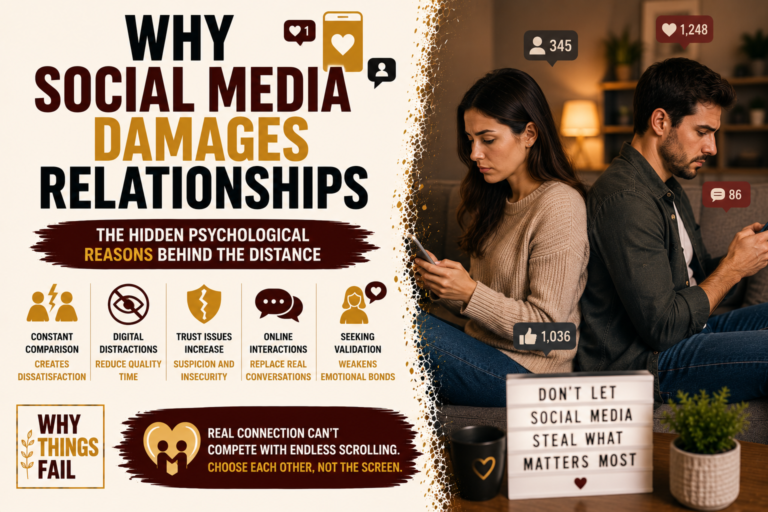
The deeper answer lies in psychology, human behaviour and the way digital platforms influence attention, emotions and social interaction. Social media rarely destroys healthy relationships overnight. Instead, it gradually changes habits, expectations and emotional responses until genuine connection becomes increasingly difficult.
Understanding why social media damages relationships requires looking beyond technology itself. It requires examining how people behave when attention becomes a product, validation becomes measurable and comparison becomes constant.
What Is Relationship Damage Caused By Social Media?
Relationship damage occurs when social media gradually weakens trust, communication, emotional intimacy or mutual understanding between people.
This does not mean social media is inherently harmful.
Many couples maintain healthy long distance relationships through digital communication. Families stay connected despite living in different countries. Friends who might otherwise lose contact continue meaningful conversations online.
The problem begins when online interaction starts replacing genuine emotional connection rather than supporting it.
Instead of strengthening relationships, social media changes how people communicate, interpret behaviour and evaluate themselves.
A delayed reply becomes a reason for suspicion.
A photograph with another person creates unnecessary jealousy.
A constant stream of carefully selected content encourages unrealistic expectations about relationships, appearance and happiness.
Relationship failure therefore rarely begins with one social media platform.
It begins when digital behaviour gradually changes human behaviour.
The Biggest Myth
The most common belief is that social media ruins relationships because people spend too much time on their phones.
Time certainly matters.
However, time alone does not explain why some relationships remain healthy despite frequent social media use while others struggle even when online activity is limited.
The deeper issue is not the number of hours spent online.
It is how social media changes attention, emotional priorities and human behaviour.
Digital platforms compete for attention by encouraging continuous engagement. Notifications, likes, comments and personalised content activate psychological reward systems that encourage repeated checking.
As attention shifts towards digital interaction, face to face communication often becomes less meaningful.
People may be physically present while remaining emotionally absent.
The real challenge is therefore not technology itself.
It is the competition between digital attention and human connection.
What Usually Happens?
Relationship problems linked to social media often follow a predictable pattern.
People initially use social media to communicate and stay informed.
Gradually, online interaction becomes more frequent than meaningful conversation.
Small misunderstandings begin to appear.
Partners question online behaviour.
Friends compare lifestyles.
Family conversations become shorter.
Digital validation becomes increasingly important.
Trust weakens.
Communication becomes defensive rather than open.
Emotional distance develops slowly until even minor disagreements create major conflict.
The relationship rarely collapses because of one online interaction.
It weakens through hundreds of small moments where digital engagement quietly replaces genuine connection.
Why Does It Happen?
The visible problems associated with social media include jealousy, distraction and poor communication.
These are symptoms.
The underlying causes are far more complex.
Behavioural psychology suggests that human beings respond strongly to rewards, uncertainty and social comparison. Social media combines all three within a single environment.
Every notification creates anticipation.
Every like provides social validation.
Every comment encourages further engagement.
Over time, the brain begins associating digital interaction with immediate emotional rewards.
Real relationships operate differently.
Trust develops slowly.
Communication requires patience.
Conflict requires empathy.
Strong relationships are built through consistent effort rather than instant gratification.
This difference creates tension between human relationships and digital platforms.
Social Comparison Changes Relationship Expectations
One of the strongest psychological influences is social comparison.
People naturally evaluate themselves by comparing their experiences with those of others.
Social media magnifies this behaviour because users are constantly exposed to carefully selected moments of success, romance and happiness.
Couples see extravagant holidays, expensive gifts and seemingly perfect relationships.
Parents compare family experiences.
Friends compare careers, lifestyles and achievements.
These comparisons rarely reflect reality.
People generally share highlights rather than ordinary moments or personal struggles.
Despite understanding this intellectually, many individuals respond emotionally.
Their own relationships begin to appear less exciting, less successful or less fulfilling simply because they are comparing reality with carefully edited content.
Dissatisfaction grows not because relationships have become worse but because expectations have quietly changed.
Instant Validation Changes Human Behaviour
Social media platforms are designed around immediate feedback.
A photograph receives likes within minutes.
A comment generates instant responses.
Messages appear and disappear rapidly.
This creates a behavioural pattern where people begin expecting immediate emotional rewards.
Healthy relationships function differently.
Trust develops over months and years.
Respect is earned gradually.
Forgiveness requires time.
Meaningful conversations cannot be rushed.
When people become accustomed to instant digital validation, the slower pace of real relationships may begin to feel frustrating.
Patience declines.
Attention becomes fragmented.
Emotional investment weakens because immediate digital stimulation becomes easier than resolving real life conflict.
Fear Of Missing Out Creates Emotional Distance
Another important psychological factor is Fear Of Missing Out, often called FOMO.
Social media constantly reminds users of experiences they are not having.
Friends attend celebrations.
Colleagues receive promotions.
Influencers travel to exotic destinations.
Families appear permanently happy.
This continuous exposure encourages the belief that fulfilment exists somewhere else.
Instead of appreciating present relationships, attention shifts towards imagined alternatives.
Partners become distracted.
Conversations lose depth.
People become physically together while mentally focused elsewhere.
Over time, emotional presence begins to disappear.
The relationship suffers not because affection has vanished but because attention has been redirected.
Jealousy Is Amplified By Uncertainty
Jealousy has always existed within human relationships.
Social media increases its intensity by creating endless opportunities for uncertainty.
A simple like.
A late night message.
A new follower.
A photograph without context.
Each action can be interpreted in multiple ways.
Without clear communication, the brain naturally fills missing information with assumptions.
Psychologists describe this as ambiguity bias.
People often assume negative explanations when complete information is unavailable.
Trust therefore becomes increasingly dependent upon digital behaviour rather than direct conversation.
Relationships become influenced by interpretations instead of evidence.
Attention Has Become The Most Valuable Resource
The deepest cause extends beyond individual behaviour.
Modern social media platforms operate within an attention economy.
Their success depends upon keeping users engaged for as long as possible.
Every additional minute spent scrolling increases advertising opportunities and platform revenue.
Human attention has therefore become a commercial resource.
This creates a conflict.
Healthy relationships require uninterrupted attention, active listening and emotional presence.
Social media platforms benefit when attention is continually redirected.
The competition is therefore not simply between two people.
It is between human connection and digital incentives designed to capture attention every moment of the day.
Warning Signs
Relationship damage caused by social media rarely begins with a dramatic event. It develops through small behavioural changes that become normal over time.
One warning sign is checking social media during conversations. When people repeatedly divide their attention between a loved one and a mobile screen, they unintentionally communicate that digital content deserves equal or greater priority.
Another warning sign is seeking validation from strangers more often than appreciation from family or partners. The emotional value of likes, comments and followers gradually begins to outweigh genuine conversations and shared experiences.
Constant comparison is another early indicator. If someone frequently compares their relationship with carefully edited online content, dissatisfaction often follows. Real relationships cannot compete with selectively presented moments that hide conflict, compromise and ordinary life.
Excessive concern about online activity should also be recognised. Monitoring when someone was last active, analysing who liked a photograph or questioning every online interaction creates an environment where suspicion replaces trust.
Another overlooked warning sign is reduced face to face communication. Important conversations become shorter while digital interaction becomes longer. Emotional intimacy gradually declines because meaningful relationships require presence rather than constant connectivity.
These warning signs are often ignored because each behaviour appears harmless in isolation. Together, however, they gradually weaken the foundations of trust, empathy and emotional security.
What Could Have Prevented It?
The decline of many relationships is not inevitable. Social media itself is not the problem. The problem lies in how people allow technology to shape their behaviour.
Healthy relationships benefit from intentional communication rather than continuous communication. Setting clear boundaries around digital use creates opportunities for uninterrupted conversations and shared experiences.
Couples and families who regularly spend time without screens often strengthen emotional connection because attention becomes fully focused on one another instead of competing with endless notifications.
Another important safeguard is recognising that online content represents selective reality rather than complete reality. Understanding this reduces unhealthy comparison and unrealistic expectations.
Open communication also prevents misunderstanding. Discussing concerns directly instead of making assumptions based on digital activity strengthens trust and reduces unnecessary conflict.
Finally, individuals benefit from becoming aware of how digital platforms influence attention. Once people understand that many platform features are intentionally designed to maximise engagement, they become better equipped to make conscious choices instead of automatic ones.
The objective is not to reject technology.
It is to ensure that technology supports relationships instead of replacing them.
Lessons
The reasons social media damages relationships reveal broader truths about human behaviour.
The first lesson is that attention is one of the most valuable forms of emotional investment. Relationships rarely fail because people stop caring. They weaken because attention is repeatedly directed elsewhere.
Another lesson is that comparison changes satisfaction more than reality changes satisfaction. When expectations are shaped by idealised online images, genuine relationships often appear less fulfilling despite remaining fundamentally healthy.
The investigation also shows that convenience cannot replace emotional effort. Sending messages throughout the day cannot substitute for honest conversations, empathy and shared experiences.
Perhaps the most important lesson is that technology amplifies existing habits rather than creating them. Strong relationships often use social media as a tool for connection. Weak relationships allow it to become a source of misunderstanding, distraction and emotional distance.
Failure Pattern
The dominant pattern behind relationship failure is Emotional Disconnection Driven By Constant Digital Distraction.
This pattern repeats because human attention is limited. Every moment devoted to digital stimulation is a moment unavailable for genuine emotional connection.
Social comparison creates dissatisfaction.
Fear of missing out encourages distraction.
Instant validation reduces patience.
Uncertainty increases jealousy.
Reduced communication weakens trust.
Together these behaviours gradually replace emotional intimacy with emotional distance.
The same behavioural pattern extends beyond romantic relationships. Friendships weaken when online interaction replaces meaningful conversation. Families experience similar challenges when shared experiences are replaced by individual screen time.
The underlying issue remains the same.
Technology changes behaviour, and behaviour ultimately shapes relationships.
Hidden Lesson
The greatest threat to modern relationships is not social media itself.
It is the quiet belief that constant connection is the same as genuine connection.
People have never communicated more frequently.
Yet meaningful communication often receives less attention than ever before.
The deeper truth is that relationships rarely collapse because of one message, one photograph or one application.
They weaken through thousands of unnoticed moments where attention is repeatedly given to digital interaction instead of the people who matter most.
Failure Scorecard
| Area | Score | Explanation |
| Communication | 4/10 | Digital interaction often replaces meaningful face to face conversations. |
| Decision Making | 5/10 | Emotional reactions frequently outweigh rational discussion during online misunderstandings. |
| Trust Management | 4/10 | Constant exposure to ambiguous online behaviour increases suspicion and insecurity. |
| Long Term Thinking | 5/10 | Immediate digital gratification often receives greater priority than lasting relationship health. |
| Emotional Awareness | 5/10 | Many people underestimate how social media influences their emotions and behaviour. |
| Emotional Control | 4/10 | Jealousy, comparison and fear frequently influence responses before facts are known. |
| Planning | 6/10 | Few couples or families establish healthy digital boundaries before problems appear. |
| Adaptability | 7/10 | Relationships improve when individuals consciously adjust their digital habits and communication patterns. |
Key Takeaways
- Social media rarely damages relationships overnight. It changes behaviour gradually.
- Attention is the foundation of emotional intimacy.
- Constant comparison creates dissatisfaction even in healthy relationships.
- Instant digital validation can reduce patience and empathy.
- Trust weakens when assumptions replace direct communication.
- Digital connection should support rather than replace real world relationships.
- Healthy boundaries protect relationships without requiring people to abandon technology.
- The quality of communication matters far more than the quantity of messages exchanged.
Frequently Asked Questions
Why does social media damage relationships?
Social media can damage relationships by encouraging comparison, reducing meaningful communication, increasing jealousy and diverting attention away from genuine emotional connection.
Does social media always harm relationships?
No. Social media becomes harmful only when it replaces healthy communication, creates unrealistic expectations or encourages behaviour that weakens trust and emotional intimacy.
Why does social media create jealousy?
Social media often presents incomplete information. Likes, comments and photographs lack context, causing people to make assumptions that increase insecurity and suspicion.
Can healthy relationships survive heavy social media use?
Yes. Relationships remain healthy when communication, trust and mutual respect take priority over digital activity. Technology works best as a communication tool rather than a substitute for emotional connection.
What is the biggest lesson from this investigation?
The greatest lesson is that relationships are strengthened by attention, trust and presence. Social media becomes damaging only when it consistently redirects those qualities away from the people who need them most.
Conclusion
Social media has changed how people communicate, but it has also changed how they compare, interpret and value relationships. The technology itself is neither good nor bad. The lasting impact depends on the behaviours it encourages and the choices people make every day.
Understanding why social media damages relationships reveals a deeper truth. Lasting relationships are rarely destroyed by a single digital interaction. They are gradually reshaped by repeated decisions about where attention is placed, how trust is maintained and whether genuine human connection remains more valuable than constant online engagement.