Introduction
Trust is one of the most valuable assets any individual, business or institution can possess. Unlike money, technology or physical resources, trust cannot be bought instantly or rebuilt overnight. It develops slowly through consistent actions, shared expectations and reliable behaviour, yet it can disappear after a single poor decision.
History provides countless examples of organisations losing customers, investors withdrawing capital and partnerships collapsing because trust was broken. Financial scandals, corporate fraud, failed investments and damaged business relationships often appear different on the surface, but many share the same underlying cause. Somewhere within the system, trust began to erode long before the final failure became visible.
Understanding why trust breaks down matters because trust influences every financial decision. Consumers trust brands before making purchases. Investors trust company management before allocating capital. Employees trust leaders before committing their effort. Business partners trust contracts, reputations and shared incentives before entering long term relationships.
The important question is not simply why trust disappears.
The deeper question is why people continue making decisions that gradually weaken trust without recognising the long term consequences.
Understanding this process reveals that broken trust is rarely an isolated event. It is usually the predictable outcome of behavioural patterns, poor incentives and repeated decisions that slowly undermine confidence.
What Is Trust Breakdown?
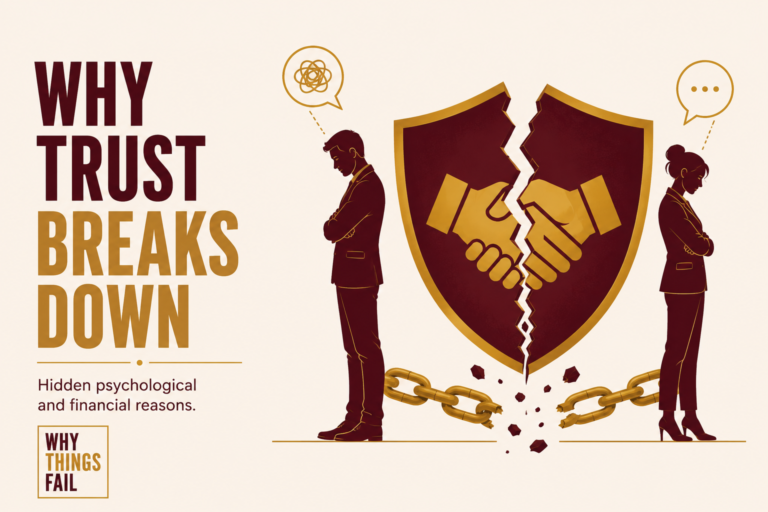
Trust breakdown occurs when confidence in a person, organisation or system declines to the point where cooperation becomes difficult or impossible.
Many people assume trust disappears after a major betrayal.
In reality, trust often weakens through a series of small disappointments that gradually change expectations.
A missed promise.
Poor communication.
Hidden information.
Conflicting incentives.
Inconsistent behaviour.
Each event may appear insignificant on its own. Together, they reshape how people interpret future actions.
Trust therefore functions much like reputation.
It compounds through consistency.
It deteriorates through inconsistency.
Whether the context involves business leadership, financial markets, banking, entrepreneurship or personal relationships, trust fails when behaviour repeatedly contradicts expectations.
The Biggest Myth
The most common misconception is that trust is destroyed by one dramatic event.
Major scandals certainly accelerate the process, but they rarely represent the true beginning of failure.
Corporate collapses seldom begin with accounting fraud.
Investment fraud rarely begins with stolen money.
Business partnerships rarely fail because of one disagreement.
Instead, trust usually declines gradually.
Small ethical compromises become accepted.
Transparency decreases.
Accountability weakens.
Communication becomes selective.
People ignore these changes because no single incident appears serious enough to demand action.
By the time a major crisis becomes visible, trust has often been deteriorating for months or even years.
The visible failure is simply the moment hidden weaknesses become impossible to ignore.
What Usually Happens?
The pattern behind trust failure is remarkably consistent.
A relationship begins with confidence.
Positive experiences strengthen expectations.
Success creates familiarity.
Familiarity reduces scrutiny.
Small compromises become normal.
Questions become less frequent.
Accountability declines.
Eventually, behaviour begins drifting away from the standards that originally created trust.
Warning signs appear but are dismissed because previous success creates the belief that everything remains under control.
When a significant failure finally occurs, people often describe it as sudden.
In reality, the loss of trust had been developing quietly long before anyone recognised the danger.
Why Does Trust Break Down?
Trust rarely disappears because people deliberately intend to destroy it.
More often, it weakens because human behaviour changes under different incentives, pressures and expectations.
The visible problem may be dishonesty, poor leadership or financial misconduct.
The deeper causes are psychological.
Success Often Reduces Accountability
One of the most overlooked reasons trust breaks down is that success changes behaviour.
During the early stages of a business, partnership or investment relationship, people work hard to earn confidence. Communication is frequent. Promises are fulfilled. Decisions receive careful scrutiny because reputation is still being established.
As success grows, accountability often declines.
Leaders receive fewer challenges.
Employees become less willing to question decisions.
Investors become more confident in management.
Customers assume quality will remain consistent.
Success creates familiarity, and familiarity frequently reduces vigilance.
Behavioural economists describe this as a form of overconfidence.
Past success creates the belief that future success is inevitable.
This confidence encourages shortcuts that would never have been accepted during the early stages of building trust.
Incentives Shape Behaviour More Than Intentions
People often assume ethical behaviour depends entirely on personal character.
Character certainly matters.
However, behavioural economics demonstrates that incentives strongly influence decision making.
If an executive receives bonuses based only on quarterly profits, short term performance may become more important than long term reputation.
If employees fear punishment for reporting problems, important information remains hidden.
If organisations reward results without evaluating how those results are achieved, ethical standards gradually weaken.
This explains why trustworthy individuals can still participate in systems that produce untrustworthy outcomes.
Poor incentives do not always create dishonesty.
They often encourage silence.
Silence allows small problems to become major failures.
Confirmation Bias Hides Growing Problems
Once trust has been established, people naturally search for evidence that confirms existing beliefs.
Customers continue believing a respected brand is reliable.
Investors continue believing experienced executives are making sound decisions.
Employees continue believing leadership has everything under control.
Psychologists refer to this tendency as confirmation bias.
People pay greater attention to information supporting their existing opinions while dismissing evidence that challenges those beliefs.
This psychological shortcut delays recognition of serious problems.
Instead of investigating warning signs, people explain them away as temporary difficulties or isolated mistakes.
By the time undeniable evidence appears, trust has already been significantly damaged.
Fear Prevents Honest Conversations
Fear is another powerful force behind broken trust.
Employees fear losing promotions.
Managers fear admitting mistakes.
Business owners fear damaging their reputation.
Investors fear acknowledging poor judgement.
These fears discourage honest communication.
Problems remain hidden because revealing them appears more dangerous than ignoring them.
Ironically, this short term protection creates greater long term damage.
Trust depends upon transparency during difficult moments, not merely competence during successful ones.
Organisations that discourage open discussion often discover problems only after those problems have become public.
Small Compromises Become New Standards
Few organisations begin with unethical intentions.
Trust usually declines through gradual behavioural change.
One overlooked policy.
One delayed disclosure.
One misleading statement.
One ignored complaint.
Each compromise slightly changes what becomes acceptable.
Sociologists call this pattern “normalisation of deviance”, a term coined by Diane Vaughan after studying the Challenger disaster. NASA officials repeatedly saw O-ring damage on earlier shuttle flights, but because each flight still returned safely, the problem slowly came to be treated as acceptable. No single decision felt reckless. The standard simply moved a little each time.
Behaviour that once appeared unacceptable slowly becomes routine because repeated exposure reduces emotional resistance.
Eventually, people stop recognising the difference between responsible behaviour and risky behaviour.
The final scandal often attracts public attention.
The hundreds of smaller decisions that made the scandal possible rarely receive the same scrutiny.
That is precisely why trust breakdown remains so predictable.
It is not caused by one catastrophic decision.
It is created through repeated behavioural choices that slowly reshape culture, incentives and expectations until confidence can no longer survive.
Warning Signs
Trust rarely collapses without warning. In almost every case, there are clear signals that confidence is weakening. The problem is that these signals often appear insignificant until the damage has already been done.
One warning sign is a decline in transparency. Questions begin receiving vague answers. Information becomes selective rather than open. Decisions that were once explained clearly become increasingly difficult to understand.
Another indicator is inconsistency between words and actions. Leaders promise accountability while avoiding responsibility. Companies promote customer values while reducing service quality. Investors receive optimistic forecasts that fail to match operational performance. Each inconsistency weakens credibility because trust depends upon predictable behaviour.
A culture where people hesitate to speak openly is another serious warning sign. Employees stop challenging poor decisions. Customers lose confidence that complaints will be addressed. Investors avoid asking difficult questions because previous success creates a false sense of security.
Small ethical compromises should also be recognised as early indicators. Ignoring policies, manipulating performance targets or withholding important information rarely appears disastrous at first. However, these behaviours gradually reshape organisational culture until larger ethical failures become acceptable.
These warning signs are often ignored because people focus on immediate success instead of long term credibility. As long as profits remain strong or relationships appear stable, behavioural weaknesses receive little attention.
What Could Have Prevented It?
Trust cannot be protected through good intentions alone. It requires systems that encourage accountability, transparency and consistent behaviour even when circumstances become difficult.
One of the strongest safeguards is creating incentives that reward long term outcomes rather than immediate results. When leaders, employees and organisations are measured only by short term performance, ethical judgement often becomes secondary to achieving targets.
Open communication is equally important. Organisations where people feel safe reporting mistakes are more likely to identify problems before they become crises. Transparency allows small failures to be corrected before they develop into permanent reputational damage.
Independent oversight also strengthens trust. Boards, auditors, regulators and external reviews reduce the likelihood that overconfidence or internal bias will distort decision making. Accountability is most effective when it exists before problems appear rather than after failure becomes public.
Consistency remains another essential safeguard. Trust grows when actions repeatedly match commitments. Whether the context involves business leadership, investing or customer relationships, reliable behaviour creates confidence because it reduces uncertainty.
Most importantly, individuals and organisations must recognise that trust is earned continuously. Every decision either strengthens or weakens credibility. There is rarely a neutral outcome.
Lessons
The investigation into broken trust reveals lessons that extend well beyond business and finance.
The first lesson is that trust is a strategic asset rather than an emotional concept. It influences investment decisions, customer loyalty, employee engagement and organisational resilience. Once lost, rebuilding it often requires far greater effort than maintaining it in the first place.
Another lesson is that success can become a hidden risk. Strong performance often reduces scrutiny, allowing behavioural weaknesses to develop unnoticed. Organisations should become more accountable during periods of success rather than less.
A further lesson is that culture influences behaviour more consistently than written policies. Ethical guidelines have little value if incentives reward behaviour that contradicts them. Systems determine how people behave when difficult decisions arise.
Perhaps the most important lesson is that trust depends upon consistency rather than perfection. People often forgive honest mistakes when organisations respond with transparency and accountability. They are far less forgiving when mistakes are concealed or responsibility is avoided.
Failure Pattern
The dominant pattern behind trust failure is Poor Decision Making reinforced by Overconfidence, Weak Accountability and Short Term Thinking.
This pattern appears repeatedly across businesses, governments, financial institutions and personal relationships because human behaviour follows similar psychological principles.
Success creates confidence.
Confidence reduces scrutiny.
Reduced scrutiny allows small compromises.
Small compromises gradually become accepted behaviour.
Eventually, those behaviours create a failure large enough to destroy confidence completely.
The final crisis receives public attention, but the true failure began much earlier through repeated decisions that slowly weakened credibility.
Hidden Lesson
Trust rarely disappears because people suddenly become dishonest.
It disappears because small behavioural compromises quietly replace consistent principles.
The deepest lesson is that trust is not destroyed by one dramatic event. It is usually exhausted through hundreds of ordinary decisions that individually appear harmless but collectively transform the way people perceive reliability.
When confidence finally collapses, the event feels sudden.
The process was anything but sudden.
Failure Scorecard
| Area | Score | Explanation |
| Financial Discipline | 6/10 | Trust failures often arise from prioritising immediate financial results over sustainable credibility. |
| Decision Making | 4/10 | Decisions become increasingly influenced by incentives and overconfidence instead of objective judgement. |
| Risk Management | 5/10 | Reputational risks are frequently underestimated until they become public crises. |
| Long Term Thinking | 4/10 | Short term objectives commonly outweigh the importance of preserving trust over time. |
| Financial Knowledge | 7/10 | Knowledge is often available, but ethical judgement and behavioural discipline determine outcomes. |
| Emotional Control | 5/10 | Fear, pride and reputation management frequently discourage honest communication. |
| Planning | 6/10 | Many organisations create policies but fail to reinforce them through consistent accountability. |
| Adaptability | 6/10 | Organisations that acknowledge mistakes early recover more effectively than those resisting change. |
Key Takeaways
- Trust is built through consistent behaviour rather than isolated achievements.
- Success often reduces accountability, creating conditions where trust gradually weakens.
- Incentives influence behaviour more powerfully than intentions alone.
- Confirmation bias delays the recognition of serious problems.
- Transparency during difficult periods strengthens credibility more than perfection during successful periods.
- Small ethical compromises frequently become the foundation of larger failures.
- Strong systems protect trust by encouraging accountability before problems emerge.
- Rebuilding trust requires significantly more effort than maintaining it.
Frequently Asked Questions
Why does trust break down so easily?
Trust breaks down because confidence is based on expectations. When actions repeatedly fail to meet those expectations, even small inconsistencies gradually reduce credibility until cooperation becomes difficult.
What is the biggest cause of broken trust?
The biggest cause is not usually one major betrayal. It is the gradual accumulation of small behavioural compromises combined with poor accountability and weak transparency.
Can trust be rebuilt after it has been broken?
Yes, but rebuilding trust requires consistent behaviour over time. Honest communication, accountability and reliable actions are more effective than promises or public statements.
Why do successful organisations still lose trust?
Success often creates overconfidence and reduces scrutiny. Without strong systems of accountability, behavioural weaknesses remain hidden until a significant failure exposes them.
What role does psychology play in trust?
Psychological biases such as confirmation bias, overconfidence and fear influence how people interpret information, respond to warning signs and make decisions. These biases often delay action until trust has already been damaged.
Conclusion
Trust is often described as fragile, yet its collapse is rarely accidental. It follows a recognisable pattern in which incentives, behavioural biases, weak accountability and repeated compromises slowly replace the principles that originally earned confidence.
Understanding why trust breaks down reveals that reputational failure is seldom caused by a single mistake. It is the predictable outcome of decisions that gradually separate actions from expectations, leaving individuals, organisations and institutions to discover that the greatest losses often begin long before trust finally disappears.