Quick Answer
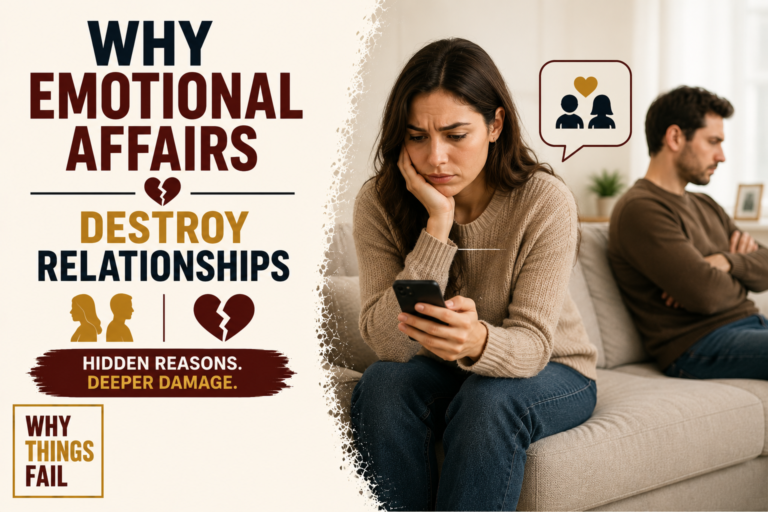
Emotional affairs destroy relationships because they redirect emotional intimacy, trust and commitment away from a primary partner. Although physical boundaries may never be crossed, emotional secrecy, unmet needs and psychological attachment gradually weaken the relationship until trust begins to collapse.
Introduction
Many people assume that infidelity begins with physical intimacy.
In reality, many relationships start breaking down long before any physical affair occurs.
A private conversation becomes a daily habit.
Emotional support begins coming from someone outside the relationship.
Secrets replace openness.
Gradually, emotional energy that once strengthened the relationship is invested elsewhere.
This process often feels harmless in the beginning because no obvious boundary appears to have been crossed. There may be no physical contact, no public betrayal and no intention to end the relationship.
Yet emotional affairs consistently create some of the deepest relationship wounds.
They challenge trust, emotional security and commitment, which are the foundations of healthy long term relationships.
Understanding why emotional affairs destroy relationships requires looking beyond the conversations themselves. The real issue is not simply who someone talks to. It is why emotional attachment shifts, why boundaries weaken and why people often fail to recognise the damage until the relationship reaches a crisis.
Relationship failure rarely begins with one dramatic event.
More often, it develops through hundreds of small decisions that slowly change emotional priorities.
What Is An Emotional Affair?
An emotional affair is a close emotional connection with someone outside a committed relationship that gradually replaces emotional intimacy with a partner.
Unlike physical affairs, emotional affairs are defined less by physical behaviour and more by emotional investment.
People begin sharing personal thoughts, fears, achievements and frustrations with someone else before sharing them with their partner.
They seek comfort, validation and understanding from another person.
Conversations become increasingly personal.
Secrecy gradually becomes normal.
The emotional connection strengthens while the primary relationship quietly weakens.
This shift often occurs without either person intending to betray their relationship.
That is precisely why emotional affairs are so difficult to recognise.
They usually develop slowly rather than suddenly.
The Biggest Myth
The most common belief is simple.
An emotional affair is harmless because nothing physical happened.
This misunderstanding overlooks how relationships function.
Healthy relationships are built on emotional trust before physical intimacy.
Partners expect to be each other’s primary source of emotional support, vulnerability and connection.
When that role gradually transfers to another person, the relationship begins losing one of its most important foundations.
The damage is therefore not measured by physical behaviour alone.
It is measured by emotional distance, broken trust and the gradual replacement of intimacy.
Many relationship therapists argue that emotional betrayal often feels more painful than physical betrayal because it represents a conscious investment of emotional energy over time.
The betrayal is not only what happened.
It is everything that stopped happening within the relationship itself.
This view is shared by leading relationship therapists. Esther Perel, whose work is considered foundational on this topic, argues that the defining element of an affair isn’t whether it’s physical or emotional it’s the secrecy that drives lying and deception. As she puts it, it’s the structure of the affair, not the specific behavior, that constitutes the betrayal
What Usually Happens?
Emotional affairs rarely begin as deliberate attempts to betray a partner.
Most begin through ordinary interactions.
A colleague listens during a stressful period.
A friend offers emotional support.
An online conversation becomes increasingly frequent.
Shared interests create regular communication.
Personal struggles become easier to discuss.
Gradually, emotional dependence develops.
Conversations become more private.
The partner becomes less involved emotionally.
Secrecy increases.
Emotional intimacy shifts outside the relationship.
By the time someone recognises what has happened, the emotional attachment has often become deeply established.
The relationship does not suddenly fail.
It slowly loses emotional closeness until trust begins to disappear.
Why Does It Happen?
Understanding emotional affairs requires moving beyond blame.
People rarely wake up intending to betray someone they love.
Instead, emotional affairs emerge from a combination of human psychology, emotional needs and behavioural patterns that gradually reinforce one another.
The affair is often the visible outcome.
The deeper causes usually remain hidden.
Emotional Needs Seek The Path Of Least Resistance
Every person has fundamental emotional needs.
They want to feel understood.
They want appreciation.
They want emotional safety.
They want someone who listens without judgement.
When these needs remain unmet for long periods, people naturally seek them elsewhere.
This does not justify emotional affairs.
It explains why they become possible.
Behavioural psychologists describe human beings as naturally seeking environments that provide emotional reward while reducing emotional discomfort.
If one relationship becomes associated with conflict, criticism or emotional distance, while another provides acceptance and validation, the brain begins strengthening the second connection.
This process is often unconscious.
The attraction develops because emotional needs are being rewarded.
Emotional Validation Can Become Addictive
One overlooked aspect of emotional affairs is the power of validation.
Feeling appreciated activates powerful reward systems within the brain.
Receiving regular compliments, attention and understanding creates positive emotional reinforcement.
Each conversation becomes emotionally rewarding.
Each message strengthens psychological attachment.
Over time, the emotional connection becomes increasingly important.
The relationship shifts from occasional friendship to emotional dependence.
People frequently mistake this emotional excitement for genuine compatibility.
In reality, they are often responding to novelty, attention and positive reinforcement rather than a deeper understanding of the other person.
Familiarity Often Reduces Appreciation
Long term relationships naturally become familiar.
Partners become accustomed to one another.
Daily responsibilities replace excitement.
Routine gradually replaces novelty.
This change is completely normal.
Unfortunately, many people interpret reduced excitement as reduced love.
When someone new enters their life, every conversation feels interesting.
Every compliment feels meaningful.
Every shared experience feels emotionally significant.
Behavioural economists refer to this tendency as novelty bias.
The brain naturally gives greater attention to new experiences than familiar ones.
Without recognising this psychological tendency, people may incorrectly assume the new emotional connection is stronger than the existing relationship, when in reality it simply feels different.
Emotional Secrecy Changes Behaviour
One of the clearest indicators of an emotional affair is secrecy.
The problem is not privacy.
Healthy relationships require personal space.
The problem begins when communication is intentionally hidden.
Messages are deleted.
Phone conversations become private.
Important interactions are omitted from everyday discussions.
Behaviour changes because secrecy creates psychological conflict.
People naturally adjust their actions to protect information they believe might threaten their relationship.
Ironically, this secrecy often causes more damage than the conversations themselves.
Trust depends upon openness.
Once secrecy becomes normal, emotional distance grows rapidly.
Small Decisions Create Major Consequences
Relationships rarely collapse because of one conversation.
They weaken through repeated behavioural choices.
Replying late at night.
Sharing personal struggles.
Seeking emotional comfort elsewhere.
Looking forward to another person’s messages more than conversations at home.
Each decision appears insignificant on its own.
Together, they gradually change emotional priorities.
This illustrates one of the most important principles in behavioural psychology.
Major life outcomes are frequently created by small repeated behaviours rather than dramatic events.
An emotional affair is therefore not simply a relationship problem.
It is the predictable outcome of repeated emotional investment directed away from the primary relationship.
Warning Signs
Emotional affairs rarely begin with obvious betrayal. They develop through subtle behavioural changes that gradually become part of everyday life. By the time the relationship feels threatened, the emotional shift has often been taking place for months.
One of the earliest warning signs is emotional prioritisation. Someone begins sharing exciting news, personal struggles or important achievements with another person before sharing them with their partner. Emotional intimacy quietly changes direction.
Another warning sign is increased secrecy. Passwords suddenly become private. Messages are deleted. Conversations are hidden or described as unimportant. Secrecy is not the cause of relationship failure, but it often signals that emotional boundaries are already changing.
Emotional comparison is another indicator. A partner begins comparing the understanding, attention or empathy received from someone else with what exists at home. The comparison is rarely spoken aloud, but it gradually changes expectations and satisfaction within the relationship.
People also become emotionally unavailable. Conversations at home become shorter. Affection decreases. Time together feels routine while communication with another person becomes increasingly energising.
Perhaps the most overlooked warning sign is rationalisation. Individuals convince themselves that nothing inappropriate is happening because there has been no physical intimacy. This belief allows emotional attachment to deepen while reducing feelings of responsibility.
These warning signs are often ignored because they appear ordinary in isolation. It is their accumulation that gradually weakens trust and emotional security.
What Could Have Prevented It?
Most emotional affairs could not have been prevented by stricter rules alone. They are more effectively prevented by maintaining emotional connection before emotional distance develops.
Healthy relationships require consistent emotional investment. Listening carefully, expressing appreciation and creating opportunities for honest conversations help maintain emotional intimacy over time.
Clear boundaries also matter. Friendships outside a relationship are healthy, but boundaries become essential when conversations become increasingly personal, emotionally dependent or intentionally secretive. Recognising these changes early prevents emotional attachment from becoming stronger than commitment.
Another important factor is emotional awareness. People often recognise dissatisfaction without understanding its cause. Instead of seeking emotional fulfilment elsewhere, identifying unmet needs within the relationship creates opportunities for constructive conversations.
Relationships also benefit from regular communication about expectations. Many emotional affairs develop because partners assume they understand each other’s emotional needs without discussing them openly. Honest dialogue reduces misunderstanding before emotional distance becomes significant.
Ultimately, prevention depends less on controlling other people and more on protecting emotional trust through consistent attention, openness and mutual respect.
Lessons
Emotional affairs reveal that relationships rarely fail because of one dramatic event. They fail because emotional connection gradually weakens while emotional investment quietly grows elsewhere.
One important lesson is that emotional intimacy requires continuous attention. Trust cannot survive indefinitely without communication, appreciation and vulnerability.
Another lesson is that human behaviour is strongly influenced by emotional rewards. People naturally move towards relationships where they feel understood, valued and emotionally safe. Recognising this tendency encourages greater awareness of how emotional priorities develop over time.
Perhaps the most important lesson is that commitment is reflected through daily behaviour rather than occasional promises. Small acts of openness, honesty and emotional availability strengthen relationships far more effectively than grand gestures after trust has already been damaged.
Failure Pattern
The dominant pattern behind emotional affairs is Emotional Decision Making combined with Ignoring Warning Signs.
The pattern begins with emotional distance inside the primary relationship. Instead of addressing dissatisfaction directly, emotional needs are gradually fulfilled elsewhere. Positive emotional reinforcement strengthens the outside connection while reducing investment in the existing relationship.
As emotional dependence increases, secrecy becomes normal. Rationalisation replaces accountability. By the time trust is broken, the behavioural pattern has usually become deeply established.
This pattern extends beyond romantic relationships. Friendships, business partnerships and family relationships also deteriorate when communication weakens, emotional needs remain unmet and difficult conversations are avoided.
Hidden Lesson
The greatest threat to a relationship is rarely another person.
It is emotional neglect that quietly changes where trust, vulnerability and connection are invested.
An emotional affair does not suddenly destroy a relationship. It reveals that emotional priorities have already shifted long before anyone recognised the consequences.
The deeper lesson is that relationships rarely collapse because love disappears overnight. They weaken because emotional attention gradually follows the path where it feels most consistently rewarded.
Failure Scorecard
| Area | Score | Explanation |
| Emotional Commitment | 4/10 | Emotional energy gradually shifts away from the primary relationship. |
| Decision Making | 5/10 | Short term emotional comfort often outweighs long term relationship consequences. |
| Boundary Management | 3/10 | Healthy emotional boundaries become increasingly blurred. |
| Long Term Thinking | 4/10 | Immediate emotional satisfaction frequently replaces commitment to long term trust. |
| Relationship Awareness | 5/10 | Emotional distance develops gradually and often remains unnoticed. |
| Emotional Control | 4/10 | Emotional needs and validation strongly influence behaviour. |
| Communication | 4/10 | Honest conversations decrease while secrecy increases. |
| Adaptability | 6/10 | Relationships improve when emotional needs are recognised early and addressed constructively. |
Key Takeaways
- Emotional affairs usually begin with emotional connection rather than physical attraction.
- Trust is weakened through repeated secrecy rather than one isolated event.
- Emotional validation can gradually become psychologically rewarding.
- Small behavioural choices often create significant relationship consequences.
- Emotional intimacy requires continuous investment from both partners.
- Ignoring unmet emotional needs increases vulnerability to outside emotional attachments.
- Healthy boundaries protect relationships without preventing healthy friendships.
- Long term relationships depend upon consistent trust, communication and emotional availability.
Frequently Asked Questions
Why are emotional affairs so damaging?
They redirect emotional intimacy, trust and vulnerability away from the primary relationship, creating emotional distance that often feels like betrayal even without physical intimacy.
Can an emotional affair happen without romantic intentions?
Yes. Many emotional affairs begin as ordinary friendships. The problem develops when emotional dependence, secrecy and emotional prioritisation gradually replace healthy relationship boundaries.
Why do people ignore the warning signs?
People often focus on the absence of physical intimacy while overlooking the gradual shift in emotional attachment. This allows behavioural changes to continue without recognising their long term impact.
Can relationships recover after an emotional affair?
Recovery is possible when both partners acknowledge the underlying causes, rebuild trust through consistent openness and address the emotional needs that contributed to the affair. Recovery depends on sustained behavioural change rather than promises alone.
What is the biggest lesson from emotional affairs?
The greatest lesson is that relationships are strengthened or weakened by everyday emotional choices. Trust is rarely lost in one moment. It is gradually shaped by where people invest their attention, vulnerability and emotional energy.
Conclusion
Emotional affairs do not simply reveal personal weakness or poor judgement. They expose how human psychology, unmet emotional needs and repeated behavioural choices can quietly redirect trust and intimacy away from a committed relationship. The final betrayal is often only the visible outcome of a much longer emotional process.
Understanding this process changes the conversation from assigning blame to recognising patterns. Relationships are rarely destroyed by one conversation or one individual. They are more often shaped by countless small decisions that gradually determine where emotional connection, trust and commitment ultimately belong.