Introduction
Conflict is an unavoidable part of every relationship.
Whether between partners, family members, friends or colleagues, disagreements naturally arise because people have different personalities, expectations, experiences and ways of interpreting the world. Healthy relationships are not defined by the absence of conflict. They are defined by how conflict is managed.
Yet many relationships gradually deteriorate because conflicts remain unresolved. Small disagreements become recurring arguments. Minor misunderstandings evolve into emotional distance. Over time, trust weakens, communication becomes defensive and both people begin feeling unheard despite continuing to talk.
The common assumption is that relationships end because people stop loving each other.
In many cases, the deeper problem is different.
Relationships often fail because people lose the ability to resolve conflict in a healthy and constructive way.
Understanding why poor conflict resolution damages relationships is therefore about far more than communication skills. It requires examining the psychological patterns, emotional responses and behavioural habits that transform ordinary disagreements into long term relationship failure.
What Is Poor Conflict Resolution?
Poor conflict resolution is not simply arguing frequently.
Conflict itself is neither positive nor negative. It is a natural consequence of two people with different opinions, needs and expectations sharing a relationship.
The problem begins when disagreements are handled in ways that increase emotional distance rather than mutual understanding.
Some people avoid difficult conversations completely.
Others respond with criticism, anger or defensiveness.
Some repeatedly bring up past mistakes instead of addressing the present issue.
Others withdraw emotionally, refusing to communicate until resentment quietly grows.
In each case, the disagreement itself is rarely the primary problem.
The real issue is that the conflict leaves both people feeling less understood, less respected and less emotionally secure than before.
Poor conflict resolution therefore represents a breakdown in the process of repairing relationships after disagreement.
The Biggest Myth
One of the most common beliefs is that successful relationships rarely involve conflict.
This belief is misleading.
Research in relationship psychology consistently shows that even healthy couples experience disagreements. What separates strong relationships from struggling ones is not how often conflict occurs but how effectively it is resolved.
People who avoid every disagreement often appear harmonious from the outside.
Internally, however, unresolved frustrations may continue accumulating for months or even years.
Similarly, relationships that involve occasional disagreements can remain emotionally healthy when both people feel respected, listened to and valued throughout the conversation.
The absence of conflict should never be confused with the presence of emotional connection.
Healthy relationships are built through successful repair after conflict rather than complete avoidance of disagreement.
What Usually Happens?
Relationship conflict often follows a predictable sequence.
A small disagreement occurs.
One person feels misunderstood.
The other feels criticised.
Both become focused on defending themselves instead of understanding each other.
The original issue gradually becomes less important than the emotions surrounding it.
Future disagreements begin referencing previous arguments.
Trust slowly weakens.
Communication becomes increasingly cautious or increasingly hostile.
Eventually, both individuals start protecting themselves emotionally instead of protecting the relationship.
At this stage, conversations become battles to win rather than opportunities to understand.
The relationship begins deteriorating long before either person recognises the seriousness of the problem.
Why Does It Happen?
Understanding relationship failure requires looking beyond the disagreement itself.
Most conflicts do not become destructive because of their subject.
They become destructive because of the emotional and psychological processes that influence how people respond under pressure.
Emotional Reactions Override Rational Thinking
Conflict activates emotional responses that developed long before the current relationship existed.
When people perceive criticism, rejection or disrespect, the brain often shifts into a protective state. Instead of carefully analysing what the other person is trying to communicate, attention focuses on self protection.
This explains why many disagreements escalate so quickly.
One person believes they are expressing concern.
The other interprets the same words as personal criticism.
Both individuals react to different emotional realities even though they are participating in the same conversation.
The disagreement therefore becomes less about facts and more about emotional interpretation.
The Need To Be Right Replaces The Need To Understand
Many conflicts continue because people unconsciously change their objective.
Instead of solving the problem together, they begin trying to prove that they are right.
This behavioural shift changes the entire conversation.
Listening becomes less important than preparing the next response.
Questions become opportunities to challenge rather than understand.
Evidence that supports personal opinions receives attention while contradictory information is dismissed.
Psychologists describe this as confirmation bias.
People naturally search for information that validates existing beliefs while overlooking evidence that challenges them.
Within relationships, confirmation bias creates dangerous assumptions.
One disagreement becomes proof that the other person “always behaves this way.”
Small mistakes become interpreted as permanent personality flaws.
Over time, objective discussion becomes increasingly difficult because both people are defending beliefs rather than exploring reality.
Unresolved Emotions Accumulate
Most relationships are not destroyed by one argument.
They are weakened by dozens of unresolved conversations.
Every unresolved disagreement leaves emotional residue.
Disappointment remains unspoken.
Resentment quietly develops.
Trust begins declining even when daily interactions appear normal.
Behavioural psychologists often describe this as emotional accumulation.
Each unresolved issue increases emotional sensitivity during future disagreements.
A minor misunderstanding that would once have been forgotten within minutes now triggers frustration linked to months of previous disappointments.
Eventually, people stop reacting only to the present conversation.
They begin reacting to the emotional weight of every unresolved conflict that came before it.
Fear Of Vulnerability Encourages Emotional Distance
Many people believe conflict becomes destructive because of anger.
In reality, fear is often the stronger emotion.
Fear of rejection.
Fear of criticism.
Fear of appearing weak.
Fear of not being valued.
Rather than expressing these emotions honestly, people frequently protect themselves through silence, defensiveness or emotional withdrawal.
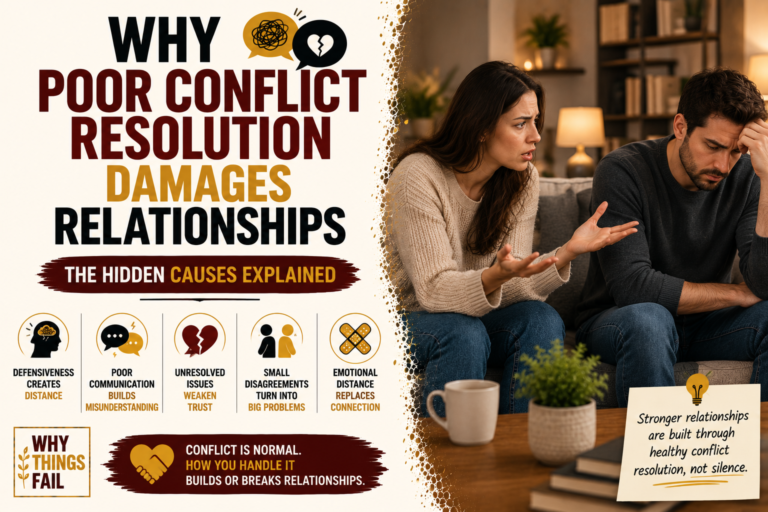
These responses create temporary emotional safety for the individual but increase emotional distance within the relationship.
Ironically, the behaviours designed to prevent emotional pain often become the very behaviours that produce it.
Poor Communication Is Usually A Symptom Rather Than The Cause
Communication is often blamed whenever relationships struggle.
While communication certainly matters, it is rarely the deepest explanation.
Poor communication usually reflects underlying psychological patterns.
Stress reduces patience.
Past experiences influence interpretation.
Unmet emotional needs shape expectations.
Personal insecurities affect confidence during disagreement.
When these deeper factors remain unrecognised, improving communication techniques alone rarely solves the problem.
The same unhealthy patterns simply reappear through different conversations.
True conflict resolution therefore requires understanding not only what people say, but also why they interpret situations differently and how their emotional experiences influence their behaviour.
Short Term Emotional Relief Creates Long Term Relationship Damage
Many people choose responses that reduce immediate emotional discomfort without considering their long term consequences.
Avoiding difficult conversations feels easier than discussing painful issues.
Winning an argument feels more satisfying than admitting personal responsibility.
Withdrawing emotionally feels safer than becoming vulnerable.
These decisions provide temporary relief.
However, they gradually weaken trust, emotional intimacy and mutual understanding.
The relationship becomes increasingly fragile because immediate emotional comfort repeatedly takes priority over long term emotional health.
Over time, both people begin protecting themselves instead of protecting the relationship itself.
Warning Signs
Poor conflict resolution rarely appears suddenly. It develops through small behavioural changes that slowly weaken the relationship. Because these changes often occur gradually, people adapt to them instead of recognising them as warning signs.
One warning sign is that conversations increasingly become debates rather than discussions. The focus shifts from understanding each other to proving who is correct. Winning the argument becomes more important than protecting the relationship.
Another warning sign is emotional withdrawal. One or both people begin avoiding meaningful conversations because previous discussions ended badly. Silence creates temporary peace, but unresolved issues continue growing beneath the surface.
Repeated criticism is another indicator. Instead of addressing a specific behaviour, people begin criticising personality and character. Statements become personal rather than constructive, making the other person feel attacked instead of understood.
Defensiveness is equally damaging. Every concern is interpreted as blame, making honest communication increasingly difficult. Rather than accepting responsibility where appropriate, both individuals spend more energy explaining their behaviour than resolving the problem.
Perhaps the most overlooked warning sign is emotional indifference. When people stop expressing disappointment, frustration or even anger, it may not mean the relationship has improved. It may mean they no longer believe their concerns will be heard. At this stage, emotional disengagement often replaces emotional investment.
These warning signs are frequently ignored because neither person intends to damage the relationship. Each behaviour appears to solve an immediate emotional problem while quietly creating a much larger one over time.
What Could Have Prevented It?
Most relationship breakdowns cannot be prevented by eliminating conflict.
They can be prevented by changing how conflict is approached.
The first step is recognising that disagreements are shared problems rather than personal battles. When both people view themselves as partners solving one issue instead of opponents defending separate positions, the tone of the conversation changes immediately.
Emotional regulation is equally important. Responding after emotions have settled allows both individuals to think more clearly and listen more effectively. Many damaging words are spoken not because people truly believe them, but because strong emotions temporarily reduce self control.
Curiosity also strengthens conflict resolution. Asking questions with the intention of understanding rather than challenging encourages openness and reduces defensiveness. People become more willing to explain their perspective when they do not feel judged.
Accepting personal responsibility is another essential habit. Healthy relationships are rarely built by proving who was entirely right or entirely wrong. They are strengthened when both people recognise how their own behaviour contributed to the conflict.
Finally, repairing relationships should become as important as resolving disagreements. A sincere apology, empathy, reassurance and genuine efforts to rebuild trust often determine whether conflict strengthens or weakens emotional connection.
The objective is not to avoid difficult conversations.
The objective is to ensure difficult conversations leave the relationship stronger rather than weaker.
Lessons
Poor conflict resolution reveals lessons that extend well beyond personal relationships.
The first lesson is that communication problems are usually behavioural problems before they become language problems. Words often reflect deeper emotions, assumptions and unmet needs.
Another lesson is that emotional intelligence is more valuable than emotional intensity. Strong emotions are natural, but allowing them to control behaviour often produces consequences that outlast the original disagreement.
Relationships also demonstrate the importance of long term thinking. Choosing temporary emotional satisfaction by winning an argument frequently damages long term trust. Protecting the relationship often requires sacrificing the immediate desire to be right.
Perhaps the most significant lesson is that trust is built through repeated repairs. Every successfully resolved conflict increases emotional security. Every unresolved conflict weakens it.
Healthy relationships are therefore not defined by perfection.
They are defined by the willingness to repair what conflict temporarily damages.
Failure Pattern
The dominant pattern behind relationship failure is Emotional Decision Making combined with Poor Communication and Short Term Thinking.
This pattern appears repeatedly because people naturally respond to emotional discomfort by protecting themselves. Some become defensive. Others withdraw emotionally. Some criticise while others avoid difficult conversations altogether.
These responses reduce immediate emotional pressure but gradually increase long term relationship damage.
The same behavioural pattern appears in families, friendships, workplaces and business partnerships. Whenever emotional reactions consistently replace thoughtful communication, trust begins declining and cooperation becomes increasingly difficult.
Conflict itself is not the recurring pattern.
Poor responses to conflict are.
Hidden Lesson
The greatest threat to a relationship is rarely disagreement.
It is the gradual belief that being understood matters more than understanding someone else.
When this belief becomes dominant, every conversation becomes centred on personal validation rather than mutual understanding.
Relationships rarely collapse because one argument was too large.
They weaken because hundreds of small opportunities for empathy, accountability and repair were repeatedly missed.
The deeper lesson is that conflict reveals the quality of a relationship more clearly than periods of harmony ever can.
Failure Scorecard
| Area | Score | Explanation |
| Emotional Discipline | 4/10 | Strong emotions often influence behaviour before thoughtful communication begins. |
| Decision Making | 5/10 | Many responses are driven by immediate emotions rather than long term relationship goals. |
| Conflict Management | 4/10 | Problems are frequently avoided or escalated instead of being resolved constructively. |
| Long Term Thinking | 5/10 | Short term emotional relief often takes priority over preserving trust. |
| Emotional Awareness | 6/10 | Many people recognise their feelings but struggle to understand the emotions driving the other person. |
| Communication | 5/10 | Conversations become defensive rather than collaborative during conflict. |
| Accountability | 5/10 | Personal responsibility is often replaced by blame and justification. |
| Adaptability | 6/10 | Healthy relationships improve when both individuals remain willing to learn and adjust their behaviour. |
Key Takeaways
- Conflict does not destroy relationships. Poor conflict resolution does.
- Emotional reactions often influence behaviour more than logical reasoning.
- The desire to be right frequently prevents genuine understanding.
- Unresolved disagreements accumulate into long term resentment.
- Trust is strengthened through successful repair rather than perfect harmony.
- Emotional intelligence is essential for healthy communication.
- Long term relationships require accountability from both people.
- Protecting the relationship is more valuable than winning individual arguments.
Frequently Asked Questions
Why does poor conflict resolution damage relationships?
Poor conflict resolution damages relationships because unresolved disagreements gradually reduce trust, emotional safety and mutual understanding. Over time, resentment replaces connection and communication becomes increasingly defensive.
What is the biggest mistake people make during conflict?
The biggest mistake is trying to prove they are right instead of trying to understand the other person’s perspective. This shifts the conversation away from solving the problem and towards protecting individual pride.
Can healthy relationships have arguments?
Yes. Healthy relationships experience disagreements just like unhealthy ones. The difference is that healthy relationships use conflict to improve understanding and rebuild trust rather than allowing resentment to grow.
Why do people avoid resolving conflict?
Many people avoid conflict because they fear rejection, criticism or emotional discomfort. Avoidance provides temporary relief but usually allows problems to become more serious over time.
How does unresolved conflict affect trust?
Unresolved conflict weakens trust because repeated disappointments remain emotionally unresolved. Each ignored issue makes future disagreements more emotionally charged and reduces confidence that concerns will be taken seriously.
Conclusion
Poor conflict resolution rarely destroys relationships overnight. Instead, it weakens trust through repeated moments where fear replaces honesty, defensiveness replaces curiosity and short term emotional comfort replaces long term emotional connection.
Understanding this changes the way relationship failure is viewed. The greatest danger is not conflict itself but the behavioural patterns that prevent conflict from becoming an opportunity for greater understanding, stronger trust and deeper emotional resilience.